 Disaster & Recovery, Disaster Prevention: World Cup Chile 1962, Japan
2002
Disaster & Recovery, Disaster Prevention: World Cup Chile 1962, Japan
2002The Soccerphile World Cup 2002 Archives Click here to go to the current Soccerphile.com
Disaster & Recovery, Disaster Prevention: World Cup Chile 1962, Japan
2002by R. Sanborn Brown
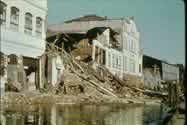
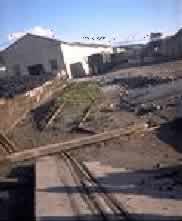
Roadways were ripped apart, the earth opened up, and in the harbor half-sunken cargo vessels listed like huge ghost ships. On nearby Easter Island, massive Moai stone sculptures were felled by a tidal wave. In May 1960, the largest earthquake of the 20th century with a magnitude of 8.5 struck southern Chile, reducing a nearby city to a mountain of rubble. The dead numbered 5,700, some two million homes were destroyed - a third of all buildings in the country were damaged beyond repair - and a tsunami killed 142 people across the Pacific in Japan.
The 1962 World Cup had at this point already been awarded to Chile. Could the shattered country host the tournament? Would the seventh Cup take place at all? Soon after, the President of the Chilean Soccer Federation Carlos Dittborn said, "We have lost everything—and that is precisely why we will do everything in our power to rebuild and host the World Cup."
In less than two years, Chile had completed construction of all of the necessary stadiums and the capital Santiago was back on its feet and was once again a functioning metropolis. Dittborn did not live to see the World Cup: he died just prior to the opening of the tournament. Had he lived, he would have witnessed soccer minnow Chile go on to defeat perennial powerhouse Italy. Then in the quarter final, Chile beat another pre-tournament favorite in the former Soviet Union before losing to eventual winners Brazil in the semi-finals. Chile claimed a third-place finish - a feat it has never come close to matching in the ensuing 40 years.
Chile failed to qualify for the Korea/Japan 2002 Cup. Were they to come, what sort of disaster prevention would the children and grandchildren of those who rebuilt Chile in 1962 find in present-day Japan?
Like Chile, Japan is located on the Pacific Rim of Fire and is prone to earthquakes. Much criticized for its handling (or rather its bungling) of both disaster prevention and management following the Kobe Earthquake in 1995 (magnitude 7.2; 6,400 dead), what has Japan done to prepare for this summer's World Cup?
According to the Asahi Shinbun's "The Power of (Disaster) Prevention" series, all 10 Japanese stadiums have been equipped to double as evacuation shelters in the event of a catastrophe. In the past in Japan, stadiums have been used as evacuation centers: during the aftermath of the Kobe earthquake, 520 people were briefly housed in the Hanshin (horseracing) Racetrack.
The new venues, however, are not mere spaces in which to seek refuge; they are all built with warehouses stocked with food supplies. Newly opened Saitama Stadium is, moreover, also equipped with a 3,250 cubic meter cistern that uses rain water to water the pitch and flush toilets. In the event of a disaster, this water would be diverted into purifiers, which are capable of producing 3,000 liters of water per hour—enough for 3,000 people to live for a month.
In addition, there is food stockpiled beneath the stands behind both goals in 2,200 square meter storage facilities. Already stored items include blankets, biscuits and even baby bottles. At Kobe Wing Stadium, large screens both inside and outside of the stadium have been set up to serve as a way of conveying vital information during a crisis.
A second issue relates to man-made disasters: terrorism and hooliganism. Japanese officials appear to be reasonably confident of their preparations in the event of an earthquake; regarding terrorism and hooliganism, they are not as sure. In order to allay those fears, at Saitama Stadium a special viewing room located below a large screen above the side stand has been constructed. Police and firefighters will man this room, from which the entire stadium can be easily viewed.
In addition, sixty-three cameras have been set up inside and outside the stadium to monitor what is going on at all times. Moreover, unlike older stadiums with limited access, Saitama Stadium has been built with 48 exits. Officials calculate that a sold-out crowd of 63,700 people would be able to evacuate within thirteen minutes. Last October evacuation tests to confirm the viability of exit routes were held using dolls.
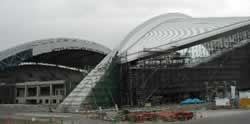
At Kobe Wing Stadium, a thousand people participated in evacuation tests held in November. In spite of this, officials from the Security Division of the Japan Organizing Committee for the 2002 FIFA World Cup (JAWOC) remain anxious. Approaching the May kick-off, they are moving forward with large-scale evacuation tests and preparations at all ten sites.
Barring a natural disaster though, managing man-made problems will no doubt be the key this summer to hosting and running a successful World Cup. For all the heroism and effort involved in preparing for and hosting of the 1962 World Cup, including the death of local FA Chairman Dittborn, the Chilean people and organizers had to contend with neither global terrorism nor rampaging hooligans.
The Soccerphile World Cup 2002 Archives
Click here to go to the current Soccerphile.com
Soccerphile Ltd - All Rights Reserved