In a final interview at the Japan Football Association in Tokyo prior to his return to Brazil, Coach Zico claimed with a straight face that he had no regrets and would not have changed a thing about Japan's World Cup campaign. Longtime Zico watchers will not be surprised, but those vaguely in touch with the tenuous concept known as reality were stunned.
Having just been humiliated - Japan managed but one legitimate goal and just one point from three matches - Zico placed blame for the quick exit on the players' physiques. Asian players are too small and not physically tough enough, according to the once great Brazilian.
Hello? A very cursory look at some of the big names of this year's World Cup reveals the following the heights:
Javier Saviola: 168 cm
Lionel Messi: 169 cm
Pavel Nedved: 170 cm
Pablo Aimar: 170 cm
Robinho: 172 cm
Pele: 172 cm
Zico: 172 cm
Carlos Tevez: 173 cm
Landon Donovan: 173 cm
Michael Owen: 173 cm
Silvain Wiltord: 174 cm
David Villa: 175 cm
Deco: 175 cm
Wayne Rooney: 177 cm
Henrik Larsson: 178 cm
Ronaldinho: 178 cm
Alex Frei: 180 cm
Fernando Torres: 180 cm
Francesco Totti: 180 cm
Arjen Robben: 180 cm
Naohiro Takahara: 180 cm
There are of course exceptions; and players are indeed bigger and better conditioned than in the past. However, Latin players tend to be the same size or not much larger than their Asian rivals, particularly those from Iran. Moreover, many of the northern European strikers are small - but quick and tough. On the backline, true, the Japanese are relatively small. Still, not all great defenders are massive: Spain's Carlos Puyol, Holland's Giovanni van Bronkhorst, and Italy's Fabio Cannavaro are all 1.78 cm. What they have in abundance, though, is skill - and grit.
However, to assign blame for the Asian Cup champions' failure to progress to the second round to body type is not merely absurd but a convenient way of diverting attention from the true source of the problem: Zico himself and, sad to say, the lack of mental stature of the players themselves. With few exceptions, Japanese players have no balls.
Australia displayed everything Japan does not have: aggression, passion, grit. The boys from Oz were not going to lose, the one "goal" Japan scored notwithstanding. In the second half, coach Guus Hiddink subbed in Tim Cahill. From that point on, Australia poured forward. In response, Zico put on Shinji Ono to shore up the middle. Confusion ensued. Goalkeeper Kawaguchi made save after save and kept the score lower than it might have been.
Again, Zico waits until too late to sub in. In the sweltering heat, Japan's players are running on empty. Fortunately, so too is Croatia. With just 10 minutes to go, Zico finally sends on a replacement forward. And, once again, goalkeeper Kawaguchi was very sharp. He stopped a penalty.
Ironically, Japan played its best soccer of the tournament in the loss to Brazil. In Reiji Tamada's sudden strike, Japan actually scored. They relaxed and played the back and forth, up and down the field kind of soccer they are capable of. However, against Brazil, you need at least two or three goals at the start. Finishing killed Japan. World class finishing, which Japan has yet to discover.

The best news out of Japan - after Zico's departure - is the signing of Ivica Osim, the current JEF United and former Serbia coach. He looks set to stay on through the 2010 World Cup in South Africa. Unlike Zico, Osim is a true coach. He has taken lowly JEF and turned them into a respectable side.
His biggest problem will be the mess Zico left him. In addition to the poor results in the Cup, nearly every player on the Japanese side in Germany was in his late twenties. This will evince itself as Japan struggles to qualify for the next World Cup.
Japan's most successful soccer player ever, the icon Hidetoshi Nakata, has hung up his boots for good. The 29-year-old announced his retirement after Japan crashed out of the first round of the World Cup.
The photogenic and intelligent midfielder ends a ten-year professional career that began at Bellmare Hiratsuka in 1995. From there he made his debut for the national side in May 1997. In the French World Cup, in 1998, he attracted attention from European clubs and transferred to Perugia in Italy's Serie A.
After seven years in Italy - where he played for Parma, Roma, Bologna, and Perugia - he moved to Bolton in the Premier League last year.
Rumors are swirling that he will join the Japan Football Association. We doubt it. Trilingual Hide is more likely to write a novel or create a fashion brand or become a movie star. Another rumor has him in Business School in the US. This we can imagine: branding himself and making a fortune.
|
|
Buy Japan Jerseys |
The second half of the season kicks off in mid-July. Kawasaki is a goal-machine, but may struggle down the stretch in the fall.
Unlike Kashima it does not have the depth or experience.
All bets are open at this point in time.
|
|
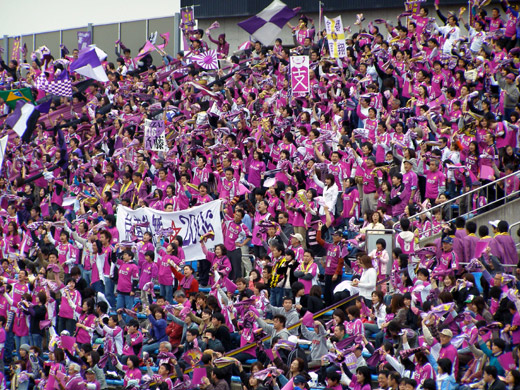
Kyoto Purple Sanga Fans |