
2009 | 2010
 Cape Town Stadium known as Green Point Stadium during the planning stage, Cape Town, South Africa
June 14, 2010
Despite protests from players and broadcasters, the "angry bees" sound created by the plastic trumpets is here to stay for the duration of the 2010 World Cup. World Cup spokesperson Rich Mkhondo said vuvuzelas are "ingrained in the history of South Africa" and complaints by such players as France's Patrice Evra and Portugal's Cristiano Ronaldo will go unheeded.
A disturbance broke out between riot police and stewards in the car park at Moses Mabhida stadium in Durban shortly after the Australia and Germany match.
The stewards were protesting pay of $25 a day saying they had been promised more. There were a number of arrests and slight injuries.
 © Walter Knirr/ City of Johannesburg - JHB Railway Station Bus district
June 8, 2010
The first section of the new Gautrain line from Johannesburg Airport to the Sandton suburb of Johannesburg has opened. Eventually the $3bn development will link Pretoria with Johannesburg's Park Station. There will eventually be 10 stations and 80km of track with the journey between Pretoria and JHB cut to just 40 minutes. Trains run from 5.30am to 8.30pm with the time from Sandton to Johannesburg Airport just 15 minutes. A single ticket to the airport costs 100 Rand.
June 7, 2010
Ten Argentine members of the infamous Barrabravas group were arrested on arrival at Johannesburg Airport and deported after their names showed up on an entry blacklist.
June 6, 2010
Sixteen people were injured, some of them seriously in a crush outside Makhulong Stadium in Johannesburg before the Nigeria v North Korea warm up game. Admission to the match was free and more than the 10,000 capacity of people turned up to watch the game. A security barrier inside the ground also collapsed causing the match to be halted for a time. Nigeria won the friendly 3-1.
June 3, 2010
According to FIFA, the number of seats at the World Cup will be more than 3 million thanks to an increase of 100,000. 97% of them will be sold, FIFA insisted.
Revised seating plans and allocations have allowed for the extra seating.
May 29, 2010
Japan's national broadcaster, NHK, and all private television stations from Tokyo have announced they will not be sending female announcers to cover the World Cup. According to Japan's Foreign Ministry, there were 14 times more murders in South Africa and 23 times more rapes - in a country with a smaller population.
In addition, the overall level of interest in 2010 World Cup is much lower in Japan than the 2006 German World Cup.
May 28, 2010
As 90,000 new tickets went on sale including seats for the World Cup final, computers in Fifa ticketing centers throughout South Africa crashed again, leading to angry scenes and the calling of police. "I would like to sincerely apologise to all the fans that have been affected by the problems in the ticketing sales system," Fifa secretary general Jérôme Valcke said in a statement.
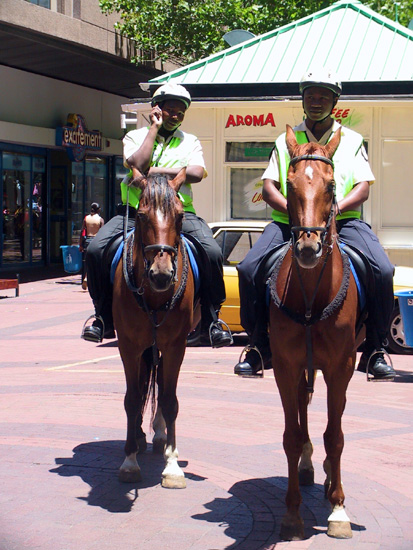 Mounted Police in South Africa
Money was taken from the hotel rooms of Colombia's soccer team at the five-star Hyde Park Southern Sun Hotel. The team was in Johannesburg to play the hosts in a friendly (won 2-1 by South Africa). Around $2,800 was taken by two 20-year-old cleaners from the players' suitcases. $2,500 was stolen from Egyptian players at their Johannesburg hotel during the 2009 Confederations Cup.
May 25, 2010
Less than three weeks remain before the World Cup, the world’s most watched sporting event. Yet, only 36,000 of the nearly three million tickets have been sold in Africa outside of the host country South Africa.
May 21, 2010
Fifa have admitted that ticket sales have been poor in Africa outside South Africa. General secretary Jerome Valcke revealed only 40,000 tickets had been sold in countries other than the host nation. South African Tourism Minister Martinus van Schalkwyk said that the figures were 76% less than those forecasted for the event and that a mere 11,300 people bought tickets in Africa, out of a total of 230,000 foreign fans expected for the tournament.
May 11, 2010
Fifa general secretary Jerome Valcke admitted that his organization had to inject a further US$100m into South Africa's World Cup project to ensure team training camps were ready on time. South Africa's organisational budget has now risen from US$419m to US$519m. Fifa stands to make US$3.3 billion from the tournament from sponsorship and the sale of TV rights. South Africa itself has spent US$5.2 billion on stadiums, security and transport for the finals -- 1.72% of the country's GDP.
May 10, 2010
Street sellers vending ice cream and drinks outside stadiums have
blasted Fifa's restrictions on unlicensed selling around the World Cup stadiums, according to a BBC report. Vendors who are not commercial partners of world football's governing body have to apply to the host city's municipal office for an "events permit" to be able to sell in the vicinty of grounds or face fines from South Africa's municipal police.
"We are being made to jump through hundreds of hoops so we can do for a month what we have been doing here for years - and that's selling at the stadium," says Nhanhla Mkhize, an ice-cream seller from the Ulamzi township in Durban.
"Now I know it is just a reminder that the rich will get richer and the poor will get poorer." Fifa argues that they are protecting the official sponsors from "ambush marketing" - surely an over-reaction in the case of a developing country with high unemployment.
May 9, 2010
The head of South Africa's police, General Bheki Cele told Parliament he wished to avoid a visit from US President Barack Obama to the World Cup in the case of the USA team's progression in the tournament as this would increase the security headaches for his force. "Our famous prayer is that the Americans don't make the second round," he said, while
insisting the South African police forces could provide sufficient protection.
He added 43 heads of state would go to South Africa during the duration of the tournament.
May 7, 2010
The World Cup trophy began a month-long tour of South Africa in the Khayelitsha township in Cape Town today in the final leg of a world tour. The trophy encased in a glass container was displayed to happy fans who had their pictures taken with the cup.
May 5, 2010
Despite initial brisk sales of tickets over the counter in South Africa, interest has seemingly waned and over 250,000 tickets remain unsold with just over a month to go to the start of the tournament. Fifa announced that matches in Johannesburg, which will host the opening and final matches, and Pretoria were sold out but there were plentiful tickets available still for matches in Nelspruit, Polokwane and Port Elizabeth.
April 15, 2010
Over 500,000 tickets for all 64 games will go on sale in South Africa today at ticketing centres in the nine venue cities, 18 supermarkets throughout the country, at banks, on the internet and through local call centres. 300 tickets are still available for the final itself at Soccer City. Only 350,000 of the initial estimate of 450,000 visitors will now attend the event and corporate sales have also been hit by the global economic downtown and the perceived security threat. Danny Jordaan, chief executive of the South Africa 2010 organizing committee, said: "We will work hard not to have any empty seats. It has been the case in every single World Cup I know that you have empty seats in certain matches. We will work hard to make sure we fill every seat in the stadium."
South Africans have bought up the most World Cup tickets - around a million, with fans from the USA in second place with 118,945 applications.
After local criticism concerning the scarcity of local performers at the pre-tournament Kick-Off Concert (see below), World Cup organizers have agreed to include more South African acts after reaching an agreement with the Creative Workers Union and the South African Ministry of Arts and Culture. The Kick-Off Concert takes place in Soweto on 10 July, the day before the opening match of the World Cup.
With two months left to go before kick off at this summer's World Cup 500,000 tickets remain unsold, with tickets still available for every match except the final. Overseas ticket sales have been notably weak and a reliance on Internet sales has not helped the home market, where less than 50% of thr population have access to the Net. A "significant number" of tickets have also been returned, including many from corporate sponsors. The global recession, fears of crime and rumours of price fixing for accommodation and domestic flights have deterred many fans, especially those from Europe, from attending. Ticket sales are much lower than for World Cup 2002 in Korea/Japan, which was much farther from Europe, much more expensive than South Africa, but perceived, importantly, as safe and secure for fan and family travel.
About 2.2m tickets have been sold so far for the tournament, with the USA accounting for 118,945 tickets. 67,000 tickets have been sold to UK passport holders but a meagre 32,269 tickets have been purchased in Germany. Fifa secretary-general Jerome Valcke said sales had been "disappointing" and questioned whether the European market was sated with football.
The final phase of ticket sales includes 11 new centers in the nine host venues where fans can buy tickets directly over the counter.
100,000 tickets will be set aside for South Africans for only $20 and officials are hoping locals will buy in enough quantities to stave off the ignomy of empty seats at Africa's first World Cup. Fifa's own policies of having fans pick up their tickets in South Africa - a poorly conceived attempt to thwart scalping - rather than receiving them in the post as at previous World Cups has also contributed to the very low ticket sales.
The Independent newspaper writes that Cote D'Ivoire manager Sven Goran Eriksson is "happy" with his reported six-figure salary plus bonuses.
The former England and Mexico manager has been hired to take over "Les Elephants" through the end of the World Cup. He was hired following the February dismissal of Vahid Halilodzic.
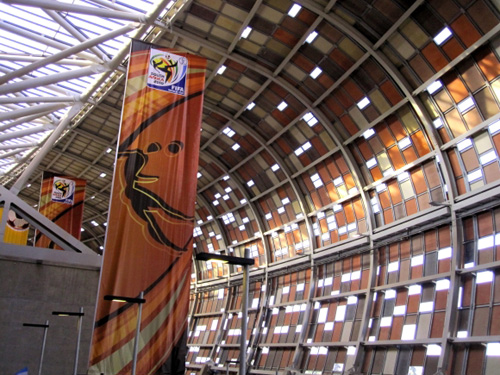 Soccer City
The Observer newspapers reports that foreign musical acts such as Alicia Keys, the Black Eyed Peas and Shakira will dominate the opening ceremony at the expense of South African musicians. Only three South African acts: rock band BLK JKS, the Parlotones and singer-songwriter Vusi Mahlasela will play at Soweto's Soccer City Stadium. There is no place for Jonny Clegg, the Soweto Gospel Choir or Ladysmith Black Mambazo. Actor Mabutho "Kid" Sithole, a spokesman for the Creative Workers' Union, expressed the anger of local artists who plan to demonstrate at the offices of the local organising committee on 15 April in Johannesburg: "If we cannot use our World Cup as a showcase for our artists, what can we use? We're not saying the foreign artists are unwelcome, just that we should have 50% South Africans, 30% from the rest of Africa and maybe 20% from the rest of the world.''
Every player on the Spanish World Cup team going to South Africa will pocket €550,000 - if they win the World Cup.
Brazil will pay its players a paltry €300,000 per player if the South Americans take the cup home. England plans on paying out €450,000 per player on the off chance that England wins the World Cup for the first time since 1966.
 Cape Town Stadium, South Africa
Mbombela Stadium in Nelspruit is in a race against time to prepare the playing surface in time for the World Cup. The pitch has been reseeded after the initial grass covering was not deemed up to standard. A friendly between Ghana and Bosnia-Herzegovina scheduled for March 3rd looks likely to be postponed or moved.
Fifa's team workshop for coaches begins this week in Sun City. England coach Fabio Capello will also be checking up on progress at the 82-room Royal Bafokeng Sports Campus, where the England team is hoping to base for the World Cup. The hotel is still a work in progress and there are concerns over the state of the training pitches.
Just 50% of VIP tickets with hospitality packages have so far been sold for the big event in June.
Of a total of 2.9 million tickets for the entire tournament, including the four categories of tickets and VIP tickets, 2.1 million have been sold.
The third ticketing sales phase, which concludes with a random draw for oversubscribed matches on 1 February, had a total of 1,206,865 applications from 192 countries. South African residents accounted for 79% of the total applications received in the third phase. Next came the USA with 50,217 applications, followed by the UK (41,529), Australia (15,523), Mexico (14,804), Germany (14,647) and Brazil (10,767). Fifa expects around 450,000 foreign fans to make the trip to South Africa, way down on initial estimates.
 Peter Mokaba Stadium © WBHO Construction
Two of the new stadiums for World cup 2010 were used for the first time this weekend.
The 68,000 seater Cape Town Stadium played host to a local derby featuring two of the top South African clubs - Ajax Cape Town and Santos.
As a logistical test, for ticketing, crowd control and secutity, only the lower tier seating 20,000 spectators was utilised.
The next sporting event will be on February 6 when two tiers allowing 40,000 spectaors will be opened for a rugby game between two of the country's top teams.
In Polokwane, north of Johannesburg, the smaller Peter Mokaba Stadium hosted a four team tournament featuring three top local clubs and Brondby of Denmark.
Seating arrangements were adequate and no major problems were encountered at either stadium.
For internal flights during the preliminary stages of the World Cup local airlines are advertising fares at more than twice the average rate.
Johannesburg to Cape Town, for example, is between Rand 2300 (economy airline) and Rand 3600 via the national carrier.
It gives the fans an ideal opportunity to travel by the excellent road system, see some of the country and do so for much less.
As an example English fans leaving Rustenberg could travel the two day journey via the diamond centre of Kimberley or stop over for 2 to 3 days in the Kalahari Desert Game Park to view the large black maned lions, leopard, cheetah, giraffe and the many plains animals.
UK company Protektorvest which plans to sell stab-vests to visiting football fans during the World Cup has been condemned by South African authorities for creating "unnecessary fear." The vests, which can come with your national team's flag retail for around 70 USD.
 Tickets, World Cup 2010
From April 2010 tickets in South Africa will be available to buy in cash in addition to on the internet or through written forms in banks. Disappointing sales to South African fans have prompted the move.
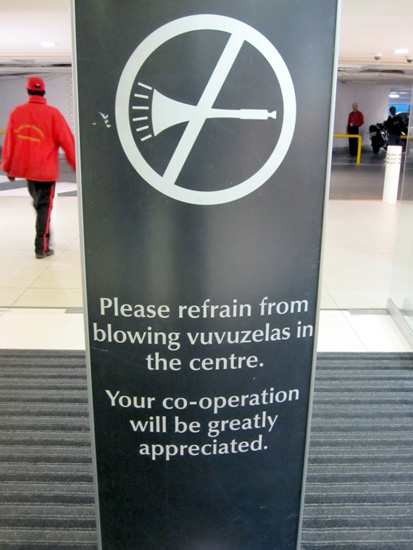 No Vuvuzelas Sign, South Africa
Followers of the Nazareth Baptist Church, or Shembe, which uses a long vuvuzela in its religious services is campaigning to have the instrument banned at the 2010 World Cup as it considers the use of the trumpets at football grounds to be demeaning to its religion.
Farewell To A Confusing World Cup