
Some images courtesy of Pula Tourist Office
 Roman amphiteatre, Pula
The chief attraction of this paradisiac is Istria's combination of a truly Mediterranean coast with the green, peaceful interior. Istria offers a feast of natural parks, intact nature and a crystal-clear sea. The heart-shaped peninsula of Istria, south of Trieste, has a strong Italian influence and is sometimes referred to as the "new Tuscany." Istria's historic sites point to its rich past as an outpost of the Roman, Byzantine and Venetian Empires.
 Istria Map
Placed right in the geometrical centre of the continent, Istria is sometimes called "the belly button of Europe".
The heart-shaped peninsula in the northern Adriatic is doubtlessly the most popular tourist destination in Croatia. Even though small portions of Istria penetrate Slovenia and Italy, most of the peninsula is part of modern Croatia. Tourists from all over Europe travel to this idyllic location to enjoy the lovely landscape, ideal climate and warm service. From early April to late October this small piece of land is a tower of Babel: Dutch and Germans rubs shoulders with Italians and Russians.
The location and the geography of the peninsula are absolutely superb. Nowhere else in Europe could you find such diversity on such a small piece of land – a geographic and cultural diversity alike.
 Roman Arena in Pula
Among the many blessings of Istria is its relative closeness to many major European cities. Milan, Turin, Vienna, Munich, Zurich and the Croatian capital of Zagreb are all within several hours' drive.
Istria is in the crossroads of worlds, a place where civilizations and peoples converge. The Slavs, Italians and Germans have coexisted here for centuries and exchanged cultures, customs and ideas.
To enter Istria is to reach the first true South, here, at the foot of the Alps. The mixture of Mediterranian and Alpine climate, free of extremes, makes it appealing enough for the young and dynamic, but suitable as well for the elderly who shun the summer heat of Spain or Greece.
Just a half hour drive from any of the buzzing, lively principal seaside resorts like Umag, Rovinj, Porec or Medulin will take a traveller to a most tranquil place in the interior: tame green hills dotted with precious medieval villages make for the dreamlike experience of calmness and joy.
 Beach in Istria
Location: Western most region of Croatia and the biggest peninsula in the Adriatic. Most of Istria belongs to Croatia, with smaller stretches of land in Slovenia and Italy.
Population: 210,000
Regional capital: Pazin (9,000)
Commercial and cultural centre: Pula (59,000)
Major towns: Umag, Rovin, Porec, Novigrad, Medulin, Vrsar,
Rabac, Lovran (along the coast),
Buzet, Buje, Motovun, Groznjan, Labin (inland)
Official languages: Croatian and Italian. Also spoken: Slovenian
Currency: Euro (since 2023), previously the Croatian kuna (kn)
Surface area: 2,820 km2
Coast length: 445.1 km (west coast 242.5 km and east coast
202.6 km) not including islands
Rivers: Dragonja (Dragogna), Mirna (Quieto) and Rasa (Arsa)
Vegetation: The nickname "green peninsula" speaks volumes. Istria is the biggest green oasis of the northern Adriatic. Forests cover 35% of the surface. Along the coast are pine trees, holm oaks and macchia and Mediterranian green shrubbery.
Istria Hotels |
|||
 |
 |
 |
|
| Hotel Adriatic | Hotel Bellevue | Hotel Aurora | |
 |
 |
 |
|
| Hotel Belvedere | Holiday Hotel | Hotel Histria | |
Four Stars
Hotel Valamar Diamant, Porec
Hotel Histria, Pula
Sol
Garden Istra, Umag
Sol Aurora, Umag
Hotel Valamar Bellevue, Rabac
Three Stars
Hotel Adriatic, Rovinj
Hotel
Belvedere, Medulin
Hotel Holiday, Medulin
Hotel
Luna, Porec
Hotel
Marina, Rabac
Hotel Neptune, Porec
Hotel Palma, Pula
Hotel
Park, Rovinj
Hotel Pical, Porec
Hotels in Medulin - Booking.com
Hotels in Porec - Booking.com
Hotels in Pula - Booking.com
Hotels in Rabac - Booking.com
Hotels in Rovinj - Booking.com
Hotels in Umag - Booking.com
Foreign visitors usually have a good time in Croatia, because of the low crime rate, decent accommodation and the fact that many locals speak foreign languages and actually like to mingle with foreign tourists.
Since 2023 the currency of Croatia is the euro.
The legal currency was previously the kuna (Croatian for marten, a popular local mammal), which was semi-convertible. You could exchange pounds or euros into kunas at hundreds of exchange offices found just about everywhere in the city.
Since anyone could also convert kunas into foreign currency, there was no black market for foreign exchange so all transactions should be carried out at official exchange businesses rather than in the street.
Exchange rates vary from place to place, but remember that a 100 GBP will buy you about 1100 kunas, 100 euros 740 kunas, and 100 dollars 580 kunas (2006 rates).
Currency Converter
Istria has plenty of bars, discos and upmarket cafés in its Adriatic resorts.
Enjoy a sunset cocktail in a number of good bars in Umag, Rovinj and Pula.
List your bar, cafe or club here. Contact Us
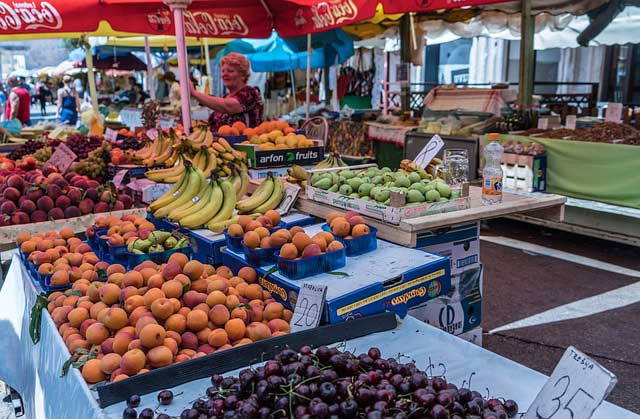 Market, Croatia
Istria's local cuisine is influenced by nearby Italy, which means excellent pizza and pasta. Istrian sausage is a local delicacy.
List your restaurant in Istria here. Contact Us
92 - police
93 - fire brigade
94 - ambulance
970 - taxi
987 - road help
0044 - access number for calling UK
List your internet cafe here for FREE! Contact Us
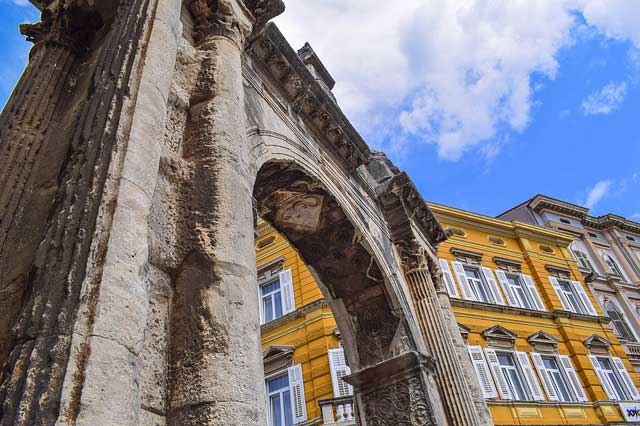 Roman Forum in Pula
Porec
Zagrebacka, 11
Tel: 451 293
Pula
Forum, 2
Tel: 219 197
www.pulainfo.hr
Rovinj
Obala Pina Budicina, 12
Tel: 811 566
 Map of Istria
From Zagreb's Pleso Airport (tel. 01 62 65 222) there are flights to Pula with Croatia Airlines.
Air France, British Airways (BA) and KLMall have connections to Croatia. Zagreb is Croatia's airline hub and has domestic flights to Dubrovnik, Pula, Rijeka, Split and Zadar. Easyjet has flights to Split from the UK, germanywings flies to Zagreb from Germany.
Pula has rail connections to Zagreb and Ljubljana, Slovenia.
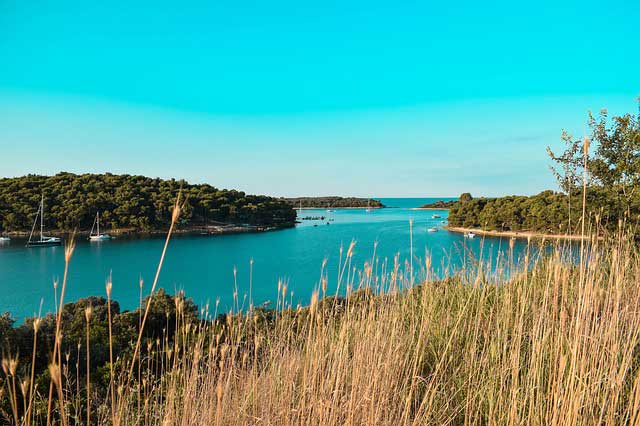 Coastline
There are buses from Pula to Zagreb, Rijeka, Dubrovnik, Porec and Split. From Rovinj there are bus services to Pula, Porec, Dubrovnik and Zagreb. From Porec there are connections to Rovinj, Pula, Rijeka and Zagreb.
There are Venezia Lines (Tel: 041 52 22 568) boats from Venice to Pula, Rovinj and Porec. The voyage lasts between 3-4 hours depending on your destination.
There are local buses, taxis and boats to the offshore islands. Car hire can work out economical if you are staying for any length of time. It is possible to hire bicycles in a number of Istrian towns.
Mild mediterranean, with moderately hot summers and mild winters.
2,400 hours of sunshine per year, 10 hours per day during the summer.
The average sea temperature ranges from 9.3 C to 11.1 C in February
to 23.3 C to 24.1 C in August. The average air temperature in the summer is 23 C.