
Some images courtesy of Pula Tourist Office
 Roman amphiteatre, Pula
Pula (Pola in Italian) is the biggest Istrian city and its cultural centre. The splendid 3000-year-old city is the queen of the Istrian south and its eventful past is carved in every stone of its many monuments from the Roman era onwards.
The most celebrated monument in Pula is Arena, a Roman amphitheater from the Emperor Vespasian's era and the city's symbol. Arena currently hosts musical, cultural and cinematographic events, notably the Pula Film Festival held annually in mid-summer (from July 15 to 21 this season in 2007). Over the years the festival has entertained numerous Hollywood celebrities such as Richard Burton, Elizabeth Taylor, Milos Forman, Sam Peckinpah, John Malkovich, Jeremy Irons and many other stars.
Other significant sights include the magnificent temple to the Emperor Augustus, a Roman theater from the 1st century, Hercules's Gate, Kastel (Castle) and the town's Archeological Museum.
Pula also offers numerous places to dine, have a drink or dance so check out establishments like Bounty Pub, Café Galerija, Cvajner, Dva Ferala, Jupiter, Pompei, Scaletta i Uljanik.
Close to Pula are several picturesque coastal and inland towns such as Medulin, Premantura, Fazana and Vodnjan, but the most popular tourist location in the vicinity is the Brijuni (Italian Brioni) archipelago, a national park rich in Mediterranean vegetation and famous for having been the site of one of Marshall Tito's residences. The only way to reach Brioni is on a group trip organized by an agency – no scarcity of these either.
The Pula economy has plenty of resources to create and maintain a top-class soccer team, but a bizarre lack of interest from the local enterprises has resulted in the relegation to the Second Division of NK Pula, losing to Zadar in the playoffs.
 Vineyard near Umag
Always an attractive summer resort, Umag (Umago in Italian) has seen its popularity soar to unprecedented heights since the early nineties when it became the venue of the Croatia Open ATP tournament. Even in the times of the Croatian war for independence (1991-1995) from Serbia and Montenegro, the tournament was well attended by fans and disputed by notable international players like Thomas Muster, Alberto Berasategui, Carlos Costa, Karol Kucera and Javier Sánchez.
This year's tournament (2007) is scheduled from July 23rd through 29th in the famed Stella Maris sports complex.
Umag is sometimes called The Gate to the Adriatic, being the north westernmost point of Croatia and the nearest Croatian resort to Western Europe (the Italian port of Trieste is barely 50 km away). This is the place for all those people with an affinity for sports as the town and its surroundings offer limitless opportunities, from horse riding, tennis, soccer, mini-golf, volleyball, beach volley to sailing, surfing, underwater fishing and nautical skiing.
 Porec
PorecPorec (Italian Parenzo) is another supremely popular destination on the western Istrian coast just south of Umag and Novigrad. Founded 2000 years ago as a military outpost, it has grown around a port shielded by the island of Sveti Nikola (Saint Nicholas).
The town's map still reflects the structure of the original Roman "castrum" (camp), the principal streets, Decumanus and Cardo Maximus, have been preserved in their antique form. Marafor is a Roman square with two temples, one of them built in the 1st century and dedicated to the Roman god Neptune.
Porec also boasts Roman-style houses, stunning Gothic Venetian palaces, a Franciscan church and a baroque-style headquarters of the Istrian assembly.
The chief monument is the UNESCO protected Euphrasian basilica erected in the fifth century and expanded in the sixth under the Byzantine bishop Euphrasius.
The main tourist zones in Porec are the Zelena and Plava laguna (Green and Blue lagoons), large resorts both with tranquil residences and sporting facilities for all sorts of activities including bungee jumping, beach volleyball, water skiing, fishing etc.
The French film director Luc Besson liked Porec so much that he paid homage to it by giving one of the characters in his movie "Fifth Element" the name of Plavalaguna (the blue-skinned operatic singer performing a piece by Donizetti).
 Rovinj
Rovinj (Rovigno in Italian) is the wealthiest town in Croatia, its per-capita income fuelled by an enormous influx of foreign tourists. Situated between Pula in the south and Porec in the north, Rovinj is the top tourist destination on the Istrian peninsula.
Rovinj arises along a heavily indented coast fronting an archipelago of 22 islets, Sveti Andrija and Sveta Katarina being the largest and the most beautiful of the small islands.
The Adriatic sea here is at its most transparent azure. The town has pre-Roman origins but it grew in importance in the first centuries of the Christian era under the Roman reign. In later centuries it was ruled by the Republic of Venice. The historic old town, situated itself on a peninsula, arouses intense emotions with its narrow winding roads, stairways, porches and balconies in which Roman, Gothic, Renaissance, Baroque and Neoclassicist elements intertwine. The visitor is stunned with the densely built houses which seem to support each other, studded around the Cathedral of St. Euphemia and once protected by the solid and imposing medieval walls, still visible in places both in the north and the south parts of the centre. The Rovinj interior is equally spectacular, with its Punta Corrente forest, the Palud swamp, the Romualdo's cove and the stone quarry Cave di Monfiorenzo, labelled "a singular geological monument of nature".
 Motovun
Motovun is a town-monument whose current appearance does not differ significantly from what it looked like in the 12th or the 13th century. From the foothill to its Venetian-style square on the top leads the longest Istrian stairway with 1052 stairs. You can always take a bus, but the climb is worthwhile for the vintage view of the landscape with vineyards, forests and the Mirna river valley stretching out below.
Motovun is a place of legends, one of which tells that in the Mirna river valley there used to live giants so tall that they were able to stand at the foothill and still place a stone block at the hilltop. That is, the legend goes, how towns like Motovun were built.
This miniature town in central Istria transforms itself in the peninsula's spiritual capital weeks before and after the Motovun Film Festival, a show of independent movies from all around the world, which attracts tens of thousands of people.
Not all of Motovun's visitors have any interest in the movies, though.
It must be the atmosphere that reigns in and around Motovun, perched on top of a 277 meter high hill, the surreal view of the surrounding countryside from behind the medieval walls or some sort of energy currents that are supposed to intersect precisely on this point of the planet.
The Motovun area has been the most important inhabited place in the region and according to New Age scientists the town owes its key position to the underlying Earth's energy meridians – so called "Dragon's Lines".
The meridians supposedly bring along the Earth's positive life energy and where the lines intersect there is a powerful source of energy, a planet's breathing hole. This pretty much sums the real effect that the Motovun area has on the people: soothing, relaxing, refreshing, increasing creativity and tolerance.
This could be the reason why people from many parts of the world feel compelled to drop by time and time again.
 View of Motovun
The nearby Istrian thermal resort Istarske Toplice with the mineral spring Sveti Stjepan (St. Stephan) has provided relief for all sort of rheumatoid, respiratory, cardiac, gynecological and skin ailments for millennia. The first analysis of the spring Sveti Stjepan was made early as 1858, and today's results show that quality of the water has remained unchanged since its Roman origins.
The spa, set beneath a high cliff, has a large outdoor pool with temperatures up to 36 ° Centigrade. Visitors can enjoy various health and beauty treatments including: aromatherapy, massage and mud packs. Istarske Toplice is 10km north of Motovun on the road to Buzet.
Istria Hotels |
|||
 |
 |
 |
|
| Hotel Adriatic | Hotel Bellevue | Hotel Aurora | |
 |
 |
 |
|
| Hotel Belvedere | Holiday Hotel | Hotel Histria | |
Four Stars
Hotel
Valamar Diamant, Porec
Hotel
Histria, Pula
Sol
Garden Istra, Umag
Sol
Aurora, Umag
Hotel
Valamar Bellevue, Rabac
Three Stars
Hotel Adriatic, Rovinj
Hotel
Belvedere, Medulin
Hotel
Holiday, Medulin
Hotel
Luna, Porec
Hotel
Marina, Rabac
Hotel
Neptune, Porec
Hotel
Palma, Pula
Hotel
Park, Rovinj
Hotel
Pical, Porec
Hotels in Medulin - Booking.com
Hotels in Porec - Booking.com
Hotels in Pula - Booking.com
Hotels in Rabac - Booking.com
Hotels in Rovinj - Booking.com
Hotels in Umag - Booking.com
Since 2023 the currency of Croatia is the euro.
The legal currency was previously the kuna (Croatian for marten, a popular local mammal), which was semi-convertible. You could exchange pounds or euros into kunas at hundreds of exchange offices found just about everywhere in the city.
Since anyone could also convert kunas into foreign currency, there was no black market for foreign exchange so all transactions should be carried out at official exchange businesses rather than in the street.
Exchange rates vary from place to place, but remember that a 100
GBP will buy you about 1100 kunas, 100 euros 740 kunas, and 100 dollars 580 kunas (2006 rates).
Currency
Converter
Istria has plenty of bars, discos and upmarket cafés in its Adriatic resorts.
Enjoy a sunset cocktail in a number of good bars in Umag, Rovinj and Pula.
List your bar, cafe or club here. Contact Us
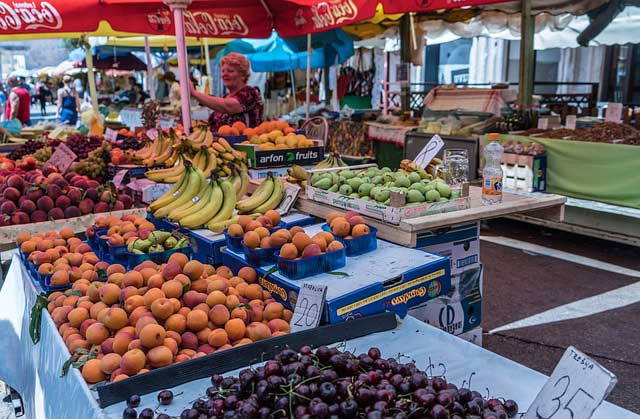 Market, Croatia
Istria's local cuisine is influenced by nearby Italy, which means excellent pizza and pasta. Istrian sausage is a local delicacy.
List your restaurant in Istria here. Contact Us
92 - police
93 - fire brigade
94 - ambulance
970 - taxi
987 - road help
0044 - access number for calling UK
List your internet cafe here for FREE! Contact Us
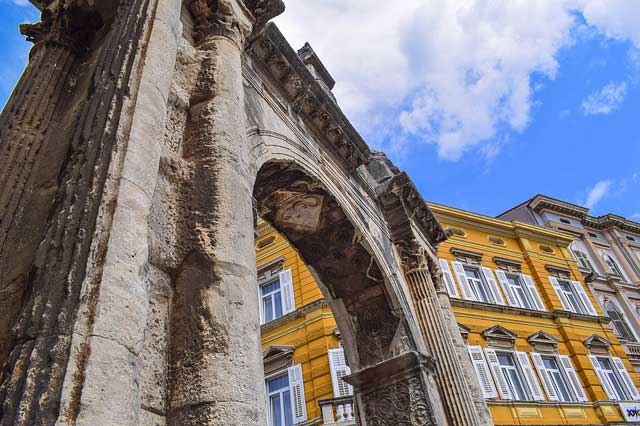 Roman Forum in Pula
Porec
Zagrebacka, 11
Tel: 451 293
Pula
Forum, 2
Tel: 219 197
www.pulainfo.hr
Rovinj
Obala Pina Budicina, 12
Tel: 811 566

From Zagreb's Pleso Airport (tel. 01 62 65 222) there are flights to Pula with Croatia Airlines.
Air France, British Airways (BA) and KLM all have connections to Croatia. Zagreb is Croatia's airline hub and has domestic flights to Dubrovnik, Pula, Rijeka, Split and Zadar. Easyjet has flights to Split from the UK, germanywings flies to Zagreb from Germany.
Pula has rail connections to Zagreb and Ljubljana, Slovenia.
 Map of Istria
There are buses from Pula to Zagreb, Rijeka, Dubrovnik, Porec and Split. From Rovinj there are bus services to Pula, Porec, Dubrovnik and Zagreb. From Porec there are connections to Rovinj, Pula, Rijeka and Zagreb.
There are Venezia Lines (Tel: 041 52 22 568) boats from Venice to Pula, Rovinj and Porec. The voyage lasts between 3-4 hours depending on your destination.
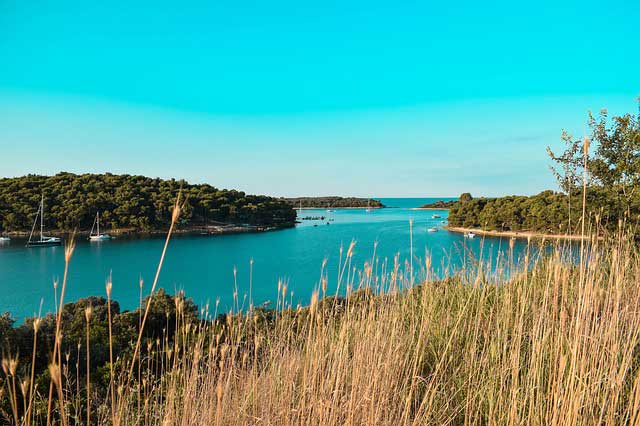 Istrian coastline
There are local buses, taxis and boats to the offshore islands. Car hire can work out economical if you are staying for any length of time. It is possible to hire bicycles in a number of Istrian towns.
Mild mediterranean, with moderately hot summers and mild winters. 2,400 hours of sunshine per year, 10 hours per day during the summer.
The average sea temperature ranges from 9.3 C to 11.1 C in February to 23.3 C to 24.1 C in August. The average air temperature in the summer is 23 C.