
 Cape Town Stadium known as Green Point Stadium during the planning stage, Cape Town, South Africa
The complete list of 10 stadiums in 9 host cities for the 2010 World Cup has been decided. The stadiums are as follows:
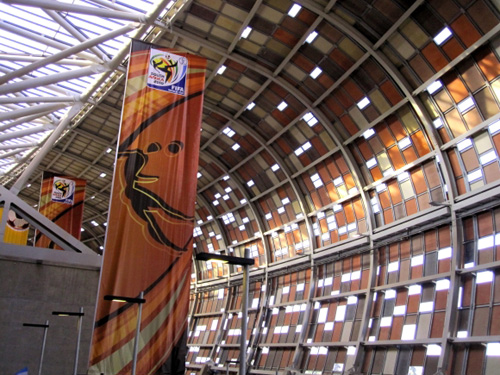
Green Point Stadium aka African Renaissance Stadium (Cape Town) now the Cape Town Stadium, 70,000 capacity. A new stadium was constructed for the 2010 World Cup. 3,000 ton roof; Seating for 68,000 during World Cup; (13,000 to be removed after World Cup); 88 turnstiles; Basement parking for 1,170 vehicles; Park and ride system in place from City Centre; Space for 120 wheelchairs; 360 floodlights for the field; Occupies 18 hectare within 80 hectare recreational park
The external facade is made with glass fibre and Teflon, which will give optimal use of natural light and give a "see through" effect. Situated 250 metres from the shores of Table Bay, and with the backdrop of Table Mountain, the stadium is destined to be one of the most magnificent sporting arenas in the world.
 Spain v Honduras, Ellis Park, World Cup 2010, South Africa
Ellis Park formerly Coca-Cola Park Stadium (2008-2012) and now Emirates Airline Park (Johannesburg), 60,000 capacity. Upgrading of South Africa's premier Rugby stadium located in the center of the city. Better known by its former name of Ellis Park, the stadium is a venue steeped in South African sporting history. It was at this Johannesburg venue in 1995 that the Springboks won the Rugby World Cup overcoming the mighty New Zealand, Jonah Lomu et al in front of a crowd 60,000 people and a certain Nelson Mandela.
 This file is licensed under the Creative Commons Attribution ShareAlike 3.0 License
Free State Stadium (Bloemfontein), 40,000 capacity. Renovation of a 1950s stadium. This venue has hosted games in both the Rugby World Cup in 1995 and the African Cup of Nations in 1996, making it a relative veteran on the South African sporting scene.
 Moses Mabhida Stadium
Moses Madhiba Stadium (Durban), 70,000 capacity. A new stadium was constructed replacing King's Park Stadium.
 Loftus Versfeld Stadium, Pretoria
Loftus Versfeld (Pretoria). 50,000 capacity. Renovation of an existing stadium. With competitive sports events having been played on the site of the Loftus Versfeld Stadium since 1903, it is one of the oldest sporting venues in South Africa. The stadium is named after Robert Owen Loftus Versfeld, the founder of organised sport in Pretoria, who died in 1932. Despite a number of naming rights deals over the years with Vodacom and Securicor, the Loftus Versfeld has always remained the name locals use to refer to the ground.
 Mbombela Stadium, Nelspruit
Mbombela Stadium (Nelspruit), 40,000 capacity. A new stadium was constructed for the 2010 tournament. The Mbombela Stadium is one of five grounds built especially for the World Cup in South Africa, the others being in Cape Town, Durban, Port Elizabeth and Polokwane. It is the first football stadium ever to be built in the Mpumalanga Province.
 Nelson Mandela Bay Stadium
 (Port Elizabeth). 50,000 capacity. A new stadium was constructed for the World Cup. There is arguably no finer setting for any other World Cup venue than the Nelson Mandela Bay Stadium. As its name many suggest, the stadium has a waterside location, overlooking the North End Lake at the heart of Port Elizabeth.
 Peter Mokaba Stadium © WBHO
Construction
Peter Mokaba Stadium (Polokwane), 40,000 capacity. New stadium. The newly built, 46,000 seater, Peter Mokaba Stadium is located next to an older stadium of the same name in Polokwane. Plans to upgrade the old stadium for the 2010 World Cup were abandoned in favour of building a new ground at a cost of 1.1bn Rand.
 Royal Bafokeng Stadium
Royal Bakokeng Stadium (Rustenburg), 40,000 capacity. Renovation of an existing stadium. It was originally built as a venue for the 1995 Rugby World Cup but has established itself predominately as a football ground since that tournament.
 Exterior Soccer City
Soccer City (Johannesburg) 94,700 capacity. Renovation of an existing stadium, on the western edge of the city where the opening game and final will be played.
New stadium with construction underway. South Africa's equivalent of "Wembley" in London, England. Johannesburg, South Africa's largest city, will be the main stay of the 2010 FIFA World Cup, with the First National Bank Stadium aka Soccer City hosting the final of the competition on Sunday 11th July. The city is the base for the FIFA organisation offices during the tournament and is also home to the Coca-Cola
Stadium, or Ellis Park - another World Cup venue.
With a capacity of 94,700, Soccer City is the largest venue on the 2010 roster. The stadium was first opened in 1989 and was significantly renovated throughout 2009. The work on the ground raised its capacity from 78,000 to the new level at a cost of R1.5bn.
See access maps to the stadiums
 Nelson Mandela Bay Stadium
Check our listings for South Africa hotel accommodation in the venue cities and other locations and book your hotel online.
Partner with Soccerphile to provide World Cup 2010 World Cup tours and safaris.
All the latest World Cup 2010 news and views.
Weather forecasts for South Africa. Temperatures, rainfall, humidity, wind speeds and 10-day forecasts.
 Cape Town Stadium, South Africa
World Cup Stadiums
2026: World Cup 2026 Stadiums North America (USA, Mexico, Canada)
2022: World Cup 2022 Stadiums Qatar
2018:
World Cup 2018 Stadiums Russia
2014: World Cup 2014 Stadiums Brazil
2006: World Cup 2006 Stadiums Germany
2002: World Cup 2002 Stadiums - Japan
2002: World Cup 2002 Stadiums - Korea

