

Andy Greeves presents the top 5 current underachieving football areas of the United Kingdom.
5 - East Anglia
Number of League teams - 4 - Colchester United, Ipswich Town, Norwich City, Peterborough United
Number of league teams in top flight - 0
Team last in top flight - Norwich City 2004-2005
The exploits of East Anglia's 'big-two' - Ipswich Town and Norwich City - have traditionally prevented the agricultural counties of Suffolk and Norfolk being dismissed as mere footballing backwaters.
Having spent over half a century between them in England's top division, Ipswich and Norwich have enjoyed a relative periods of success in decades past. Both clubs were founder members of the Premier League established in 1992, with the Canaries finishing an impressive third that season. The men from Carrow Road also have two League Cup titles to their names.
Ipswich, meanwhile, have won the old Division One title in 1961/2 and were runners up twice in the eighties and have also won the FA Cup and UEFA Cup while Norwich are two-times League Cup winners. Their supporters will also point to the fact that their club produced two England managers in Sir Alf Ramsey and Sir Bobby Robson.
But without a Premier League representative for four seasons, East Anglia's football scene would appear to be in decline. Neither Norwich or Ipswich have mounted a serious promotion since the Canaries were relegated from the top flight in 2005/05 - after just one season back in the big time. Since the advent of the Premier League in fact, Norwich or Ipswich have never managed more than three successive season in the top division, taking the role of proverbial 'yo-yo' sides to new heights.
With a population of 2.2 million people in the area and a choice of only a few clubs to support, the potential for an East Anglian club to become a real power house in English football is there. Norwich and Ipswich both regularly get 25,000-plus gates, but sadly it would seem the region will be basking in the second-runs of league football for good few years yet.
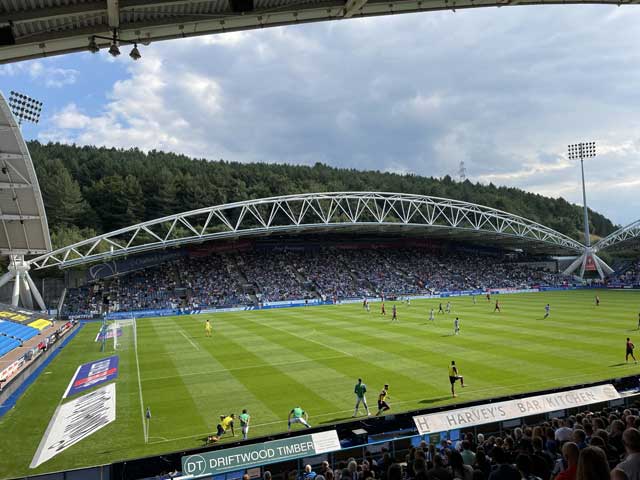 Huddersfield Town's Kirkless Stadium (John Smith's Stadium)
4 - Yorkshire
Number of League teams - 9 - Barnsley, Bradford City, Doncaster Rovers, Huddersfield Town, Hull City, Leeds United, Rotherham United, Sheffield United, Sheffield Wednesday.
Number of league teams in top flight - 1 - Hull City
Last team last in top flight - Hull City, current
Yorkshire is officially recognised by FIFA as the birth-place of professional club football, with the county home to the world's oldest certified association football club - Sheffield FC formed in 1857.
The size of the Yorkshire - home to five million plus people, the history of its clubs - top flight league winners 12 times between them and the love for football in the area, should equate to the county being a hotbed for success. While this was true in years gone by, times have changes significantly.
The county is home to two of England eight core cities in Leeds and Sheffield, which have the fifth and sixth largest populations in the UK respectively. To its shame, neither city currently hosts Premier League football however. Yorkshire's largest club Leeds United hasn't played in the top flight since 2004 and is currently in the third tier English football, despite having appeared in a Champions League just eight years ago. Sheffield United meanwhile are pushing for promotion back to the Premier League, having last played there in the 2006/2007 season, while Wednesday haven't been in the top flight since 2000. That means Hull City, in the East Riding of Yorkshire, are the only Yorkshire representative in the Premier League and even their future there is in doubt.
Yorkshire's failure in the last few decades is in painful contrast to their neighbouring county and long standing rival Lancashire. Since Leeds United won the old First Division title in 1991-92, Manchester United have won ten league title with Blackburn Rovers also winning the Premier League in 1994-95. They've also faired badly against their other traditional foe, Londoners, with Arsenal and Chelsea scooping five titles between them since 1992.
To make matters worse, Lancashire/Greater Manchester has five Premier League representatives to Yorkshire's one at the present, highlighting the county's underachievement. The Leeds United v Manchester United match, once a highlight of any league season, has been consigned to being a big match of the past, while the Steel City derby between Sheffield Wednesday and United lacks national significance played out in English football's second tier.
As a county which prides itself on the achievements of its sporting teams, Yorkshire is relying on the resurrection of its once-great football clubs to flex its athletic muscle once more.
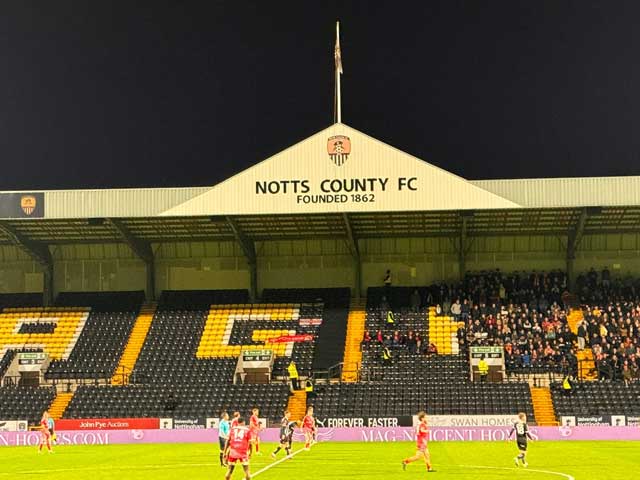 Meadow Lane - home of Notts County
3 - East Midlands
Number of League teams - 8 - Chesterfield, Derby County, Lincoln City, Mansfield Town, Notts County, Northampton Town, Nottingham Forest, Mansfield Town
Number of league teams in top flight - 0
Last team last in top flight - Derby County 2007/08
Like Yorkshire, the East Midlands has a large concentration of professional league clubs with a strong heritage in English football. Nottingham Forest, Derby County and Leicester City share four top division titles between them and Forest are one of only four English teams to have won the European Cup, an achievement they managed in both 1979 and 1980.
Following Derby's relegation from the Premiership last season, with a record lowest points tally of 11, the area is without top flight football at present. Nottingham Forest have recently broke an unwanted too, becoming the first and only former European Cup winner to drop out of the top two divisions of its domestic league, when they were relegated to League One in 2005.
Unlike Yorkshire, none of the areas' teams look like a return to the top flight anytime soon. Forest are in the Championship relegation zone and look set for a return to League One, while Derby are only a few points and few places better off. The only glimmer of hope is that Leicester City are currently riding high at the top of League One and will hope for a return to the success experience under Martin O'Neill in years to come.
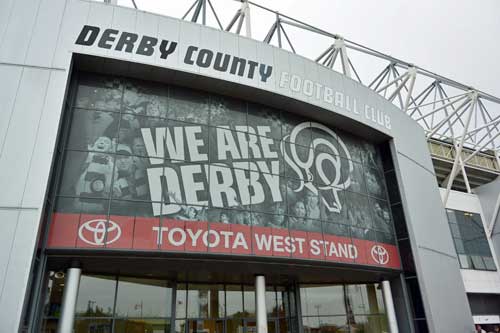 Pride Park - home of Derby County
2 - Wales
Number of League teams - 2 - Cardiff City, Swansea City
Number of league teams in top flight - 0
Last team last in top flight - Swansea City 1981/82
While Yorkshire, East Anglia and the East Midlands have teams with rich pasts, Wales' elite can only dream of bright futures.
The principality, with over three million residents, hasn't seen top flight league football played there for 27 years, with its capital club, Cardiff City, having been out of the big time even longer - since 1962. Cardiff's FA Cup victory in 1927 remains the only major honour to be won by any Welsh team and just ten years ago, both Cardiff City and Swansea City languished in the old Football League Division Three (the then-bottom tier of professional football in England and Wales).
Welsh club football's grim past is truly staggering for an area 8,022 sq miles in size and that has produced players of the calibre of Mark Hughes, Ryan Giggs, John Charles and Ian Rush to name but a few. As in East Anglia, the lack of clubs in Wales means that one of its teams could become a major force should they establish themselves in the Premier League. The question is, will this ever happen?
Unlike the regions mentioned so far, things at least appear to be on the up in Wales. Both Swansea and Cardiff are strongly positioned to make the Championship play-offs this season and when Cardiff move into their new 30,000 all-seater stadium in August, both the Swans and Bluebirds will be playing in state-of-the-art arenas. These grounds, built with the Premiership in mind, are a far cry from the days at Ninian Park and The Vetch.
Hopefully this will inspire Wales' sides to take on the best across the border.
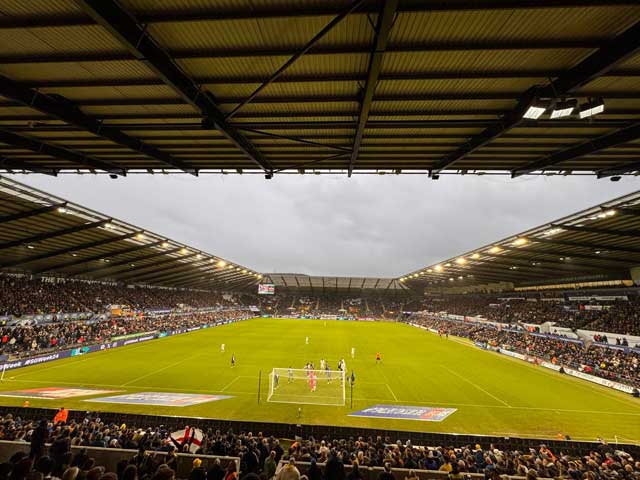 Swansea City Stadium
1 - South West
Number of League teams - 6 - AFC Bournemouth, Bristol City, Bristol Rovers, Cheltenham Town, Exeter City, Plymouth Argyle
Number of league teams in top flight - 0
Last team last in top flight - Swindon Town 1993-94
With more than 5.2 million residents, the South West is the largest of the five areas covered in this article and is, by a country mile, the biggest underachieving region in UK football.
At its heart is Bristol, the ultimate sleeping football metropolis. The eighth most populous city in the UK has two league clubs, neither of whom has ever won a major domestic honour. Bristol Rovers have never been in the top flight while City's last appearance in the highest division was way back in 1979/80.
Then there's Plymouth. Following Hull City's promotion to the Premiership last season, the Devon city became took the unenviable title of being the largest conurbation in Europe never to have hosted top flight football. The Pilgrims are sitting uncomfortably just one place and two points above the relegation zone in the Championship too, suggesting that unwanted title is likely to remain for sometime to come.
Out of its six current league teams, only two South West clubs have ever experience life in the Premier League (or equivalent), the last being Swindon Town who lasted just one season in top flight in 1993/94. Swindon are also the only club to have won any major silverware in the region, lifting the League Cup in 1969.
Like Wales, the West Country can only hope to start writing history from now on. Bristol City are the region's big hope, but currently trail the play-off place in the Championship by five points. Those who would like to see geographical football equality in the UK will be desperately hoping the Ashton Gate men can finally achieve something for the game in the South West.
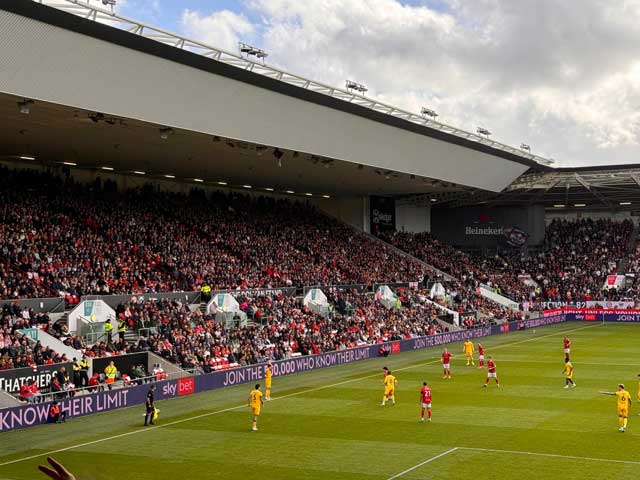 Ashton Gate - home of Bristol City
See an A-Z listing of football grounds in the UK - from the Amex to Withdean.