UK Stadiums: Ashton Gate, Bristol City, England
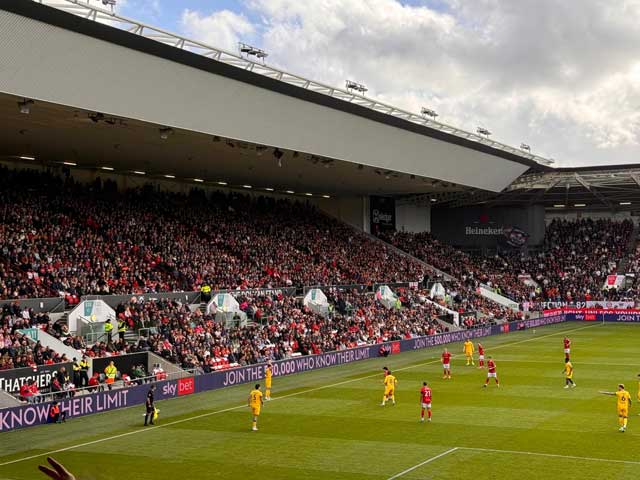
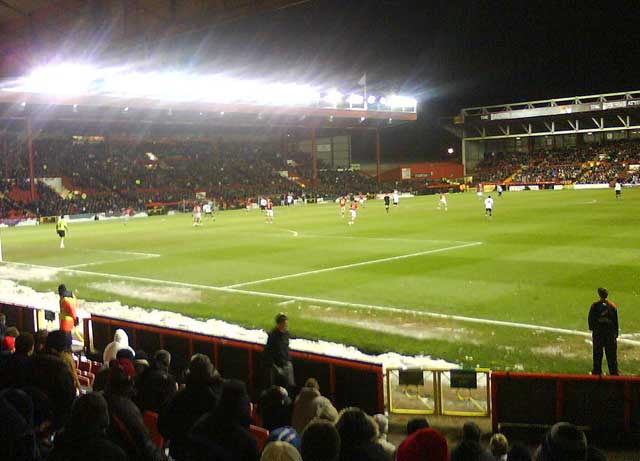
Ashton Gate in Bristol is the home ground of Bristol City Football Club and Bristol Bears rugby union team. The ground has a capacity of 26,462.
In addition, the stadium is also a venue for music concerts, conferences and other events. Indeed, it is the largest venue in the South West.

Stadium
Ashton Gate has been Bristol City's home since 1904. Although it is mostly known for football, it has also been an important venue for rugby. Bristol Bears have played here multiple times since the 1920s, including a notable match on 27 December 2006, when they defeated local rivals Bath Rugby 16-6 in front of a sell-out crowd, setting a record Premiership attendance outside Twickenham.
From 2014-15, the Bears have permanently switched to play at Ashton Gate.
Following their promotion to the Women's Super League for the 2023-24 season, it was announced that Bristol City Women would host all their home games at the Gate, moving from the club's High Performance Centre, where they had previously played most of their matches.
The stadium was the venue for the 2021 National League play-off final between Torquay and Hartlepool, which was relocated from Wembley Stadium to avoid conflicts with UEFA Euro 2020 matches.
After extensive planning, including a failed bid to build a new stadium at Ashton Vale and criticism over the lack of successful major leisure and sporting projects in Bristol, Bristol City ultimately opted for a significant redevelopment of Ashton Gate. The plan received approval in late 2013.
Stands
There are currently four stands in the all-seater stadium. They are as follows;
Lansdown Stand - originally known as the "West Stand," this structure was completed before the 2016-17 season and was renamed The Lansdown Stand in honour of majority shareholder Stephen Lansdown, who funded the Ashton Gate redevelopment.
Dolman Stand - built in 1970, the Dolman Stand, located opposite the Lansdown Stand, is now the oldest stand at Ashton Gate. During the summer of 2007, after Bristol City's promotion to the Championship, the original wooden seats in the upper section were replaced with modern plastic seating. The stand is dedicated to former club chairman and president Harry Dolman.
The Atyeo Stand - the smallest in the stadium with a capacity of 3,900, was originally built to hold around 4,200 spectators and was completed in the summer of 1994. Named after Bristol City legend John Atyeo, who made 645 appearances and scored 351 goals, making him the club's all-time top scorer, the stand is a great tribute to his legacy. Atyeo passed away in 1993, a year before the new stand was completed. It is usually closed for rugby matches.
South Stand - with a capacity of 6,381, the stand includes 40 spaces and seats for wheelchair users and their assistants. It also features a "singing section" for Bristol City's more vocal supporters. Unlike the other stands, it is not named after an individual with ties to the club.
Club History
Founded in 1894, Bristol City, nicknamed the Robins, were admitted into the Football League in 1901 and won the Second Division in 1905-06. Relegated in 1960, Bristol City earned promotion from the third tier in the 1964-65 season and the second tier in 1975-76. They spent four seasons in the top flight before suffering three consecutive relegations by 1982. After six seasons in the Championship, they were relegated but won the Football League Trophy for a third time in 2015 while securing the 2014-15 League One title. They have remained in the Championship ever since that achievement.
A significant portion of the Robins' success has come in the third tier, where they have won the division four times. They claimed the second-tier title in 1905–06, but have not repeated that feat since. While their trophy cabinet remains empty in major cup competitions, they have won the Football League Trophy three times.
City have not reached the top flight in over 40 years. Since their relegation from the First Division in the 1979-80 season, a return to the spotlight has remained a distant dream.
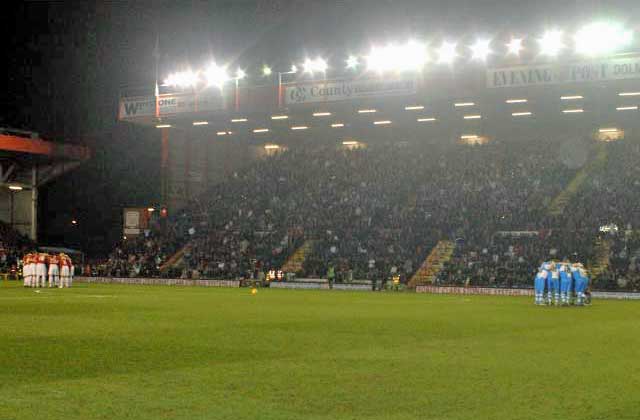
That relegation was the start of a nightmare as it was the first of three consecutive relegations. With their debt growing and financial losses mounting, the club dropped to the Fourth Division by 1982 and was declared bankrupt.
Enter the legend of the 'Ashton Gate Eight', which includes Gerry Sweeney and Trevor Tainton, each of whom agreed to terminate their contract for half of the amount owed. These contributions by key players ensured Bristol City's survival, albeit precariously. From that point on, ill feelings towards management by fans become ever more powerful and toxic.
2014-15
Since their promotion to the second tier in 2014-15, the Robins have consolidated their place in the Championship. Many young players have blossomed into regular Premier League talent after undergoing their stint at Ashton Gate. These include Tammy Abraham, Joe Bryan, Luke Ayling and Bobby De Cordova-Reid.
In the summer of 2024, many Championship teams, including Bristol City, placed their bets on affordable Japanese players to perform at this level. Yu Hirakawa, a striker on loan from J.League club Machida Zelvia, although uncapped, has already made over twenty appearances as of this writing.
City are currently three points off the play-offs and are an outside bet for promotion to the Premier League.
Club Icons
All City fans appreciate John Atyeo's greatness. He played as an amateur for Portsmouth in the 1950/51 season before joining Bristol City as a part-time professional while qualifying as a quantity surveyor. He became a full-time player ahead of the 1958/59 season. In 1963/64, he returned to part-time status to pave the way for his post-football career as a mathematics teacher.
Atyeo had a 15-year career at Bristol City, despite receiving offers from Chelsea, Spurs, Liverpool, and even AC Milan, worth approximately £20 million in today's money, which could have made him the most expensive player in England. Atyeo won six England caps from 1955 to 1957. After retiring from football, Atyeo became a full-time mathematics teacher at Kingdown School in Warminster, where he taught for over 20 years. He eventually became head of mathematics, House Master of Arn House, and Deputy Headmaster. The former Robin was widely respected as a dedicated teacher. Additionally, Atyeo wrote a regular football column for the Plymouth-based Sunday Independent newspaper.
As manager and player, Joe Jordan knows the club inside out. Jordan earned the nickname "Jaws" early in his playing career due to losing his front teeth during a Leeds United reserve match, after being kicked in the face during a goalmouth scramble. Although his teeth were replaced with dentures, he removed them for safety while playing. In Italy, he was known as Lo Squalo ("The Shark"). During his time as Bristol City manager, fans in the stands would wave giant inflatable teeth.
Andy Cole is another player that deserves a mention. Devastating for Manchester United and Newcastle, he first got his career going at Bristol City. He signed permanently for a then-record fee of £500,000, making him the club's most expensive acquisition. Throughout the 1992-93 campaign, Cole piqued the interest of many elite teams for his goalscoring abilities.
Local lad Louis Carey may not be a household name across the UK, but he is undoubtedly the greatest player of the modern era. With an extraordinary 646 appearances for the club, his record is unlikely to be surpassed anytime soon.
Access - Getting There
Bristol Temple Meads Station is Bristol's major railway station with connections to London Paddington, as well as local services to Bath Spa, Cardiff, Gloucester, Portsmouth, Southampton, Taunton, Weston-super-Mare and Weymouth.
There are also rail services north to Manchester Piccadilly Station in Manchester, York Station in York, Waverley Station in Edinburgh and Aberdeen. South West Trains run a few trains to London Waterloo in the capital.
The M5 motorway connects Bristol south to Exeter and north to Birmingham; the M4 runs east from Bristol towards London.
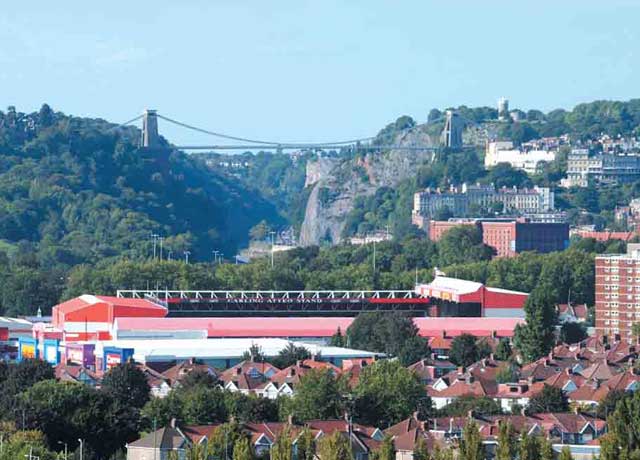
It is a 50-minute walk from Bristol Temple Meads Station to the stadium if you are feeling energetic. Alternatively, several buses run to the ground from the city center and bus station. These include the 24 citylines, the X1 badger line, the X4 badger line, the M2 MetroBus or the U2 bus from Rupert Street.
From Parson Street Station it is 25 minutes on foot to the ground or hop on the 24 citylines bus here.
Address: Ashton Road, Bristol BS3 2EJ, United Kingdom
Nearby Hotels
Bristol is well served with hotels to suit all budgets mainly clustered in the centre and out towards the Clifton are.
Some recommended places include the four star Mercure Bristol Grand Hotel, the four star The Berkeley Square Hotel Bristol in Clifton and the three star Hampton by Hilton Bristol City Centre on Bond Street.
Other places to stay in the city include the Hotel ibis Bristol Centre, the Bristol Marriott Royal Hotel and The Bristol Hotel.
See here for a complete listing of hotel accommodation in Bristol.
Text by Joji Imamiya
More UK Stadiums
Kirklees Stadium (John Smith's Stadium)
©Soccerphile.com
Buy tickets for soccer matches around the world