
Johannesburg, South Africa's largest city, will be the main stay of the 2010 FIFA World Cup, with the First National Bank Stadium aka Soccer City hosting the final of the competition on Sunday 11th July. The city is the base for the FIFA organisation offices during the tournament and is also home to the Coca-Cola Stadium, or Ellis Park - another World Cup venue.
With a capacity of 94,700, Soccer City is the largest venue on the 2010 roster. The stadium was first opened in 1989 and was significantly renovated throughout 2009. The work on the ground raised its capacity from 78,000 to the new level at a cost of R1.5bn.
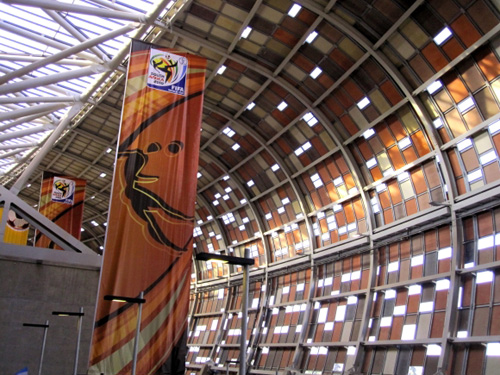
New floodlights have been installed for the World Cup as have 99 extra hospitality boxes. The changing rooms have also been completely rebuilt, to ensure ultimate player comfort before and after a match. The overall new look for the arena was inspired by traditional African pottery (calabash).
Aside from the final, the opening match, four more group games, a second round tie and a quarter-final are to played at Soccer City. This stadium is the first international football ground ever built in South Africa and where the county's national side won the 1996 African Cup of Nations. It is therefore referred to as South Africa's 'home of football'.
 This file is licensed under the Creative Commons Attribution ShareAlike 3.0 License
Soccer City hosted the first mass rally of Nelson Mandela after his release from captivity in 1990 and was where thousands of mourners lamented the assassination of Chris Hani in 1993.
Soccer City was re-built by the South African construction company Grinaker-LTA. The high-tech cladding made of fibreC that coats the exterior in traditional African colors was made by German firm Rieder.

Located near to the township of Soweto, the area surrounding Soccer City has undergone major expansion ahead of the World Cup. A total of 15,000 public car parking spaces and 5,000 executive spaces have been created, along with the Soweto Highway being widened. This should ease fears of gridlock around the stadium on match days.
A railway station is located next to the stadium, which will continue to serve the area after the tournament, when future industrial, commercial and residential developments take place near to Soccer City. There is a major transport hub here too, with taxi, bus and rail drop off and pick up points enabling over 23,380 an hour to move between stadium and city.
Park & Ride/Walk sites are located across Johannesburg during the World Cup at Wits West Campus at Wits University, Marks Park in Emmarentia, Bezuidenhout Park near Ellis Park Stadium. Fanzones and public viewing points for the tournament exist at Mary Fitzgerald Square in Newtown, Walter Sisulu Square in Kliptown, Soweto and Innes Free Park in Sandton.
OR Tambo Airport, located 14 miles east of Johannesburg, is the busiest airport in South Africa. Over 17 million customers pass through the airport every year - a figure expected to rise to 24m a year by 2015, following a recent expansion. There are five flights from OR Tambo Airport to London everyday.
See an access map to the stadium
Check our listings for South Africa hotel accommodation in the venue cities and other locations and book your hotel online.
Partner with Soccerphile to provide World Cup 2010 World Cup tours and safaris.
Weather forecasts for South Africa. Temperatures, rainfall, humidity, wind speeds and 10-day forecasts.

