
England make it, but face bigger tests in Brazil
Sean O'Conor
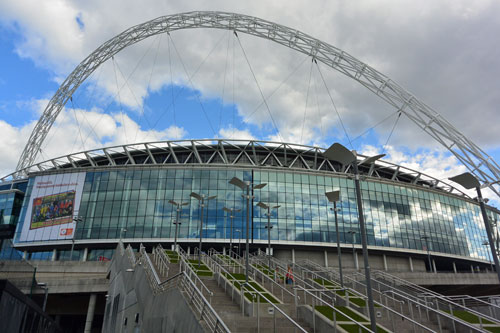
Wednesday night was a fiery one at Wembley. Although Poland had already been eliminated, 20,000-odd of their vast expat community in England had showed up for a rally of national pride.
Conscious of the dangers of mixing rival fans, the FA had officially sold 18,000 tickets to Polish supporters, a higher than average away allocation, similar to what they had given to visiting Irish and Scottish fans earlier this year.
Once I stepped inside the vast arena however, it was clear the segregation had gone to pot as Poles were dotted around everywhere, and worryingly, were also far from muted among the more numerous England fans.
Wembley is usually an anodyne experience and at worst a haunted castle on a drab industrial estate on London's periphery, a let-down for those who grew up on the terraces or go expecting an atmosphere similar to what you find at say Anfield or St James Park.
Only once have I seen punch-ups at Wembley, at the 1992 League Cup Final when Brian Clough's penchant for tickets meant a section of Manchester United fans found themselves amid Nottingham Forest's allocation.
This time the elements were primed for a repeat. The smoke from the Polish flares and the thunderous 'Polska' chants made the kick-off feel like an away match for England.
As if they had woken up to find a foreign army had pitched up in Hyde Park, dismayed locals quickly found their voices and a wall of competing sound enlivened the normally antiseptic national stadium. Happily, despite a few miscreants hauled out by burly stewards, the only barrages were vocal.
But what a start to a one-sided match at Wembley. Fair play to the Polish support for revving up what was for their team a meaningless fixture, even if a few of them should have shown more respect to their hosts.
On the field England did not panic and tried their best to deny possession to the Poles, who confirmed they were not a particularly talented outfit beyond their elegant marksman Robert Lewandowski, who drew a save from Joe Hart and fired a cross shot inches wide in the first half.
But the pressure kept coming from the home team, who enjoyed the run of both flanks and showed a refreshingly attacking approach for the second game in a row. England entertaining? You'd better believe it.
Andros Townsend continued his England honeymoon by running with confidence at the Polish defence from the right, although it was the overlapping Leighton Baines on the left wing who posed the most danger, whipping in a succession of threatening crosses, including the one which Wayne Rooney met with a textbook glancing header to open the scoring four minutes before the break.
Steven Gerrard's clincher close to the finish calmed any remaining nerves but in truth it was a comfortable victory.
And so, England, the motherland of soccer, embarks upon another odyssey of a World Cup Finals, a campaign which will be watched, analysed and chewed over by tens of millions of armchair experts.
England's qualification is not just fodder for an army of journalists, bloggers and keyboard ultras. It was cheered by legions of marketing men eager to cash in on a nation glued to the television for a month. If the sun shines, barbecues will shift by the dozen while beer sales soar anyway if England are playing.
Watching the TV advertisements during the last World Cup, you would have thought the nation had lost its marbles.
Commercial ventures piggy-backing on the popularity of football took an absurdly portentous tone. One particularly over-played spot invoked 1966 like some sacred text and as if God was speaking to Moses, ordered the current team to "join the immortals".
When Fabio Capello's eleven collapsed shambolically in Bloemfontein, the media-fest and commercial frenzy looked like a case of mass delusion.
Then there is Fleet Street to overcome. Newspapers do not wield the same power as they did before the digital age, but that does not mean they cannot upset the squad.
London's tabloid press, particularly Rupert Murdoch's The Sun, will not think twice before unsettling a particular England player, as they did with Rooney before 2006, or its manager, as their non-story regarding Roy Hodgson's 'feed the monkey' quip barely a day after qualification confirmed.
The Sun had previously mocked Roy Hodgson's rhotacism in a front-page splash, and at his first press conference as England boss, gratuitously brought up his spell playing in apartheid South Africa in the 1970s.
The Sun's backing of Harry Redknapp for the job is not the only explanation for its pathetic Hodgson-baiting. Images of Roy biting his fingernails on the bench, exploding in relief when England score and crying while in charge of Inter have given the bullies an excuse to act the Nietzchean superman.
Hodgson has done his job by winning the qualifying group, but his obvious sensitivity, consistently caught on camera, means a pressure-cooker ride while the merciless media awaits its chance to stick the knife in, an ordeal much like that which Bobby Robson or Graham Taylor had to endure.
But persistent failures of the so-called 'golden generation' have injected some sanity into the otherwise clinically insane patriotism which envelops England campaigns.
No-one in their right mind expects The Three Lions to win the cup this time, which means encouragement, not in-fighting, is required. Reaching the last four would be a miracle, but a quarter-final finish would satisfy any sane supporter, because that is England's natural level, one behind the elite group. England are only tenth in FIFA's World Rankings and are consequently not a seed for the finals draw.
No crescendo of patriotic fervour, as in 2002, can make up for a national team crying out for the fluency and rhythm of Brazil or of Spain, the tactical nous of Italy, the technique of the Netherlands, the creativity of Argentina or the dogged dominance of Germany.
Goalkeeper Joe Hart has just come out of a worryingly erratic spell for Manchester City but his England performances are holding up. At full-back England have little to worry about beyond injuries while Kyle Walker, Ashley Cole and Leighton Baines are as good at attacking as defending. Centre-backs Gary Cahill and Phil Jagielka are solid if unspectacular but fears remain they are short on experience and may slip up in Brazil.
Central midfield has several options as do the wings with the welcome emergence of Townsend, even if he offers only a refined version of Theo Walcott and Alex Oxlade-Chamberlain.
Despite, or perhaps because of only two games for England, the lion's share of the supporters' hopes rests on his shoulders.
The Tottenham flanker has indeed been a revelation, but much of that impact must be down to his unknown quantity internationally. It will not take long for other nations to realise England has a speedy right winger with good feet and take measures to shut him down.
Ashley Young's sudden loss of form at Euro 2012 was depressing after he had enjoyed such a good season for Manchester United, because without him England lack unpredictable attackers.
For all the understanding being forged between the front men Wayne Rooney, Daniel Sturridge and Danny Welbeck, the support from the middle still takes time coming from deep. Against Poland and Montenegro, England's energy and chances all came from out wide.
Gerrard can still be a potent driver as he was for the second goal against Poland or in scoring for England against the USA at World Cup 2010, yet more often he plays the frustrated orchestrator upsetting the team's rhythm by hastily trying to play a killer ball.

Frank Lampard is probably of more use to the system as he maintains the flow with useful link play, but the two standout midfielders still seem impossible to combine to effect, although Hodgson keeps picking them both.
Jack Wilshere, who in the week leading up to the game had cleverly deflected an embarassing photo of him smoking by banging the patriotic drum, possesses vision, though nothing like Paul Gascoigne's, and remains short of pace and only moderately successful running at defenders.
Solid central midfielders, flying wingers and overlapping full-backs might be enough to create a steady stream of supply for England's strikers, but how much more dangerous would they be with a creative force like Cesc Fabregas, Mesut Ozil or Wesley Sneijder, wizards who weave their magic 20-30 yards from goal.
England will be no pushover in Brazil but no challenger either. Looking at recent World Cups, the current team appears below the level of 1998 or 2006, and more like that of 2002 or 2010.
Not being seeded means at least one tough clash in the group stage, but England will make it to the second round at least. As it has been since 1998, moving beyond the last eight remains their biggest challenge.
Possible squad:
Goalkeepers: Joe Hart, Jack Butland, John Ruddy
Defenders: Kyle Walker, Leighton Baines, Chris Smalling, Ashley Cole, Phil Jones, Phil Jagielka, Gary Cahill, Michael Dawson
Midfielders: Steven Gerrard, Frank Lampard, Jack Wilshere, James Milner, Tom Cleverley, Andros Townsend, Theo Walcott, Ashley Young
Forwards: Wayne Rooney, Danny Welbeck, Daniel Sturridge, Andy Carroll
England's recent World Cup record
WC 1986 QF
WC 1990 SF
WC 1994 Did not qualify
WC 1998 2nd Round
WC 2002 QF
WC 2006 QF
WC 2010 2nd Round
Buy tickets for soccer matches around the world