
Who is the Best Footballer Ever? by Mauricio Aguilar Book Review
Sean O'Conor
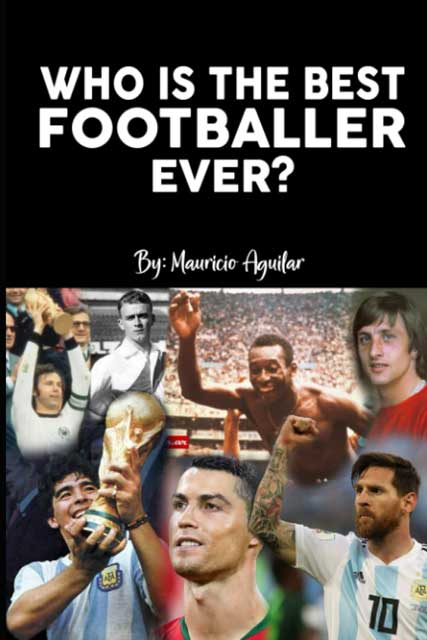
Only last week Lionel Messi announced he was quitting the international scene, closing a book of spells that has bewitched billions of watchers for two decades.
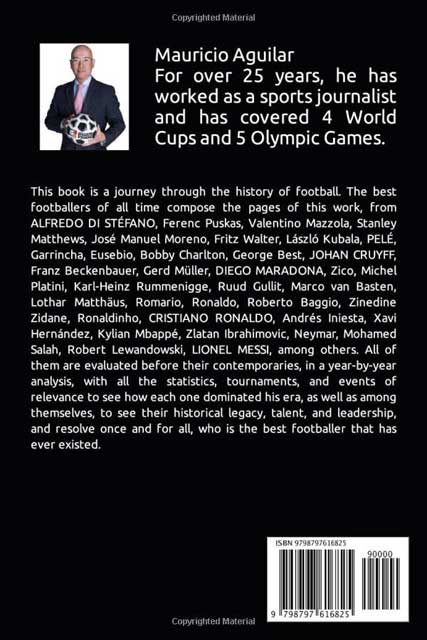
That news has kick-started another round of pantheon-placing debate, which makes Mauricio Aguilar's Who is the Best Footballer Ever? extraordinarily timely. The Guatemalan sports journalist is the latest to attempt to skewer that most vexing of conundrums - who is the greatest footballer of all time?
It is a conundrum because unlike say the high jump or the 100 metres, football is a team sport, where what matters most is that your team is in the lead when the referee blows for time. Selecting the best individual player has always been a staple of fan banter but it also common knowledge a universal consensus can never be reached.
Nevertheless, the acronym GOAT has become commonplace in football culture in recent years, largely down to the persistent presence of two world-class performers in Lionel Messi and Cristiano Ronaldo and the explosion of the internet.
GOAT is a term from American sports, probably having its genesis in the self-styled The Greatest, Muhammad Ali. More recently, the moniker has been applied to other US performers like basketball's Michael Jordan or American Football's Tom Brady, but with association football, it still sits uncomfortably.
Aguilar sensibly begins by addressing all the pitfalls in choosing the GOAT - football has different eras with different balls, different rules and different training regimes, and nobody is going to choose a defender, defensive midfielder or goalkeeper as the greatest footballer ever. We are always going to notice Erling Haaland or Harry Kane over Virgil Van Dijk or Ruben Dias, because scoring goals is the pinnacle of playing. Equally, we prefer to see Kylian Mbappe beat a defender than Sergio Ramos defy an attacker.
Scoring goals is not enough in this inquest. There are different players around you and how many goals you score depends on the service you receive from them and your overall performance is also affected by your manager's instructions. In Italy for instance, a defensive bias has schooled teams for years into winning 1-0, but that means the capocannonieri will probably not score as much as those whose teams in other leagues are encouraged to attack more.
Above all there is the power of subjective bias at play here, which makes most selections unscientific. People tend to value their formative years so the choice will be clouded by which star you grew up watching. Once television had arrived en masse in the 1960s we could begin to compare players from different countries but before then footballing careers were played out in relative isolation and most watchers were blissfully unaware of talent overseas, only noticing them briefly at World Cups or European Cup Finals, as in the case of Garrincha and Ferenc Puskas, two outstanding talents.
Correctly, Aguilar concludes you can only really compare players of the same era, which makes the Maradona v Messi debate moribund. As many have noted in the current GOAT chat, the street-fighter Diego also suffered much harsher tackling on much rougher pitches than his Albiceleste successor, who benefitted from the sports science of Barcelona's La Masia academy from the age of 13. Maradona also had weaker teammates than Messi, had an impoverished childhood and an adulthood scarred by drug addiction and the attention of the Neapolitan Camorra.
So the variables of football analysis have always made this quest a challenging one, but to his credit, Aguilar makes an ascent on Everest nevertheless with his maps, charts and logarithms. There are probably too many statistics for the romantics among us, and I confess skimming over them as the book played out, but that is how he has chosen to tackle this question.
Musa Okwonga skirted the same summit in his 2007 book A Cultured Left Foot, a most interesting musing on the elements of footballing greatness, but Aguilar really goes for it with facts and figures, diving into goalscoring averages from league to league and UEFA coefficients amongst other metrics. At least nobody can accuse him of lazy bias in his assessments.
I was glad to read he knew his football history, reminding us how fractured the world game was until recent years. Europe and South America, the two traditional poles of footballing power, have lived separate lives for much of their existence, only crossing paths at the World Cup finals when national teams met every four years.
Pelé, universally accepted as the outstanding footballer of the 1960s, never played in Europe for instance, and his club career for Santos, where he scored a mindblowing 643 goals in competitive fixtures, remains unknown to the world beyond Brazil. In 2026, clubs from the two FIFA regions still do not interact beyond a few clashes at the FIFA Club World Championship but the best South American footballers, with the exception of Messi, play in Europe, so when it comes to individuals, we can connect somewhat across the Atlantic.
Aguilar writes fluently about the concept of the GOAT in general, noting that Argentine-born Alfredo di Stefano was the first true international soccer star and player one could reasonably call complete. Those who saw him in his prime swore he was the finest player imaginable, although repeated quirks of fate meant he never played at a World Cup finals.
Before the Blond Arrow it was probably Giuseppe Meazza, the Milanese goal machine and double World Cup winner. Other pretenders to the crown from the past he mentions include John Charles and Omar Sivori.
The entire narrative is a sweep of football history, with worthwhile diversions, such as when he reminds us that the Football Association banned overseas players from 1931 until as recently as 1978, after which Tottenham famously bagged Ossie Ardiles and Ricky Villa from Argentina. Another nugget I liked was that Zico has scored far more goals than any other midfielder in world soccer.
Beyond the golden years of the GOATS the chasing pack get their column inches too - Johan Cruyff's influential genius is covered, Franz Beckenbauer's sweeping revolution too and Kenny Dalglish is noted as the outstanding player from the British Isles at the end of the 1970s. There are sections too on Kevin Keegan and Denmark's Allan Simonsen, although I would have liked more on John Charles, often touted as the British Isles's greatest player.
Keegan, as Aguilar notes, thought a lad from East Belfast was the GOAT:
"People ask me, 'Who's the best player you played against?' I played against Beckenbauer, he's good. Cruyff, unbelievable. Maradona when he was 19. But I have to say Bestie was the one."
Aguilar was not totally accurate about the historic UEFA competitions. The Cup Winners' Cup (1960-'99) was indeed a bit of a sideshow but the UEFA Cup was a strong competition before the Champions League expanded in 1997, because it had more top clubs in it than the one-per-country Champions Cup. I thought it was a bit unfair to say the NASL was not a competitive league either, but these are very minor quibbles.
The chapter on Pelé is very good, reminding us that he became the global GOAT and the only footballer who was a household name in the USA as well. FIFA President Joao Havelange scandalously kept Pelé out of USA ‘94 but President Donald Trump rightly name-dropped him at the 2026 World Cup draw and a video of the King kick-started the final's half-time show.
The section on Maradona is equally well done and you are reminded of how rugged a life he led, both on and off the pitch, in contrast to Pele, Messi or Cristiano Ronaldo, about whom he also writes at length.
He has also written it with some verve, bringing in copious mythological parallels, quoting Miguel de Cervantes and Immanuel Kant for instance and he peppers it with some humour to boot, comparing the Brazil v Argentina rivalry to that of Israel and Palestine or Meghan Markle and The Royal Family. Chapter six has a fantastic title - Between D10S, The King of Kings and the Messiah, the legacy of the football gods.
"Three players have the most significant legacies: Pelé, Maradona, and Messi. The
King of Kings is the only player to win 3 World Cups. D10S practically won Mexico '86
by himself. And the Messiah is the best offensive player ever."
Pele still remains revered, especially by Brazilians, as well as by those who witnessed him in his prime. Neymar, born in 1992, said in a moment of rare poetry, "Before Pele, football was just a sport. He changed football into an art, into entertainment. He gave a voice to the poor, to blacks and above all to others."
With the greatest of respect to Cristiano Ronaldo, who is top of the tree when it comes to bagging the records - most international appearances and goals, most goals in the Champions League and so on, Maradona's and Messi's small stature and penchant for dribbling chime with our childhood football memories.
Over the nine seasons the pair starred simultaneously in La Liga, Messi, as Aguilar shows, beat CR7 for dribbles and assists and unless we take penalties into account (Messi's biggest flaw), for scoring goals too. Aguilar attributes Ronaldo's claim to GOATness to his innumerable appearances, goalscoring, immense wealth and online media presence:
"In the era of globalization and social networks, no one is on a par with Ronaldo. He is followed by over a billion people…more than any singer or movie star, more than anyone."
As their careers have continued far into the twilight zone, it is interesting that Ronaldo, two years Messi's senior, has moved closer to goal on the pitch while Messi has drifted further away and to seasoned eyes the Argentine's orchestrating seems to make him more of a complete player than the Portuguese goal-grabber.
There is something entrancing about watching Maradona or Messi on the ball, an intangible factor that other admirable greats of recent decades - Ruud Gullit, Lothar Matthaus or Zinedine Zidane for example, magnificent as they were, did not quite produce. Messi is by no means a leader on the pitch like Cruyff, Maradona or Pele but his magic with the ball is enough.
"All the greatest players have prophets who spread their stories of conquests,
accomplishments, and miracles worldwide. For them, their victories are a source of
pride. They defend their idols in any conversation, teaching why they must be revered
as divine while converting these mortals into the football gods."
And so to the final analysis. Aguilar chooses the ten most talented footballers of all time as Cristiano Ronaldo, Cruyff, Di Stefano, Garrincha, Maradona, Messi, Pele, Platini, Ronaldo and Ronaldinho. On his subs' bench sit Eusebio and Puskas.
The actual anointing of the GOAT in 2026 effectively boils down to a choice of two Argentinians. The great flaws in Pele's claim to the throne, as Aguilar and everyone else notices, is that he never played in Europe and was surrounded by great players in his World Cup-winning shirts, whereas Maradona not only won the biggest prize with a mediocre team but hauled them to the following final in 1990 and in 1994 he might have won it again but for his drugs test in Boston. Equally, his legendary Scudetto-winning in Naples elevated him to temporal sainthood, displacing Saint Paul from the name of Napoli's stadium.
And yet, even San Diego had many an off day, a criticism that cannot be levelled at Messi, whose consistent, top-level excellence really is sans pareil and was on full display most recently at football’s premier tournament, at the ripe old age of 39.
So no prizes for guessing whom Aguilar anoints. But, as the author reminds us, this question is never an exact science and despite a phone book of statistics, he remains happy to be proved wrong. In a final flourish, he lists 14 future football book projects. I look forward to reading and debating them too.
In the end the GOAT debate can never vanquish emotion, the release of which is what makes following football such a global addiction.
Buy Who is the Best Footballer Ever from Amazon USA | UK | Japan
© Sean O'Conor & Soccerphile
Buy tickets for soccer matches around the world