
UK Stadiums: Molineux, West London, England
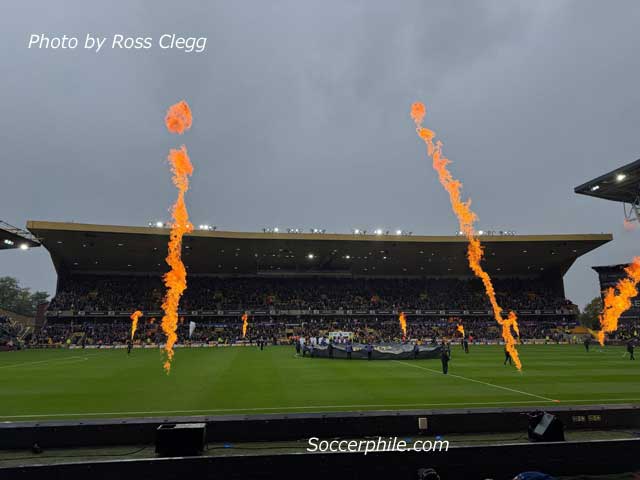
Molineux Stadium in the West Midlands, England, has a capacity of 31,750. It has been the home of Wolverhampton Wanderers since 1889. Wolverhampton are nicknamed simply Wolves or The Old Gold.
Molineux has been the venue for several international matches including senior and U21 England games. Two recent Nations League games against Italy and Hungary were held here in 2022. The stadium was also the venue for the first UEFA Cup final in 1972, a two-legged affair with Tottenham Hotspur.

Stadium Stands
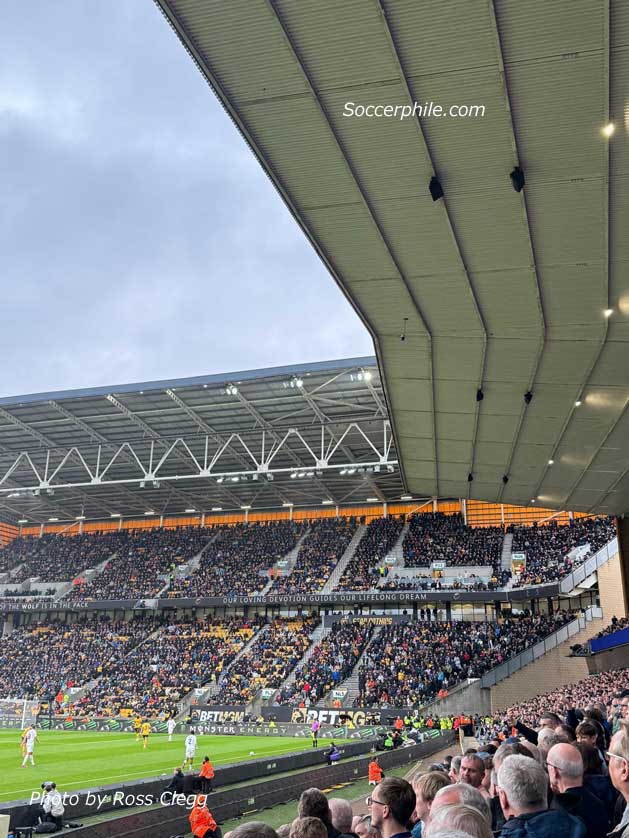
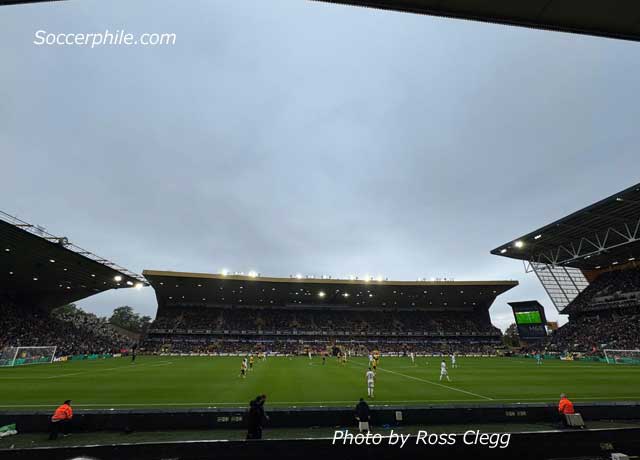
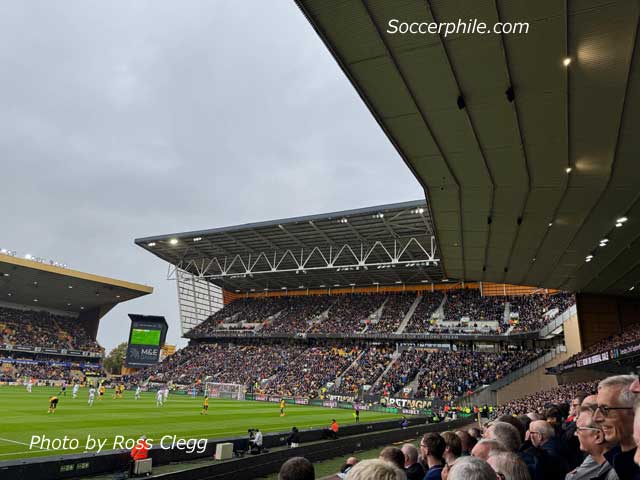
The four stands are named after Wolves legends. They are The Steve Bull Stand, previously known as the John Ireland Stand. The Sir Jack Hayward Stand, formerly the Jack Harris Stand and commonly referred to as "The South Bank," The Stan Cullis Stand, also known as "The North Bank," is the most recently renovated stand. The Billy Wright Stand has the team dressing rooms and media facilities.

Early History
The name Molineux comes from a local 18th century merchant who built a house and estate on the land. In 1860 this land was purchased and converted into a public park. This space was in turn rented out to the football club, who had previously played at Dudley Road from 1881-1889.
Molineux was the first stadium constructed for the use of a Football League club. It was also one of the pioneering British grounds to have floodlights installed in the 1950s and hosted some of the earliest European club matches in that decade.
Following the Hillsborough disaster in 1989 and the publication of the Taylor Report, the ground was remodeled and the ground's capacity fell from its previous 60,000 in the standing era. Redevelopment was financed by millionaire business man, Sir Jack Hayward, whose statue stands outside the ground along with two other Wolves' greats Billy Wright and Stan Cullis.
Further renovations took place in 2011 and 2012 with the redevelopment of the Stan Cullis Stand.

Club Icons
Wolverhampton Wanderers has produced a number of footballing legends over the years, each contributing to the club's success. Defender Billy Wright captained Wolves for over a decade and was the first player to win 100 international caps for England. His leadership and consistency made him an iconic figure at the club and in English football as a whole.

Steve Bull is another club hero, known for his goal-scoring prowess; he netted over 300 goals for Wolves, becoming their all-time leading scorer and earning a special place in the hearts of fans.
Stan Cullis, both a player and manager, guided Wolves to league titles in the 1950s and was pivotal in establishing the club as a dominant force in English football.
Derek Dougan, affectionately known as "The Doog," was a prolific striker for Wolverhampton Wanderers during the 1960s and 1970s, scoring 112 goals in 220 appearances.
John Richards was another key striker for Wolves during the 1970s, becoming the club's second all-time top scorer and a vital part of the team's success in both domestic and European competitions.
Lastly, Sir Jack Hayward, though never a player, is regarded as a club giant for his financial investment and vision in reviving the club in the 1990s, overseeing the construction of the modern Molineux and helping Wolves regain their place in top-flight football, albeit only for a single season at the time.
Through the connection with super-agent Jorge Mendes the club have had a succession of Portuguese players on their books. These include Rúben Neves, João Moutinho, Diogo Jota, Pedro Neto, Nélson Semedo, Vitinha and Daniel Podence plus coach Nuno Espírito Santo. Mexican striker Raul Jiménez is also remembered with affection by fans.
Less well-known is South Korean striker Seol Ki-hyeon who spent two seasons at the club between 2004 and 2006 scoring 8 times in 69 matches.
Managers
The club’s most successful manager is Stan Cullis, whose 16-year tenure saw Wolves secure all three of their league championships, along with two FA Cup victories. Other notable managers from the past include Major Frank Buckley, Graham Turner, Bill McGarry and John Barnwell. More recently Dave Jones, Mick McCarthy, Kenny Jackett and Nuno Espírito Santo have all managed the club. Wolves have also been managed by two former England national team managers - Graham Taylor (1994-1995) and Glenn Hoddle (2004-2006). Incidently, the Wolves position was Hoddle's last job in coaching.

Club Miscellaneous
Wolves' celebrity supporters include musicians Robert Plant (Led Zeppelin) and Beverley Knight (singer), actors like Mark Hamill (Star Wars) and Eric Idle (Monty Python), broadcaster Suzi Perry, and even boxer Mike Tyson. The club's first major national supporter was composer Sir Edward Elgar. The Guardian's Japan correspondent and occasional Soccerphile contributor, Justin McCurry, is also a big fan.
The Wolves Museum explores the club's history and tours take you into the dressing room and dugout.
The Wolves mascots are Wolfie and Wendy.
Major Honours
Domestic Competitions
Football League First Division (now Premier League) Champions (3 times) 1953-54, 1957-58, 1958-59
FA Cup Winners (4 times) 1892-93, 1907-08, 1948-49, 1960-61
Football League Cup Winners (2 times) 1974-75, 1980-81
Football League Championship (Second Tier) Champions (3 times) 1931-32, 2002-03, 2008-09
European Competitions
UEFA Cup 1971-72 (Runners-up)
Lost 3-2 on aggregate v Tottenham Hotspur
Accessibility
Molineux Stadium offers significant wheelchair accessibility with numerous wheelchair user spaces in all four stands, including pitch-side positions, and accessible elevated seats reached by lifts. The stadium features lifts to upper tiers, a disabled turnstile, 20 disabled toilets, a sensory room, and a dedicated Disability Access Officer to assist fans.
See the official website for further details: help.wolves.co.uk/support
Access - Getting There
Wolverhampton Station is the nearest train station and is a seven minute walk from Molineux. There are trains to London Euston via Birmingham New Street and Coventry; Liverpool Lime Street; Manchester Piccadilly; and Bristol Temple Meads as well as other destinations.
National Express West Midlands bus numbers 3, 4 and 5 stop outside the ground.
Address: Waterloo Road, Wolverhampton WV1 4QR
Nearby Hotels
If you wish to stay in Wolverhampton there are several options not far from the ground. The 3-star A Park View Hotel & Hamiltons Restaurant is reasonably close. The Station Side Penthouse is at the station as the name suggests.
See here for a complete listing of hotel accommodation in Wolverhampton.
More UK Stadiums
Kirklees Stadium (John Smith's Stadium)
©Soccerphile.com
Buy tickets for soccer matches around the world