South Korea Travel Guide
South Korea makes for an exotic destination with a beguiling mix of the ancient and modern plus an excellent cuisine.

South Korea City Guides
Seoul
Seoul - sprawling Seoul is South Korea's undisputed cultural, economic and political center and its sheer size dwarfs any other city on the Korean peninsula. The vibrant heart & energetic capital of the nation. The city represents the logical choice to base for a visit to Korea and is a heady mix of ultra-modern & traditional faces of Korea: ancient temples, palaces and parks along side state-of-the art shopping malls and cinemas. Read more on things to do in Seoul.
Busan
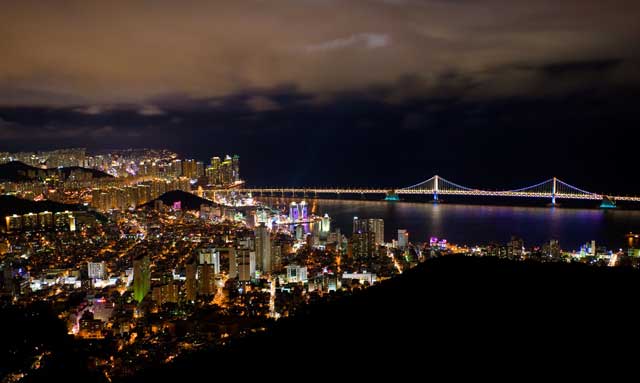
Busan - a huge sprawling city but its center is in the Jung-gu area from Busan railway station to the Jagalchi Fish Market. Shanghai Street and Texas Street are both cosmopolitan areas close to the train station with Chinese and Russians eateries respectively. Read more about things to do in Busan and Busan's top 5 destinations.
Daegu
Daegu - South Korea's fourth largest city is known as a center of manufacturing and retail. Top of the list for most visitors is Daegu's historic Herbal Medicine Market, near to the central Yasigolmok district followed by more retail therapy at Seomun Textile Market. There is even a Rice Cake Street, Motorcycle Street, Shoe Street and Sock Street.
Daejeon
Daejeon - is an urban transport hub and science and technology center. The city is within easy reach of Gyeryong & Sogni San National parks, Beopju-sa temple and Yuseong hot springs.

Gwangju
Gwangju - a modern urban sprawl famous for its pro-democracy riots in 1980. The city has a reputation as an artistic center (cuisine, music, handicrafts, calligraphy & new media). Gwangju is the administrative capital of Jeollanam province in the south west of the country. The center of this sprawling metropolis for visitors is Geunnamno near the May 18th Democratic Plaza.
Gyeongju
Gyeongju - this ancient capital of the Shilla within easy reach of Daegu and Busan is a must-see with hundreds of delightful temples, tranquil gardens and historic sites. It is the Korean equivalent of Japan's historic Kyoto. Seokguram Grotto and Bulguksa Temple are UNESCO World Heritage Sites. Read more about Gyeongju attractions and how to enjoy a short stay in Gyeongju


Incheon
Incheon - a major port city west of Seoul and home to Korea's modern international airport. Incheon is famous for MacArthur's Korean War counterattack. The old city near Incheon station has a small Chinatown and the outlying islands are a popular weekend retreat for visitors from Seoul. Football was first introduced to Korea in Incheon in 1882 by British sailors.
Jeju
Jeju - a sub-tropical resort island reached by plane or ferry from Busan, as well as flights from both Seoul and Japan. Hawaiian-style honeymoon favorite - great beaches, mountains, waterfalls: ideal for outdoor activities and trekking, plus good fruit, seafood and souvenirs (stone guardians, honey, tea).
Jeonju
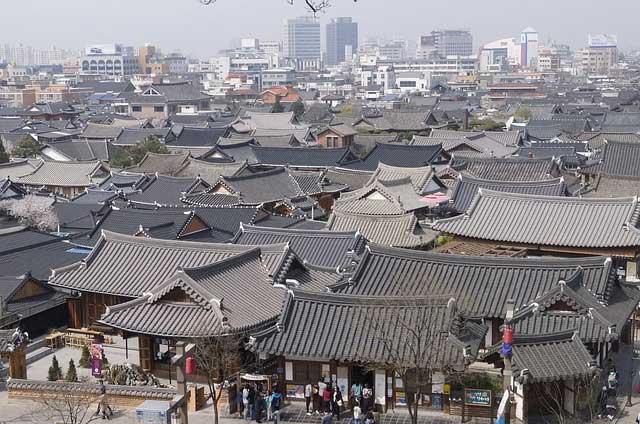
Jeonju - retains some of its rich cultural heritage as the ancient capital of the Yi Dynasty. Jeonju is famed for its food and handicrafts: paper products in particular.
Mokpo
Mokpo - a city in the southwestern tip of the Korean Peninsula in South Jeolla and gateway to a number of islands in the region.
Pyeongchang
Pyeongchang - situated in the Taebaek Mountains in Gangwon Province, Pyeongchang is a high altitude winter sports resort and hosted the 2018 Winter Olympics.
Suwon
Suwon - an hour south of Seoul on subway line 1 or by bus from various points in the capital. Suwon is the home of Samsung Electronics and the well-preserved walls of this ancient fortress city are a UNESCO World Heritage Site. The city is famed for its spotless public conveniences.
Ulsan
Ulsan - boasts the world's largest shipyard. An hour by train or bus northeast along the coast from Busan, Ulsan is a port city linking Japan and a massive center of production for the Hyundai chaebol. Cars, electronics and petro-chemicals predominate.
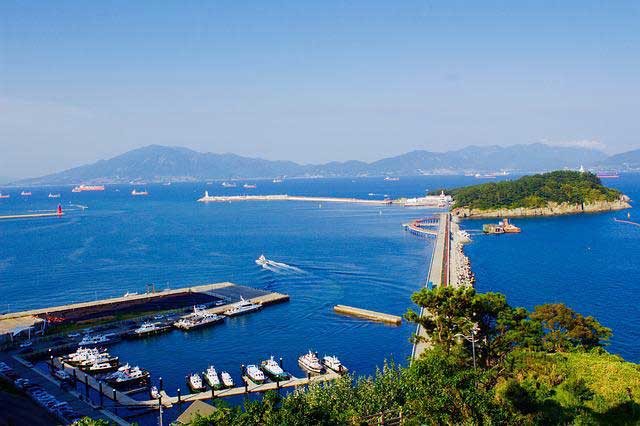
Yeosu
Yeosu - a medium-sized city set in spectacular coastline. It is the birthplace of national hero Yi Sun-shin and around 320 km south of Seoul. The natural surroundings offer some spectacular sights along the jagged coastline. A hike up one of the (small) mountains in the city will offer views to remember. Yeosu is definitely a hidden gem when it comes to scenery.
Korean Culture
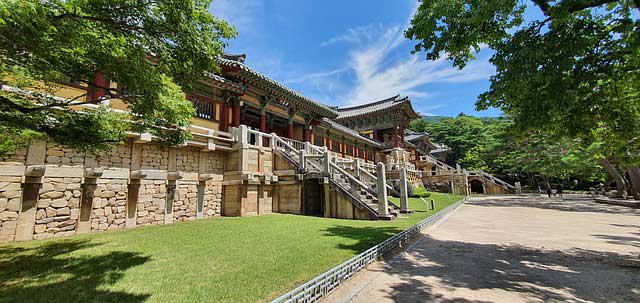
Bulguksa Temple
Bulguksa Temple - dates from 528 and was built on the orders of the Silla King Beop-heung and along with nearby Seokguram Grotto is a UNESCO World Heritage site. Partially destroyed in the Japanese invasion of 1592-98 and then subsequently abandoned, Bulguksa Temple was rebuilt in the 1970s and returned to its former glory.
Busan Aquarium
Busan Aquarium - on Haeundae Beach in eastern Busan is Korea's largest aquarium. Busan Aquarium opened in 2001 and is the work of a joint Australian-Korean design team. Around 35,000 marine creatures from 250 different species are on display.
Changdeok Palace
Changdeok Palace - was completed in 1412 after construction started in 1405, but was destroyed in the Japanese invasion of 1592-98 and then subsequently rebuilt. The ornate Throne Hall (Injeong-jeon) was used for state events and coronations. The plum blossom pattern on the ceiling dates from 1897 and symbolizes the imperial status of the Han Empire.
DMZ
DMZ - at the end of the Second World War after the liberation of Korea from Japanese rule, the country was divided into two zones along the 38th Parallel: the industrialised north under Soviet occupation, the south under the Americans. The 1950-1953 Korean War came to an end with the division of the country along .. the 38th Parallel. To the north, with the backing of communist Chinese and Soviet troops, a Stalinist state was fully established; while in the south predominantly American forces with the backing of the United Nations supported the regime there.
Drinking in Korea
Drinking in Korea - Koreans like a drink and a good time. Drinking has always enabled Koreans to cut loose from the rather stiff constraints of their hierarchical Confucian culture and a few drinks and a singalong are a big part of modern Korean social life.
Gay Korea
Gay Korea - find information on the gay scene in South Korea. Korea's gay scene, though small and low-key compared to gay life in Japan and Taiwan, is now well-established and growing. Homosexuality is not proscribed by law in South Korea and the gay rights movement has achieved some notable progress over the last decade or so. Homosexuals are protected by anti-discrimination laws and education concerning homosexuality does take place in schools.
Gyeongbokgung Palace
Gyeongbokgung Palace - is the most popular tourist attraction in Seoul. The now restored and preserved buildings served as the main royal palace of the Joseon Dynasty (1392-1910). The palace is spectacularly situated with Mount Bugaksan to the rear and the spacious grounds hold both the National Palace Museum and the National Folk Museum.
Haeinsa Temple
Haeinsa Temple - is the repository of the Tripitaka Koreana, Buddhist teachings carved onto 80,000 wooden blocks using over 50 million Chinese characters without a single mistake! Each block is made of birch wood and was treated in seawater to prevent decay.
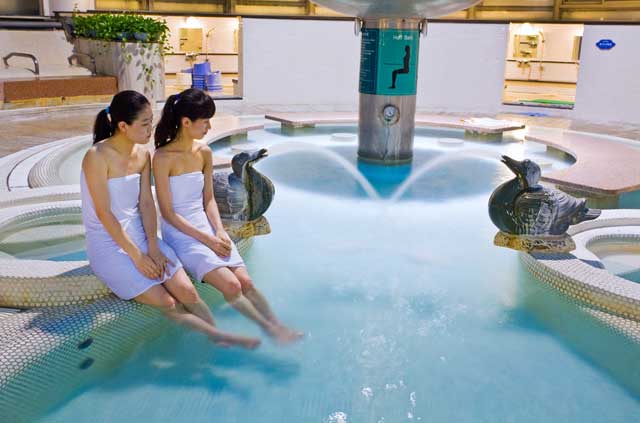
Hurshimchung Spa
Hurshimchung Spa - Hurshimchung Spa (Heosimcheong Spa) in the Dongnae area of Busan is one of the largest spas in the world, and is a great place to spoil yourself for an afternoon. The huge complex, the largest hot-spring spa in Asia, was built in the 1990s and can accommodate up to 3,000 people. The spa is part of the Hotel Nongshim.
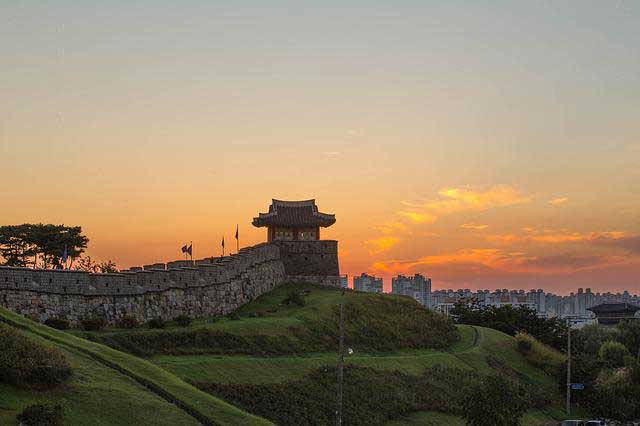
Hwaseong Fortress
Hwaseong Fortress - in Suwon is the city's most popular tourist attraction and is a UNESCO World Heritage site. The fortress was completed in 1796 by King Jeongjo, the 22nd king of the Joseon Dynasty (1392-1910), in honor of his father Prince Sado, who had been murdered by his own father King Yeongjo in Changgyeonggung Palace. The design and construction of Hwaseong Fortress harnessed new techniques of fortress constructed copied from contemporary Chinese and Japanese castles.
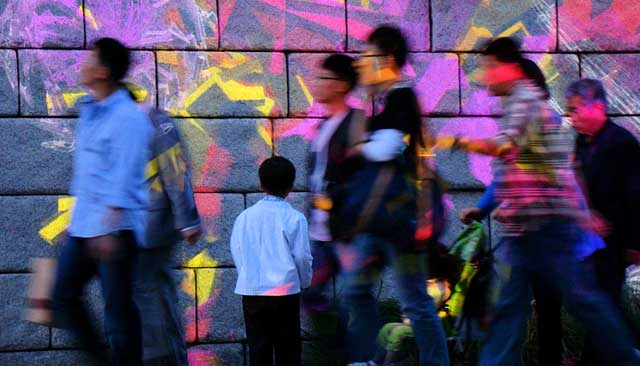
Images of Korea
Images of Korea - see a selection of photographs of both North and South Korea including architecture, nature, temples, palaces, food and entertainment.
Insa-dong
Insa-dong - a popular area with foreigners and situated at the heart of Seoul for over 600 years, this complex of streets was the center of culture during the Joseon Dynasty. Insa-dong covers a fairly large area, extending from the Anguk-dong Rotary to Tapgol Park in Jongro 2(i)-ga, past the Insa-dong Intersection, and is characterized by a maze of narrow cobbled alleyways, lined with traditional teahouses and wooden architecture (hanok), shops and boutiques, art galleries and museums, and trendy restaurants.
Itaewon
Itaewon - is the South Korean capital's most cosmopolitan area and has steadily gentrified and become less seedy over the years. Always popular with American soldiers from the nearby base, Itaewon now has trendy pavement cafes and bistros, and international restaurants. In addition, its many hostess bars on "Hooker Hill" and the recent addition of gay hangouts on adjoining "Homo Hill" close by draw lots of night time visitors.
Jagalchi Fish Market
Jagalchi Fish Market - stretched out along the waterfront of the Nampodong district of downtown Busan, Jagalchi Fish Market consists mainly of one long, narrow lane running parallel to the bay. The landside of the market lane is lined here with nothing but sashimi (raw fish) restaurants, all of them displaying their offerings in plain view and alive in aquariums, buckets and bowls.
Korean Book Reviews
Korea Books - read reviews of books on both North and South Korea including popular travel guides by Lonely Planet and Rough Guides as well as reviews of books on Korean popular culture, cinema, food, history, K-pop, religion and politics.
Korean Economy
Korean Economy - South Korea has the world's tenth largest economy. It has a population of over 51 million, 35% of whom live in Seoul and its environs. The standard of living is close to that of Hong Kong, Taiwan and Singapore. South Korea is close to Japan geographically and in economic style.
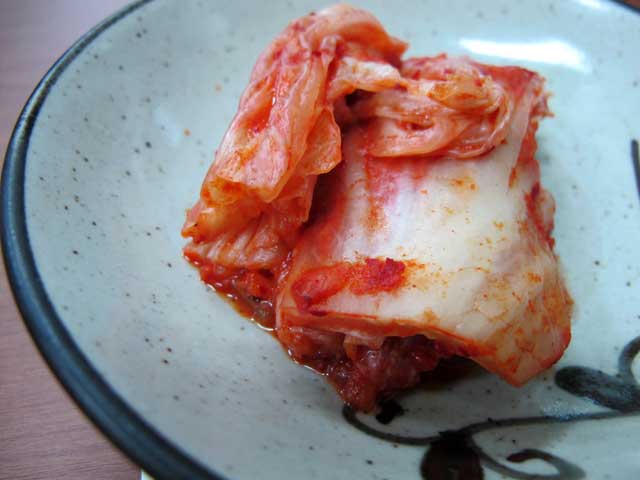
Korean Food
Korean Food - healthy and nutritious, Korean food and cuisine is winning a growing international reputation. Korean restaurants are now a common sight on the streets of New York, Los Angeles, London and Tokyo as the popularity of Korean food spreads worldwide. Bimbap and gimbap may one day be as common as sushi and sashimi among discerning international diners.
Korea Facts & Figures
Korea Facts & Figures - View statistics and statistical data regarding South Korea including: land area, population, government, transportation, tourism, communications, ethnic make up, GDP, economic growth, unemployment, main Korean cities and their populations, sport and trade figures.
Korean Glossary
Korean Glossary - glossary of Korean words and phrases from Anju to Yeogwan. See a list of important Korean cultural words and terms with an explanation in English. Also listed are common Korean acronyms (AREX, DMZ, KAL, KNTO, ROK, USO etc), Korean food words, K-pop references and historical words.
Korean Language
Korean Language - the Korean language uses an easy-to-learn alphabet - han-gul (meaning "one-script") - dating from the fourteenth century, which was originally designed to depict the actual articulation of the sounds made by the speaker's mouth in pronunciation. han-gul originally consisted of 28 symbols, although 4 are no longer used. han-gul has 10 vowels and 14 consonants.

Korean Patterns & Symbols
Korean Patterns & Symbols - Korean society traditionally adapted to and found meaning in the order of nature. Wanting to pass on the hidden meanings of the natural world to future generations and believing them as a law and order in their daily lives, Korean people have created myriads of beautiful and diverse patterns and motifs (often embodying auspicious meanings) which can be found adorning everything from Korean traditional architecture to objects of every day life.
K-Pop
K-Pop - go anywhere in East and South-east Asia and you are likely to hear Korean pop music blaring out of radios, shops and televisions. Increasingly these days, residents of London, Paris, New York, Los Angeles and Tokyo are being treated to Asia's most successful commercial music.
Makgeolli (Makkoli)
Makkoli - is often referred to as "Korean rice wine." Actually, it's fermented rice skillfully processed to end up as a milky-white drink with a finely tuned sweet / sour / bitter taste and an alcohol content of about seven percent.
Military Related Sites in South Korea
Military Related Sites in South Korea - read a guide to the DMZ and various museums and monuments dedicated to war on the Korean Peninsula. Included are Panmunjon, Dorosan Station, Imjingak, the Korean War Memorial in Yongsan and Independence Hall.
National Theater of Korea
The National Theater of Korea - is a great venue in Seoul for watching performances of pansori, traditional Korean folk tales told by solo singers accompanied by rhythmic drumming. The National Theater of Korea hosts the National Changgeuk Company of Korea, which performs traditional Korean changgeuk or pansori, as well as the National Dance Company of Korea, the National Drama Company of Korea, and also the National Orchestra Company of Korea.
Noryangjin Market
Noryangjin Market - one of the best places for sampling seafood in Seoul is Noryangjin Market or Noryangjin Fisheries Wholesale Market to give it its full name. Noryangjin Market is a wholesale auction market supplying seafood to Seoul and the surrounding area.
Seokguram Grotto
Seokguram Grotto - like nearby Bulguksa Temple, Seokguram Grotto is a UNESCO World Heritage site and was built by the same King Kim Dae-Seong in honor of his parents from a former life.
Seoul Entertainment
Seoul Entertainment - take a tour of Korean drinking culture and the best places to drink and party in the capital Seoul. Drinking in South Korea is something that can't be avoided and it can be hugely enjoyable. The locals are among the biggest drinkers in Asia and any visitor to Seoul can find packed drinking holes on any night of the week.

Seoul Shopping
Seoul Shopping - Seoul is becoming, if it is not already, one of the major shopping hubs in Asia. From luxury goods in Apgujeong to jeans at Dongdaemun market to funky t-shirts in Hongdae - there really is something to suit every taste and budget.
Split Screen Korea
Split Screen Korea - the fascinating story of South Korean movie director Shin Sang-ok who had a successful career on both sides of the 38th Parallel. Did he defect to North Korea after falling out with Park Chung-hee or was he kidnapped to make films for Kim Jong-il?
Taekwondo
Taekwondo - Taekwondo (태권도 "the way of the hand and the foot") is one of the most systematic and scientific of Korean traditional martial arts. Taekwondo is a discipline that not only emphasizes physical expertise, but also enhances the practitioner's mental spirit and overall life through training body and mind. Although developed throughout Korean history, Taekwondo is also a modern sport that has gained an international reputation and is now included among the official sports in the Olympic Games.
Telephone Numbers
Telephone Numbers in Korea - find a listing of important telephone numbers in South Korea including transport and emergency services (Korean police, ambulance, fire brigade), foreign embassies and consulates in Seoul and Busan and international and domestic dialing codes for Seoul, Busan (Pusan), Daegu, Daejeon, Incheon, Ulsan and other major cities in South Korea.
Time Differences
Time Differences Korea & The World - Korea uses Korea Standard Time (KST), which is the standard time zone for North and South Korea and is UTC (Coordinated Universal Time)/GMT (Greenwich Mean Time) +9 hours.
UNESCO World Heritage Sites
UNESCO World Heritage - see a listing of UNESCO World Heritage sites in South Korea and the year they were inscribed to the UNESCO list.
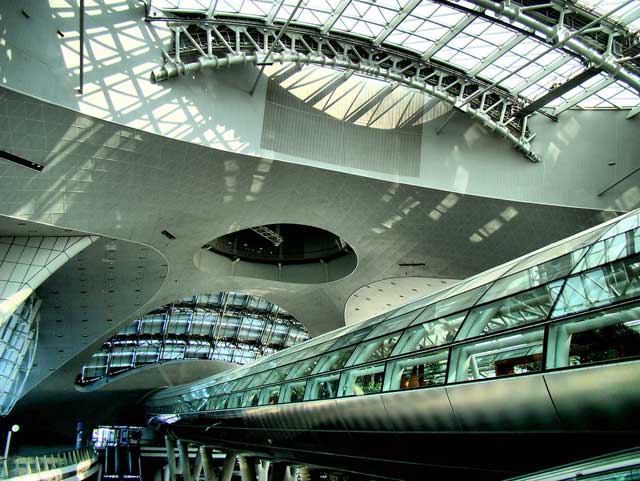
Transport
AREX
AREX - the new Korail Airport Railroad links Seoul Station in Seoul to Incheon International Airport in Incheon in only 43 minutes on the fastest express trains. This compares with the highway limousine bus which takes around one hour. The high-speed airport line intersects with KTX trains, Seoul subway lines 1 (for Suwon) and 4, the Gyeongui Line and Seoul city buses at Seoul Station. There's free Wifi on the train, too!
Busan Buses
Busan Buses - Busan's public bus system is cheap, extensive and easy to use and similar in organization to buses in Seoul. Busan's buses are divided into 3 categories: local buses, cross-country buses, and airport buses. Local buses include: regular city buses, express city buses and night buses.
Bus Travel in Korea
Bus Travel in Korea - travelling around South Korea on the bus system is an efficient, cheap and very comfortable way to see the country. And as there are bus lanes on the expressways for much of the time, Korean buses sometimes whizz past the car drivers. While Korea's rail network is good, the bus routes go to many more places and every city, no matter how big or small, has a bus terminal.

KTX
KTX - the Korea Train eXpress (KTX) is Korea's high-speed train operated by Korail. KTX trains connect Seoul Station to Busan via Daejeon and Daegu on the Gyeongbu Line and Gwangju and Mokpo from Yongsan Station on the Honam Line. Both Seoul and Yongsan stations intersect with the Seoul subway system and other routes on the Korean rail system.
Seoul Buses
Seoul Buses - the public bus system in Seoul is more difficult to use than the excellent subway, but with a little effort it is possible to enjoy riding above ground and get a grip of Seoul's urban geography. Seoul's buses are divided into 4 color-coded categories and have the letters "Y", "B", "R", or "G" displayed on them depending on their color.
Seoul Station
Seoul Station - is the major rail hub in South Korea and the starting point for KTX trains to Busan. Seoul Station stands next to the Japanese-built former station, which was modeled on Tokyo Station in Japan and constructed in 1900.
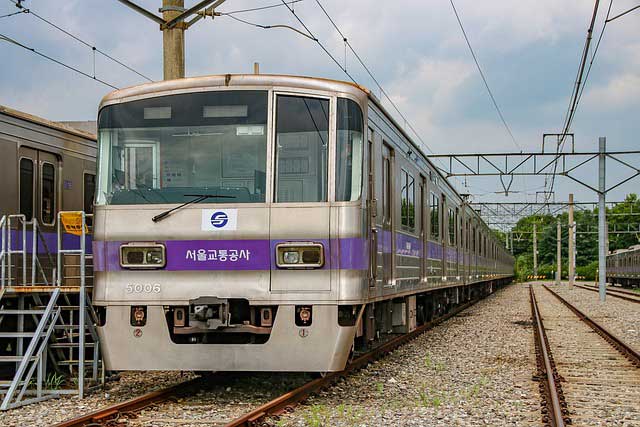
Seoul Subway
Seoul's Subway - system is one of the most extensive metro systems in the world: 22 lines, over 300 stations and over a thousand kilometers of track. And the system is still expanding! The metro in Seoul is cheap, clean, efficient, frequent and safe. The Seoul subway system runs both underground (around 70%) and above ground. It connects central Seoul with both Suwon and Incheon. Line 1 runs more than 100 km from Soyosan in the north to Cheonan to the south of the capital.
Taxis in Seoul
Seoul Taxis - are cheap and can be found just about anywhere, especially stations and department stores. There are different types of cabs operating in the city including International Taxis where the driver speaks a foreign language and Call Taxis (usually available only in Korean at the call center). A 20% surcharge applies between midnight and 4 am on all taxis in the capital.
Train Travel in Korea
Train Travel in Korea - travelling by train in Korea is a straightforward, efficient and often speedy way to see the country. There are the high-speed bullet trains that whisk you from Seoul in the north-west to Busan, the second city on the south-east coast, in not much more than two hours. Those in less of a hurry can take a slower train that may trundle but offers a comfortable and laid-back travelling experience.
Yongsan Station
Yongsan Station - the modern Yongsan Station, completed in 2004, is a major rail hub in South Korea and the starting point for KTX trains to Gwangju and Mokpo. Trains for Jeonju, Gwangju, Mokpo and Yeosu depart from Yongsan Station.
North Korea
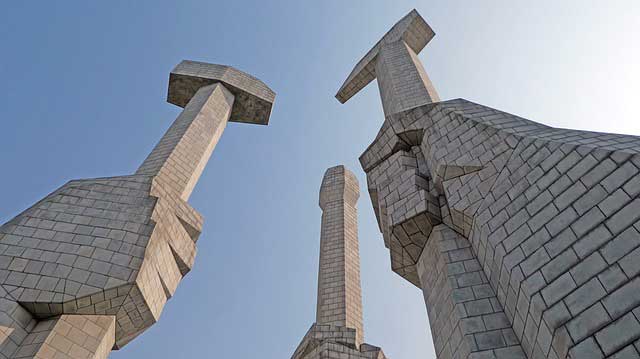
Pyongyang Guide
Pyongyang Guide - it is hard to be unimpressed by the capital city, Pyongyang. During the Korean War, the city was completely leveled. (More bombs were dropped on the DPRK by the U.S.-led U.N. forces in 1950-53 than on Japan and Germany combined during World War II.) It may not be the prettiest city in the world, and older apartment blocks are definitely showing their age, but the rebuilding from scratch of Pyongyang has been a commendable effort undertaken at "Chollima speed."
The Great North Korean Picture Show
The Great North Korean Picture Show - is a documentary about North Korean cinema by Singaporean documentary film couple James Leong and Lynn Lee. They went to North Korea in 2008 when one of their works was invited to the Pyongyang International Film Festival. Encountering North Korean cinema for the first time, Leong and Lee were fascinated.
Tours of North Korea
Tours of North Korea - think of North Korea and many opinions, images and words come to mind but have you ever thought of North Korea as a tourist destination? People are beginning to be more adventurous and daring in their choice of nations to visit and North Korea is slowly making a name for itself as a go to destination to explore and appreciate.

Books on Korea
Read reviews of books on both South Korea and North Korea including travel guides, books on Korean food, religion, politics, K-pop and culture.
Hotels in Korea - Booking.com
Hotels in Seoul - Booking.com
South Korea Hotels - Agoda
Seoul Hotels - Agoda
Find Hotels in Daegu - Agoda
Hotels in Busan - Agoda
Book Daegu Hotels - Booking.com
Incheon Hotels - Agoda
Book Incheon Hotels - Booking.com
Pyeongchang Hotels - Agoda
Suwon Hotels - Agoda
Search Suwon Hotels - Booking.com
Ulsan Hotels - Agoda
Uncover Ulsan Hotels - Booking.com