
UK Stadiums: Field Mill, Mansfield, Nottingham, England

Field Mill (aka One Call Stadium for sponsorship reasons) in Mansfield, Nottinghamshire, England, is a 9,186-capacity stadium. It is the home of Mansfield Town Football Club. It is considered the oldest football playing arena within the Football League, as it has hosted football matches since 1861, though some reports suggest its history may go back as far as 1850.
Although Field Mill has an illustrious past, the tag "the oldest football ground in the world" belongs to Sandygate Road, the home arena of Hallam FC.
Field Mill was the venue for the first competitive match under artificial light, hosting the North Notts League Senior Cup final in 1930.
The name Field Mill originates from the Field Mill building that operated a cotton doubling business, the employees working for Herbert Greenhalgh. Greenhalgh's XI are officially the first football team to be formed in Mansfield. The Field Mill building was once a grand edifice, a five-storey building.
A fire in 1904 severely damaged the building. It was demolished for good in 1925.
On the opposite side of Quarry Lane lay a field adjacent to the mill, used for the works' cricket team. At this time, the field was known as the Greenhalgh's Ground. In 1885, the name of the ground was changed to Field Mill.
The Greenhalgh project was in full force in the football world, as in 1892 Field Mill hosted the stadium's first FA Cup tie between Mansfield Greenhalghs and Eckington Works. The Greenhalghs emerged 5-2 winners.
Following the dissolution of Mansfield Greenhalghs, Mansfield Amateurs and Old Meeting House moved in and shared the ground. But soon Old Meeting House chose a different ground and were replaced by Mansfield West End. Field Mill was the home venue of West End for only two years, however.
Greyhound racing was introduced for three years at Field Mill in 1928. When Mansfield Town were elected to the Football League, the dog races were discontinued.
Redevelopment
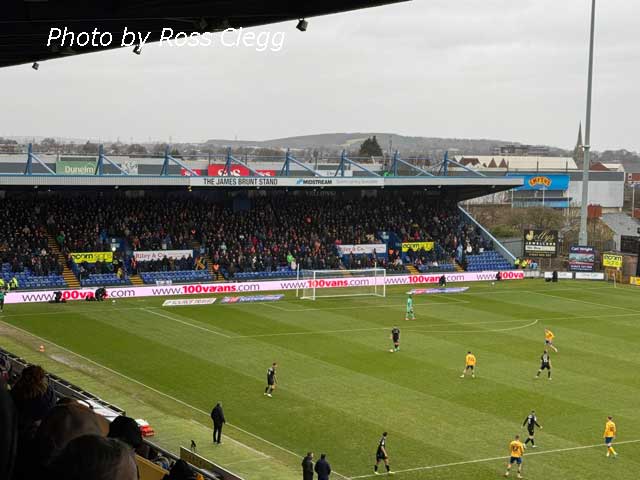
Three new stands were built in 2000 as part of the redevelopment process. The West Stand (later named the Ian Greaves Stand), the North Stand (now the James Brunt Stand for sponsorship), and the Quarry Lane Stand became part of the Mansfield furniture.
The Ian Greaves Stand is the largest in the arena, containing 5,417 seats. Both the upper and lower tiers of the stand have a capacity of over 2,500. The dugouts were moved to the front after a request from the then-manager Steve Evans, but this was unfortunate news for fans watching from Blocks D & E as they now have an impeded view.
The Quarry Lane End houses the home supporters. The corner of this stand is also where the players' tunnel is located.
The Bishop Street Stand is currently off-limits as it was boarded up in 2006. There have been plans to build a new stand here but progress has been minimal.

Club History
Due to its Wesleyan church roots, the club was formed as Mansfield Wesleyans by Frederick Abraham and Thomas Cripwell in 1897. Mansfield in the early stages only played friendly matches and the odd cup tie. The team adopted a light blue and chocolate-striped kit and made the pitch on Westfield Lane their home ground. The first match played on this ground was a 2-2 draw with Sherwood Foresters in September 1897.
The club joined the Mansfield and District Amateur League before the 1902-03 campaign. The club's first-ever league match was a local derby, away at Mansfield Corinthians. It finished as a 0-1 loss, but Walter Tattersall was a bright spark. Tattersall later went on to bigger things at Tottenham and Watford. Their second fixture was again played away from home, a drubbing at the hands of Shirebrook Swifts by a 0-13 scoreline!
The following season, 1903-04, Mansfield were a respectable outfit finishing third. Had it not been for a two-point deduction handed for fielding an unregistered player, the Wesleyans would have been runners-up.
The Stags
When Mansfield (nicknamed The Stags) ditched its amateur status in 1906, they parted ways with the church and rebranded as Mansfield Wesley.
In 1910, another name change occurred, to become Mansfield Town, much to the dismay of local rivals Mansfield Mechanics. From that year until World War I, the Town swapped many divisions, namely the Notts and District League, Central Alliance League and Notts and Derbyshire League.
Field Mill only became home to Mansfield Town post-World War I, as Mansfield Mechanics repeatedly failed to pay their rent on time. In 1923-24 and 1924-25, The Stags achieved promotion from the Midland Counties League based on standings but could not gain election to the Football League on either occasion.
Football League Status
Mansfield Town finally attained Football League status in 1931, but the Southern Section of the Third Division was competitive, and Town found it difficult to climb the league ladder. One of the bright sparks of the 1930s for Mansfield Town was the sale of Ted Harston, who emerged as a deadly striker after signing from Bristol City. Despite scoring more goals than he had appearances for Mansfield, Harston only featured five times in two years for his new club Liverpool, due to a broken leg.
In August 1958, Mansfield fielded a black player for the first time in their history when Lindy Delapenha from Jamaica made his debut. As the first player from his country to feature in professional English football, Delapenha had an accomplished CV with Middlesbrough and Portsmouth before joining The Stags.
Town gained promotion back to Division Three in 1962-63. But their campaign was marred in controversy when Brian Phillips and Sammy Chapman were handed lifetime football bans for bribing Hartlepool United players before a critical fixture.
FA Cup Run
1968-69 saw the club's most spectacular FA Cup run. After seeing off Tow Law Town, Rotherham United, Sheffield United and then Southend United, The Stags faced a West Ham team containing three English titans of 1966, Geoff Hurst, Martin Peters and Bobby Moore. The Hammers also had talented names in Harry Redknapp and a young Trevor Brooking. The fixture was postponed five times before it finally commenced, Field Mill staging one of the greatest games in the club's history. Scottish goalkeeper Bobby Ferguson was beaten three times in the West Ham net by goals from Dudley Roberts, Ray Keeley and Nick Sharkey. This 3-0 win was Mansfield's first victory over a First Division opponent. Their fairy-tale run concluded in the following round, however, after a frustrating 0-1 loss at home to Leicester City, with Peter Shilton making numerous vital saves for The Foxes.
1976-77 was a season mainly filled with happy memories as Mansfield pipped Wrexham to the Third Division title. But the Nottinghamshire outfit were humbled in the FA Cup that season by Matlock Town in round two.
The 1977-78 in Division 2 is The Stags' only season so far in the second tier of English football throughout their history. Though Mansfield rallied with four wins from six games at the latter end of the season, they finished second bottom and were relegated along with Blackpool and Hull City.
1986-87 ended on a high, getting the better of Bristol City to win the Football League Trophy at the old Wembley Stadium with more than 58,000 in attendance. Kevin Kent put Mansfield ahead after 57 minutes. But Bristol City equalized through Glynn Riley. The scores were tied after 120 minutes of football so only penalties could separate the two sides. Keith Cassells of Mansfield was the first to miss, and soon Bristol City were on the cusp leading 4-2. But penalties from Gordon Owen and future Premier League manager David Moyes for Bristol City were saved by the outstanding Kevin Hitchcock. Tony Kenworthy buried his effort to secure Mansfield's only cup win to date.
In the following season, Mansfield dared to dream in the FA Cup, defeating Preston, Lincoln City and Bath City scoring four goals in each game. Their round four opponents were top-flight Wimbledon in a home tie. Wimbledon were looking comfortable at halftime in the match as Alan Cork and Terry Phelan helped themselves to a goal each. Kevin Kent gave Mansfield hope with twenty minutes remaining after punishing Wimbledon goalkeeper Dave Beasant for failing to deal with a back pass. Field Mill erupted when Lawrie Sanchez clumsily brought down Tony Lowery and conceded a penalty kick. The effort from Steve Charles was firm, but Beasant was sharp with his reactions, securing his team a narrow win. "The Crazy Gang", as John Motson famously described Wimbledon, eliminated three more teams before defeating the might of "The Culture Club", or Liverpool FC, in the final to win their only FA Cup trophy.
1993
1993 was a crucial year in Mansfield's modern history, as Keith Haslam acquired the club from Abacus Holdings in the summer. At age 34, Haslam became the youngest chairman in the Football League at the time. He is known for having a short fuse, sacking George Foster with just four games played after taking over.
1994-95 was noteworthy for eliminating Leeds United 1-0 on aggregate in the League Cup. A famous Simon Ireland effort was enough for the win at Elland Road before subduing The Whites in a 0-0 draw at home. Mansfield were knocked out in the following round after a loss to Millwall. On the league front, a spectacular run around Christmas time helped Mansfield grab the last playoff spot in the Third Division (now called League Two). Their promotion playoff semi-final opposition was Chesterfield, who crushed The Stags during extra time of the second leg, as Mansfield were down to nine men by that point. Chesterfield would go on to gain promotion to the third tier.
Division Two
In 2002-03, The Stags found themselves in the third tier, or Division Two, but had to put up with immediate relegation. Keith Curle was hired mid-season to steady the ship, but could not fix a leaky defence that conceded 97 goals in the league. Journeyman striker Iyseden Christie was clinical in front of goal that campaign to no avail.
Mansfield could have achieved yo-yo club status with promotion back to the third tier the following season but were denied by Huddersfield Town in the promotion playoff final at the Millennium Stadium in Cardiff. The match headed to penalties, but Wayne Corden and Liam Lawrence failed to convert their spot-kicks, so it was The Terriers who clinched promotion.
In April 2008, ugly scenes erupted in Mansfield's final home fixture against Rotherham United when a 0-1 loss all but guaranteed relegation from the Football League for the first time in 77 years. Home fans made owner Keith Haslam the scapegoat, attacking him after the full-time whistle.
Conference
With Mansfield occupying the Conference, Haslam chose to sell the club to a consortium. For the first three seasons in the fifth tier, Mansfield were unable to escape mid-table mediocrity.
The Stags finally extricated themselves from the clutches of Conference football in 2012-13. Alongside their automatic promotion in this campaign, Town again enjoyed an FA Cup run and faced a Brendan Rodgers-led Liverpool at home in round three. Liverpool's Luis Suarez was unsurprisingly at the heart of controversy as his goal to make it 2-0 clearly touched his hand before the strike. The Reds would hold out for a 2-1 scoreline. Kidderminster Harriers pushed Mansfield all the way in the league, but The Stags achieved promotion without the need for the dreaded playoffs.
2018-19 was again agonizing for Mansfield fans, losing to MK Dons in a winner-takes-all match for automatic promotion to League One on the final day. Although The Stags had Nottingham Forest loanee Tyler Walker firing on all cylinders throughout the season, they lacked cutting edge in their playoff semi-final against Newport County. Newport scraped a win on penalties.
Mansfield would suffer further agony in the playoffs in 2022 as they were outclassed 0-3 by Port Vale in the final at Wembley Stadium.
By 2023-24, Mansfield had been in League Two for a decade, but their supporters needn't wait any longer as the club finished third and clinched automatic promotion. Town had an eight-point lead between themselves and fourth-placed MK Dons at the end of the season. The season highlight was a 9-2 demolition job over Harrogate Town in mid-February.

Players
Ken Wagstaff, mentioned in our Hull City stadium guide, is undoubtedly a Mansfield icon. Born in Nottinghamshire, Wagstaff was given a first-team opportunity early in his career when Mansfield's then-manager Raich Carter handed his debut in a 2-1 away win at Rochdale in August 1960. In 181 games, Wagstaff was on the scoresheet on 93 occasions, cementing his legacy before his high-profile move to Boothferry Park.
Rod Arnold is, in all likelihood, the best goalkeeper Mansfield has ever had. A Wolverhampton native, Arnold initially joined the club on loan from Wolves, earning a clean sheet in his debut against Fulham in 1971. He made the switch permanent in 1973, being the cornerstone of a relatively prosperous decade for the club. Arnold won the Fourth Division in 1975 and the Third Division two years later. Post-retirement, he has worked at Hull City as a goalkeeping coach.

Access - Getting There
The only train route into Mansfield is the Worksop train, which departs from Nottingham station. There have been incidents where away fans alight at Mansfield Woodhouse station, but the correct stop is Mansfield station. After alighting, signposts for Portland Retail Park will help with your journey. From Mansfield station, One Call Stadium is visible. Visitors are recommended to leave the station via the footbridge adjacent to Platform 2. The distance between the station and the arena is less than 0.5 miles. Next to Mansfield train station is the Mansfield bus station, which has long-distance coach services.
For fans travelling by car, type in NG18 5DA to your satnav. On matchdays, parking is unavailable near the stadium. However, alternative parking is provided at NG18 1EL on Grove Street and Watermeadows, NG18 1BA, for relatively cheap fees.
Address: Quarry Lane, Mansfield NG18 5DA
Nearby Hotels
Accommodation options in Mansfield include the 3-star Mansfield Lodge Hotel, the Midlands Hotel, also 3-star and the Pine Lodge Hotel & Restaurant Mansfield.
Search here for a complete listing of hotels in Mansfield.
More UK Stadiums
©Soccerphile.com
Buy tickets for soccer matches around the world