
Origin Stories: Book Review
Sean O'Conor

Football historian Chris Lee has produced an awesome 380-page history of the sport's global expansion, Origin Stories, based on his website Outside Write.
After covering the 19th century English birth of the game, the story shifts to the four corners of the globe and the explosion of soccer via Britain's merchants, miners and railway workers.
The other disciples who spread the faith were the locals who had witnessed it in England and then came home enraptured with football. Within less than a generation a rowdy old British pastime had turned into the world's most popular sport, an amazing achievement.
As Lee describes, before Victorian organisation, matches were messy, teams had to agree how to play before starting and frequently changed the rules at half time.
In the 1860s for example, games ending level on goals were decided on the number of 'rouges' - where a player kicked the ball beyond the goal line and touched it down. The term still exists in Canadian Football.
The first international club match, between England's Portswood Park and France's Havre Football Club, involved goals, rouges and touchdowns, confusingly.
Football's early days saw eccentrics a plenty such as Charles Wreford-Brown, famous for inventing the abbreviation soccer, but who also had a pocketful of sovereigns on the field which he would hand out to whomever had scored.
Football was a mighty melange before codifying made it the simple game we know today. For that reason the rugby-style sport in the United States is called American Football and in England, Blackheath Football Club, which today plays rugby, was a founder member of both the Football Association and the Rugby Football Union.
While there is a consensus that Sheffield FC (1857) is the world's first football club, history has never hovered over one man as the inventor of the sport in the same way Abner Doubleday is worshipped by baseball fans or James Naismith by basketball.
Ebenezer Cobb Morley could be the closest thing to a founding father for having steered the inaugural meeting of the Football Association towards a kicking game and the Cambridge Rules, which incidentally allowed players to catch the ball and made teams change ends after each goal.
But the plethora of historic football games from around the world from tsu-chu and la soule to harpastum and calcio storico makes it impossible to hand the crown to one man.
As the battle between carrying and kicking led to the schism between football and rugby, the dispute over getting paid for playing was just as acrimonious.
From today's perspective the British flinching from professionalism seems bizarre but the Corinthian ideal was so popular that it led to the breakaway game of rugby splitting into two sports and English football bizarrely having two governing bodies - the Football Association and the Football League.
I never realised the famous Queen's Park club of Scotland, who played at Hampden Park, were amateur as recently as November 2019. Perhaps because the game was being led by upper-class English twits, it was left to no-nonsense Scots to bring the sport to other nations, including Argentina, Brazil, Japan and Spain.
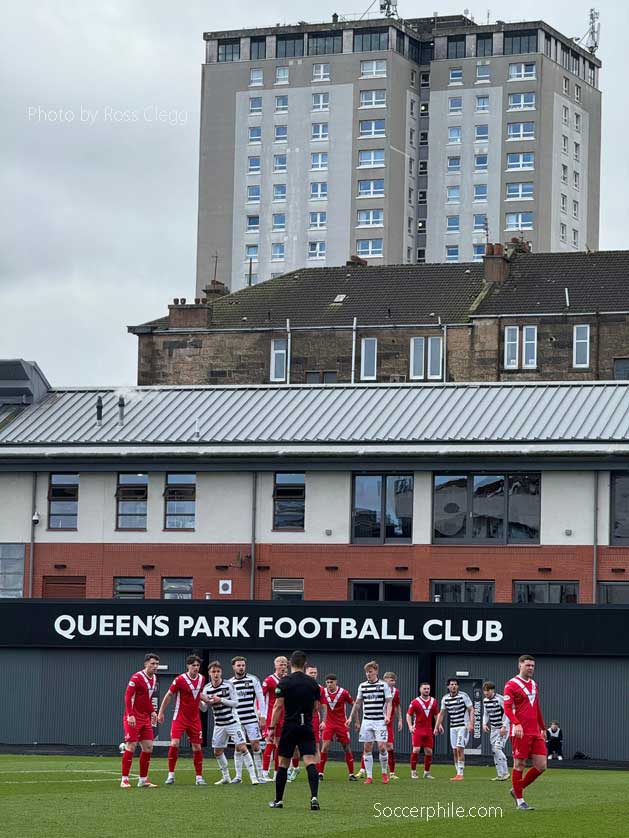
The Scottish contribution in general appears to have been unfairly ignored by history. Not only did they produce the great stadium architect Archibald Leitch, the first mixed-race international captain and above all promote passing football over English kick-and-rush, they were also the first to pay players, albeit clandestinely.
There were Scottish schools who played proto-football games as far back as the late 18th century and there is a strong case for The Foot-Ball Club of Dalry, Edinburgh, established in 1824, claiming Sheffield FC's title of the world's first football club.
When it came to the world's first international, England v Scotland at the Oval in 1870, Kenneth MacKenzie, born outside Scotland of Scottish ancestry, was the first oriundo (granny rule) in football history and teammate Robert Crawford the first international goalscorer. Final score: England 1:1 Scotland, att. 600.
Ireland gets a similarly thorough section including tributes to the inventor of the spot-kick William McCrum and Patrick O'Connell, who captained his country, played for Manchester United and coached five Spanish clubs including Barcelona and Real Betis, where he won La Liga. The relative statuses of rugby and Gaelic football are not covered in depth.
The section on Wales is much shorter, which is a shame because there is a lot to dig into with regard to the urban/football v rural/rugby divide, the role of education in Welsh sport and the Welsh language.
How rugby became the national sport in Wales but football ruled the coastal cities is glossed over, but there is a fascinating mention that football is now becoming associated with the young and the independence movement.
Of course the world's most popular sport is not the most popular one in every country and explaining why it caught on like wildfire in some places and failed to seed in others has always been tough.
I had the general impression that the British colonies were lukewarm about football because the empire's ruling class had gone to schools which preferred cricket and rugby, although that is not much explored here.
Rugby and football arrived in many lands as the same sport anyway, a mix of carrying and kicking, much like Gaelic football is today. In Australia and North America rugby football and its derivatives came to dominate association football yet the opposite happened in countries like Brazil and Germany.
On the other hand these two main types of football coexist in places like Argentina, France and South Africa, albeit with different constituencies. Why is this? Indeed, how did rugby league top football in towns close to soccer hotbeds of northern England?
Rather than football naturally flourishing because it was simpler to play, its growth was more down to enthusiastic individuals organising leagues before other sports could get going, but even then there are exceptions.
In the United States, football had a head start on the more complicated rugby but ended up in its shadow. After 150 years as a struggling sport, only now is the spherical-ball game entertaining serious designs on America's Big Four.
Harvard University is usually blamed for football's travails in America because it had been influenced by Canada's rugby-playing McGill University before it started to spread the oval-ball game across the USA.
And yet the US formed the first professional league outside of the UK, founded a club as far back as 1862, a football association in 1884 and had a thriving East Coast league in the early twentieth century. But American football still triumphed.
As it happens, cricket was America's first organised sport but disappeared by the wayside too.
France is well covered in the book, with its tricolore of pioneers Robert Guérin, founder of FIFA, Henri Delaunay of UEFA and Jules Rimet of the World Cup.
The growth of football outre-manche was so sluggish however that Swindon and Barnsley were invited to play an exhibition match in Paris in 1910 followed by Clapton Orient and Millwall the following year. France's status as the weakest of the Big Five leagues today was ever thus.
As headquarters for both FIFA and UEFA Switzerland seems an unlikely capital for modern football but they got their tentacles into the world game early on.
The Lausanne Football Club in 1860 was probably the continent's first and Swiss men went on to found Barcelona and Internazionale, as well as clubs in countries as far apart as Bulgaria and Colombia. Brazil's Fluminense was founded by an Anglo-Swiss man Oscar Cox and another Swiss man Alfred Dick became the president of Juventus in 1905.
The usual story was that English expats working in shipping or sharing Britain's industrial technology would start sports clubs overseas and then the locals would eventually take over, as happened with the Genoa Cricket and Football Club and the Milan Foot-Ball and Cricket Club.
It was interesting to learn how many nascent clubs in Europe switched from rugby-style rules to association ones, although that does not explain the parts of the world where rugby beat football. Oddly in the French chapter there is no mention of how rugby became more popular in the south-west.
The other question which springs to mind is why football eclipsed cricket, especially in South American countries with clement climates, when so many football clubs had begun as winter adjuncts to the bat and ball game. The fact the opposite occurred in India is not explored.
The British imprint in world soccer still runs deep. In Argentinian football it is obvious to this day with club names like River Plate and Newell's Old Boys, the latter named after one Isaac Newell from Strood in Kent.
Jose Luis Brown, of Scottish ancestry, scored Argentina's first goal in the 1986 World Cup final, while in Colombia, one of Radamel Falcao's great-grandfathers was a Yorkshireman.
In Hungary, where the Mighty Magyars would briefly dazzle the world in the early 1950s, the game was initially called Anglollabda - 'Englishball'.
Brazil too owes its national totem to the British, particularly Brazilian-Scottish Charles Miller who started the first clubs and Scottish-born Thomas Donohue, who allowed non-whites into the sport from 1904.
The enthusiasm with which English clubs toured Europe in the early 20th century spreading the creed of football sounds like a golden age of entente cordiale, in stark contrast to the depressing ethno-nationalism of the 1930s or more recent years.
So many British coaches walked into jobs on the continent in a way that would be unthinkable now, but the Europeans were in awe of the "Misters" and their footballing knowledge in the same way we would defer to Americans coaching gridiron in Europe today.
So Glaswegian Jake Madden became the father of Czech football, Edinburgh-born William McKay the father of Spanish football and teenager Harry Hinton the unlikely father of the Portuguese game.
The bigger picture of England, with the help of some Scots, exporting its upstart sport around the world and it becoming a global phenomenon is an extraordinary accomplishment, one which we have probably failed to properly acknowledge.
The fact a top Brazilian club is named after an English Victorian amateur outfit, the Corinthians, a Chilean side is called Everton, or the name of an Argentine first division club Banfield derives from an Edward Banfield of Ilfracombe is also charming.
It can be easily forgotten that mighty A.C. Milan retains the English spelling of Milano and it is Genoa C.F.C. not A.C. Genova, because both were expat cricket and football teams at their births.
While Juventus copied Notts County's strip, Independiente aped Nottingham Forest's while Atletico Madrid's colours probably date from a consignment of Southampton shirts.
Sparta Prague indeed copied their colours from Arsenal, but if I am nitpicking they do not wear red as stated but rather the burgundy of Woolwich Arsenal. The red shirts of Nottingham Forest, which later became Arsenal's, were conversely inspired by the followers of Giuseppe Garibaldi.
On the subject of Italy there is no mention of volata - the curious hybrid of football and rugby promoted by the fascists in the 1920s and early '30s in an attempt to displace the foreign game of football.
I found the chapters on the places which did not adopt football as their favourite sport - Australia, India and the USA for instance, particularly interesting and whilst much of this territory has been mapped before, Lee's work with other soccer historians from Outside Write has updated a lot of the knowledge.
The ample research has unearthed some gems. Future Atletico Madrid manager Fred Pentland and former England international striker Steve Bloomer ended up interned in Germany during WWI, a conflict which claimed the lives of 26 Inter players and staff and Genoa CFC founder James Richardson Spensley amongst many footballers.
Football hooliganism was there as early as football, if the medieval English village game and calcio fiorentino are anything to go by. In 1898 it went international when a match between English and German Bohemians was violently attacked by an anti-Teutonic mob of Hungarians. Scots also roughed up an English agent snooping around Dumbarton in the 19th century.
The early days of football have been covered many times before but it is hard to think of an equivalent tome.
It is not a definitive or comprehensive world history however - the Middle East & Africa get 22 pages in total, less than Spain, while nations like Colombia, Mexico and Russia merit a few lines only. Some countries are covered in depth - Austria, Italy and Spain have great chapters, but others have brief coverage or digress into national team stories.
Where it focuses the protagonists, the political backdrop and the anecdotes it scores highly.
But it suffers from an occasional dive into stats and repetitive chronologies and it really lacks an index, yet it is still overall an impressive achievement and the product of much research culled from many sources.
Despite the creeping globalisation of the Premier League and growth of international tournaments, English football fans remain at most vaguely cognisant of the missionary work their recent ancestors did to make the game the phenomenon it is today.
Let us hope this book will help change that.
Buy Origin Stories from Amazon USA | UK | Japan
© Sean O'Conor & Soccerphile
Buy tickets for soccer matches around the world