
Spain Stadiums: Metropolitano Stadium, Madrid
Andy Greeves
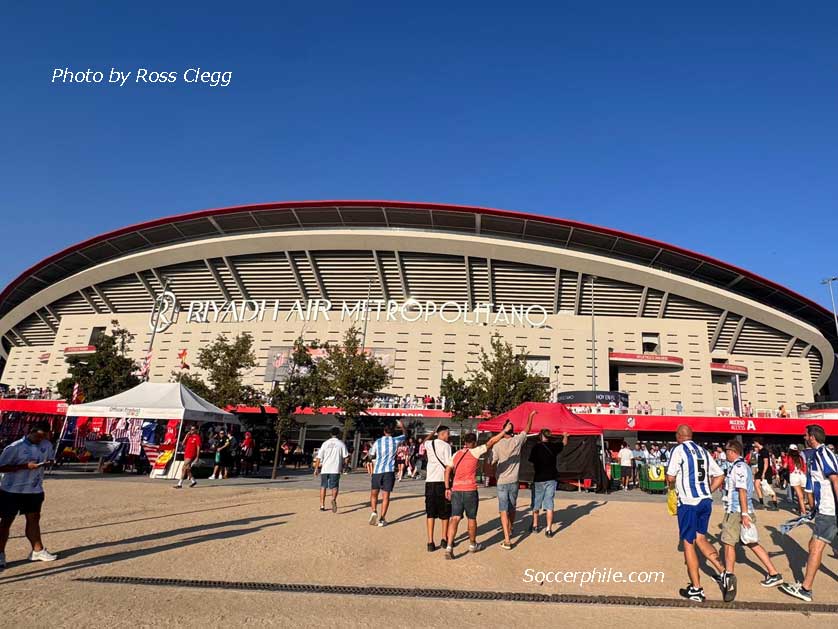
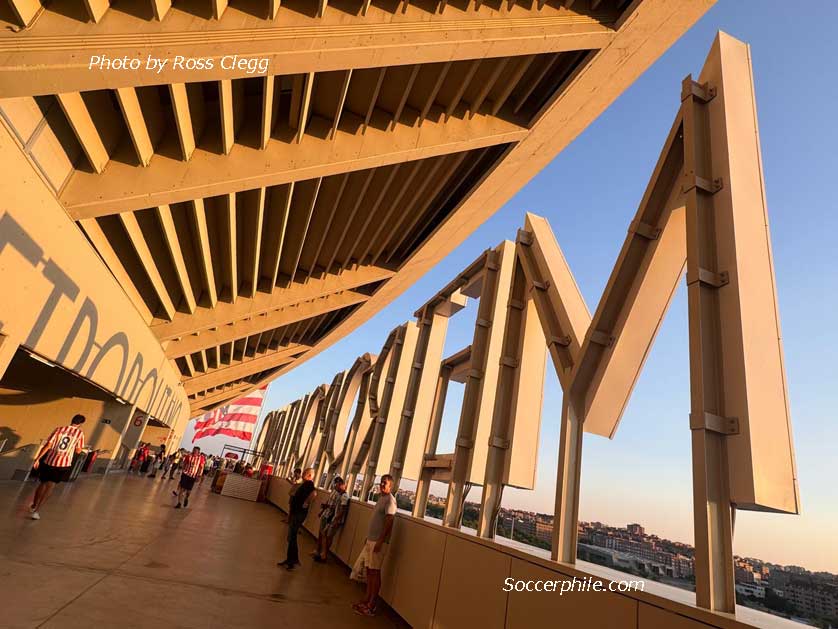
Located in the Rosas neighbourhood in the San Blas-Canillejas district of Madrid, the Metropolitano Stadium (officially known as the Riyadh Air Metropolitano Stadium for sponsorship purposes) has been home to Atlético Madrid since 2017. The stadium has a capacity of 70,813 and features an eye-catching 360° screen that was installed in 2025.
The Metropolitano Stadium staged the 2019 UEFA Champions League Final between Liverpool and Tottenham Hotspur and will host the 2027 final. It is also a likely host venue for matches for the 2030 FIFA World Cup which will be staged in Spain, Portugal and Morocco.

Stands
The original Metropolitano Stadium - then known as the Estadio de la Comunidad de Madrid (Community Stadium of Madrid) - opened in September 1994. It was the centrepiece of Madrid's ultimately unsuccessful bids to stage the 1997 World Athletics Championships and 2016 Olympic Games.
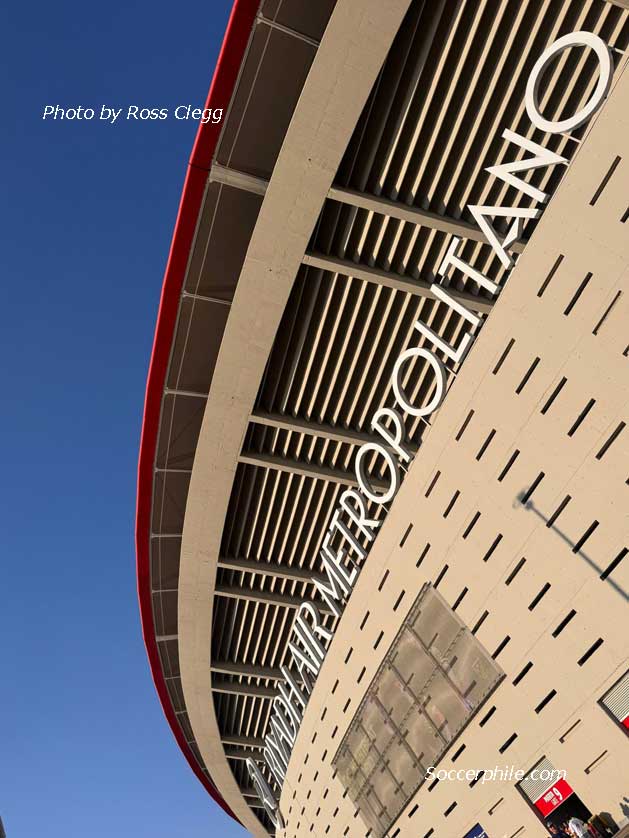
The original stadium was incomplete and featured only one major stand on the west side of the ground. Architects Cruz y Ortiz incorporated this stand into the 'new' Metropolitano Stadium design, creating full bowl arena with a tensioned cable-net roof. Each stand has three main tiers - grada baja (lower tier), grada media (middle tier) and grada alta (upper tier) with the upper tier divided into distinctive sections with third and fourth level seating on the north, east and south sides of the ground while there is a fifth level on the 'Lateral Oeste' (West Side). There is also a balcony level for hospitality seating between the middle and upper tiers on the north, east and south sides of the stadium.
While the other three stands form a perfectly joined 'C' shape, there are gaps between the upper sections of the ground in the north west and south west corners, giving the original Lateral Oeste - with its players' tunnel and press box - a distinctive look.
History
While it missed out on hosting the 1997 World Athletics Championships, the Estadio de la Comunidad de Madrid still staged a number of notable events in its early history including the second leg of the 1996 Supercopa de España and the 9th IAAF (International Association of Athletics Federations) World Cup. Rayo Vallecano also played a number of 'home' games at the ground during the 1997-98 season while renovation work took place at their stadium, the Campo de Fútbol de Vallecas.
But in 2004, the stadium nicknamed 'La Peineta' (The Comb) was closed and stood derelict until November 2011 when a series of works began to prepare area for future construction. Three years prior, in December 2008, an agreement was reached between Atlético's president Enrique Cerezo and mayor of Madrid Alberto Ruiz-Gallardón for the site of the Estadio de la Comunidad de Madrid to one day become the location of the club's new stadium.
Initially planned to be opened in 2015, the Estadio Metropolitano finally opened on 16 September 2017 as Atlético Madrid hosted Málaga in a La Liga match in the presence of King Felipe VI of Spain.
The Spain national team played at the venue for the first time on 27 March 2018, beating Argentina 6-1 in a friendly. The ground staged the Copa del Rey Final that same year while Spain's rugby union team have also played a number of matches there.

The Club: Atlético Madrid
Founded on 26 April 1903 as Athletic Club Sucursal de Madrid (a branch of Bilbao-based Athletic Club), the club was known as 'Athletic Madrid' between 1921 and 1939 before merging with Club Aviación Nacional to become 'Athletic Aviación de Madrid'. They were renamed Atlético de Madrid on 1 January 1947.
Athletic Club Sucursal de Madrid started out playing at Tiro del Pichón before moving to the Campo de O'Donnell in February 1913 and then the Estadio Metropolitano de Madrid (not to be confused with the current Metropolitano Stadium) in University City in Moncloa-Aravaca district to the northwest of the city centre in 1923.
Athletic Madrid were one of 10 founder members of the Primera División (later known as La Liga), finishing sixth in the inaugural league season in 1929. Under the management of former Espanyol, Barcelona and Real Madrid goalkeeper Ricardo Zamora, Athletic won their first La Liga titles back-to-back in 1939-40 and 1940-41.
Under their 'new' Atlético Madrid name, the club experienced a golden era during the 1950s and 1960s, winning La Liga in 1949-50, 1950-51, 1965-66 and 1969-70 while they were Copa Del Rey winners in 1959-60, 1960-61 and 1964-65. They also won the European Cup Winners' Cup in 1961-62 under the management of José Villalonga.
In 1966, Atlético left the Estadio Metropolitano de Madrid - which was to be replaced by office and university buildings - for a new site on the banks of the Manzanares River in the Arganzuela district of Madrid. Originally called the Estadio Manzanares, Atleti's new ground was renamed the 'Estadio Vicente Calderón' in 1972 in honour of their long-term president, Vicente Calderón.
Atléti carried their success of previous decades into the 1970s. After winning the aforementioned La Liga title in 1969-70, they were Spanish champions again in 1972-73 and 1976-77. There were Copa del Rey triumphs in 1972 and 1976 while a 4-1 aggregate victory over Argentinian club Independiente saw them win the Intercontinental Cup in 1974. 'Los Colchoneros' ('The Mattress Makers' - see 'fun facts' for more information on this nickname!) entered the Intercontinental Cup that year as European Cup runners-up as the winners Bayern Munich declined to participate.
The late Luis Aragonés had four spells in charge of Atlético from 1974 to 1980, from 1982 to 1987, once again from 1991 until 1993 and finally from 2001 to 2003. Overseeing the La Liga success of 1976-77, three Copa del Rey victories in 1976, 1985 and 1992 as well as the aforementioned Intercontinental cup triumph in 1974, Aragonés is Atléti's second most decorated manager after current boss, Diego Simeone.
A magical season for Atlético Madrid saw the club win both La Liga and the Copa del Rey under the management of Radomir Antić. Key members of Atléti's 'double' winning side included goalkeeper José Molina, defenders Delfí Geli, Roberto Solozábal, Santi Denia and Toni Muñoz, midfielders Milinko Pantić, Diego Simeone, Juan Vizcaíno and José Luis Caminero and forwards Lubo Penev and Kiko.
Atléti were unable to achieve further success after their season of seasons in 1995-96. They finished fifth, seventh and then 13th in La Liga over the next three campaigns. And a disastrous season in 1999-2000 saw Atléti were relegated for the just the second time in 66 years with club owner Jesús Gil and his board suspended during the campaign pending an investigation into the misuse of club funds. Aragonés returned to the Estadio Vicente Calderón in May 2001 and helped the Colchoneros win the 2001-02 Segunda División title.
Aragonés gave Fernando Torres the platform to shine at Atlético Madrid, with the striker scoring six goals in 36 matches in Atléti's promotion-winning campaign in 2001-02. The following season he scored 19 goals in 35 La Liga appearances and eventually went on to net 91 times in 244 for the club through until a move to Liverpool in the summer of 2007 for a reported £20m.
Atléti had a rather underwhelming period at the start of the 21st century, finishing between seventh and 12th in La Liga between 2002 and 2007. The 2007-08 season marked a return to prominence for the club who achieved their first qualification for the UEFA Champions League since 1996. Sergio Agüero scored 19 La Liga goals that season while Diego Forlán netted 32 times in the league in 2008/09 to once again guide Atléti to a fourth-place finish in La Liga and a Champions League slot. And further proof of the club's rise came in 2009/10 when they won the UEFA Europa League.
Former player Diego Simeone was appointed as Atlético Madrid's new head coach in December 2011 heralding the start of another golden era for the club. Atléti won the UEFA Europa League once again in Simone's debut season as boss and lifted the Copa del Rey in 2012-13. Even better was to come in 2013-14 as the Colchoneros won their first La Liga title since 1996.
Atléti have remained competitive ever since, never finishing outside La Liga's top four. They were UEFA Europa League winners for third time in 2017-18 and La Liga champions for a second time under Simeone in 2020-21. The club has also been two-time UEFA Champions League runners-up under Simeone - painfully losing the final to rivals Real Madrid in both 2014 and 2016.
Honours
La Liga winners: 1939-40, 1940-41, 1949-50, 1950-51, 1965-66, 1969-70, 1972-73, 1976-77, 1995-96, 2013-14, 2020-21
Segunda División winners: 2001-02
Copa del Rey winners: 1959-60, 1960-61, 1964-65, 1971-72, 1975-76, 1984-85, 1990-91, 1991-92, 1995-96, 2012-13
Supercopa de España winners: 1985, 2014
UEFA Cup/Europa League winners: 2009-10, 2011-12, 2017-18
European Cup Winners' Cup winners: 1961-62
UEFA Super Cup winners: 2010, 2012, 2018
Intercontinental Cup winners: 1974
Madrid Derby
The Madrid derby (El Derbi Madrileño) between Real Madrid and Atlético Madrid is one of the fiercest rivalries in European football. It has traditionally been portrayed as a clash over the identity and soul of the Spanish capital. Real Madrid has long been associated with the establishment, glamour and wealth of the city's elite, while Atlético Madrid developed a strong working-class identity rooted in the capital's neighbourhoods, embracing a reputation for resilience, struggle and defiance against the establishment.
The rivalry reached a boiling point in the mid-2010s when the two clubs faced off in two UEFA Champions League finals (2014 and 2016). In both matches, Atlético was minutes or penalties away from ultimate glory, only for Real Madrid to snatch the trophy away. These agonizing defeats left deep scars and amplified the bitterness between the fanbases.
Unlike El Clásico, which is a regional battle against Barcelona, this is a literal war for the streets of Madrid. Fans live, work, and commute alongside each other daily. Winning means total dominance over the local fountains - Real fans celebrate at Cibeles, while Atlético fans take over Neptuno.
Fun Facts
- The Metropolitano Stadium is the first stadium in the world to operate on 100% LED lighting.
- In March 2019, the stadium set a then-world attendance record for a women's club football match when 60,739 fans turned out to watch Atlético Madrid play Barcelona.
- The name 'Metropolitano' is a nostalgic nod to the club's old Estadio Metropolitano (see above), where Atlético played their home matches before moving to the Vicente Calderón in 1966.
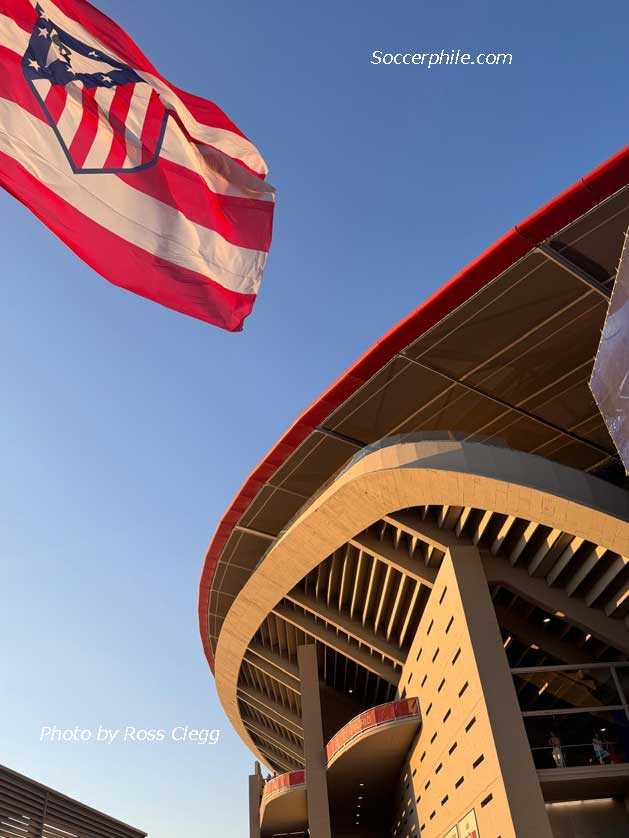
- Atlético got their famous Los Colchoneros nickname from a period in post-civil war Spain when standard mattresses were traditionally covered in red and white striped fabric. It was joked that Atlético's players looked like walking mattresses and the nickname stuck!
Access - Getting There
The nearest Metro stop to the Metropolitano Stadium is 'Estadio Metropolitano' on Line 7. However, you can also arrive at the stations 'Las Rosas' (Line 2) and 'Canillejas' (Line 5) which are both around a 15 minute walk. All stations have increased services on matchdays. In addition, EMT operate a special bus service from two hours before and 1.5 hours after the event. The special bus will connect Canillejas transport hub with the Plaza de Grecia, situated in front of the stadium.
5 EMT bus routes and 20 Intercity bus routes serve the stadium's surrounding area.
Address: Av. de Luis Aragonés, 4, San Blas-Canillejas, 28022 Madrid

Accessibility
In 2025, Atlético Madrid has become the first football club to receive Access Champions Certification by AccessibAll. The Metropolitano has almost 500 dedicated seats for fans with disabilities and their companions as well as 20 tactile tables (Touch2see technology) to allow people with visual disabilities to follow the match.]
Stadium Tours
Atléti offer a stadium tour, combined with a visit to the club's museum. You are able to access the dressing rooms, mixed zone, players' tunnel and dugouts as well as the presidential suit and press conference room. The club's interactive museum meanwhile offers an immersive tour of over 120 years of Atlético Madrid history. An audio guide for the tour is available in Spanish and English. Tour prices start from 25,00€ for adults and 18,00€ for children.
A variety of tour experiences can be booked at tour-museum.atleticodemadrid.com/home including a premium package which allows you to go onto the Metropolitano pitch and perform a kick-off!
Visitors with reduced mobility should call +34 91 726 04 03 or email territorioatleti@atleticodemadrid.com in advance to arrange their visit to the stadium, with disabled visitors receiving a 50% discount.

Madrid Hotels
Madrid has a range of hotels, guest houses and pensions to suit all budgets. Find hotel accommodation in Madrid.
The Hotel101 - Madrid is a 4-star property with a fitness center, seasonal outdoor swimming pool, and a children's playground.
The four-star Hotel Pinar Plaza features a rooftop swimming pool, sun terrace, and lush garden.
The UMusic Hotel Madrid is located in downtown Madrid, offering easy access to attractions such as Plaza Mayor (a three-minute walk), Mercado San Miguel, and Puerta del Sol.
Other places include the excellent, 4-star Catalonia Plaza España Hotel & Spa offering a rooftop swimming pool, fitness center, sun terrace, and restaurant.
All photos by Ross Clegg

World Stadiums
Estadio Nuevo Colombino Huelva
Tosu Stadium (Ekimae Real Estate Stadium)
©Soccerphile.com
Buy tickets for soccer matches around the world