
Keep Calm and Carry On
With many questioning whether it is feasible or indeed, ethical, to conclude this season's club competitions as a result of the coronavirus pandemic, Andy Greeves takes a look back at the 1914/15 and 1946/47 Football League seasons that continued amidst the most challenging of social and economic backdrops
Despite the uncertainty over how and when the various suspended football leagues around the world can be concluded, there is understood to be a steadfast commitment from many clubs, associations and broadcasters to complete the 2019/20 season's fixtures in their entirety.
UEFA, European football's governing body, has written to all its domestic bodies urging them not to abandon their competitions and has even warned places in the UEFA Champions League and UEFA Europa League could be forfeited if any national association cancel their league and cup seasons.
"Since participation in UEFA club competitions is determined by the sporting result achieved at the end of a full domestic competition, a premature termination would cast doubts about the fulfilment of such condition," read the letter.
With health systems around the world stretched to their limits right now and the coronavirus claiming thousands of lives every day, the resumption of the 2019/20 season has become as much a moral question as a logistical one. It seems likely that if leagues resume, matches would be played behind closed doors - potentially at venues such as training grounds rather than stadiums. BBC Sport's Simon Stone wrote, of the Premier League's supposed standpoint:
"Premier League sources are equally adamant nothing will be agreed that places any unnecessary strain on medical resources at a time of national crisis. Even in a sterile environment it is acknowledged how bad it would look for the game if a player needed hospital treatment for a broken leg at a time when significant numbers of the general population were dying of coronavirus."
Although she has since back-tracked on her opinion, West Ham United vice-chairman Karren Brady previously called on the current Premier League season to be declared "null and void" while Tottenham Hotspur striker Harry Kane believes that the end of June is "probably the limit" for the campaign to be concluded.
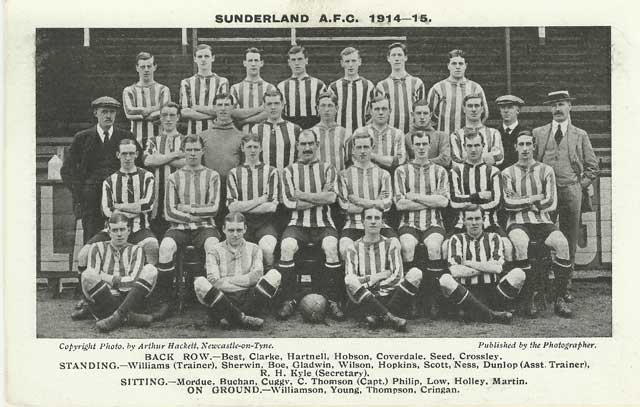
Questions over whether a league season should have started - let alone concluded - were asked of English football over a century ago following the outbreak of World War I on July 28, 1914. While the campaign's traditional curtain-raiser - the FA Charity Shield - was cancelled, all four divisions of the Football League and the FA Cup were held in their entirety.
As matches went ahead each weekend, the satirical magazine Punch scorned the continuation of the 1914/15 season with an October 1914 cartoon depicting 'Mr Punch' speaking to a footballer and commenting "No doubt you can make money in this field, my friend, but there's only one field (referring to the battle field) today where you can get honour".
A soldier, serving in France, wrote to a British newspaper at the start of the conflict to complain that "hundreds of thousands of able-bodied young roughs were watching hirelings playing football" while others were serving their country.
The renowned writer Arthur Conan Doyle - who once played as a goalkeeper for Portsmouth AFC (no connection to Portsmouth FC) under the pseudonym A.C. Smith - declared the campaign as an unnecessary distraction to the war effort and commented; "if a footballer has strength of limb, let them serve and march in the field of battle".
Attendances at matches largely dropped throughout the campaign. Tottenham Hotspur, who had welcomed 26,000 spectators for their second home game of the 1914/15 season against Chelsea saw just 7,500 spectators pass through the White Hart Lane turnstiles for their last game of the campaign against Sheffield United. Sunderland's average gate of 22,000 in 1913/14 dropped to 11,000 a year later.
Amidst a growing rise of public opinion against professional footballers, the so-called 'Football Battalion' - or the 17th (Service) Battalion, Middlesex Regiment of the British Army to give its full name - was established by William Joynson-Hicks on December 12, 1914. England international Frank Buckley was the first player to join.
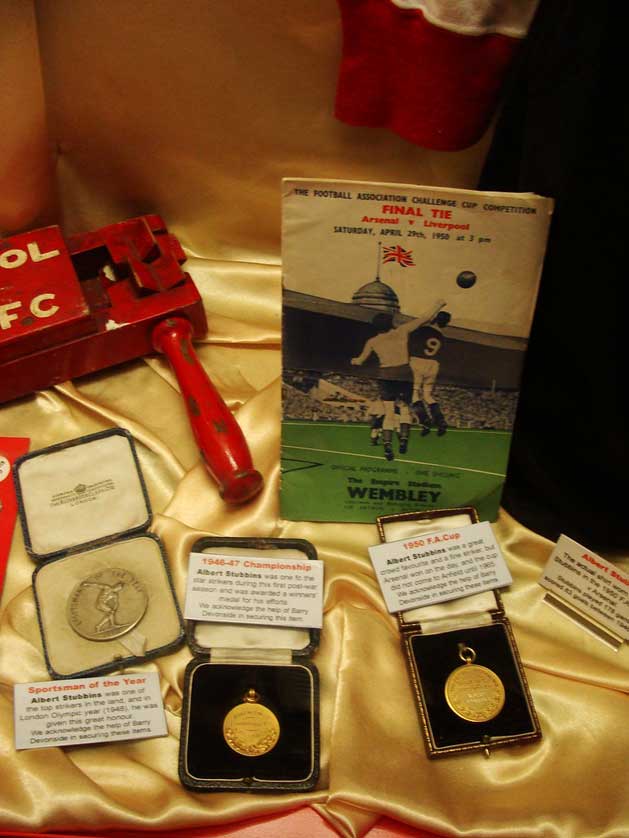
Only 122 professionals of an eligible 1,800 players had signed up by March 1915, which led to further criticism of the football industry in sections of the British press.
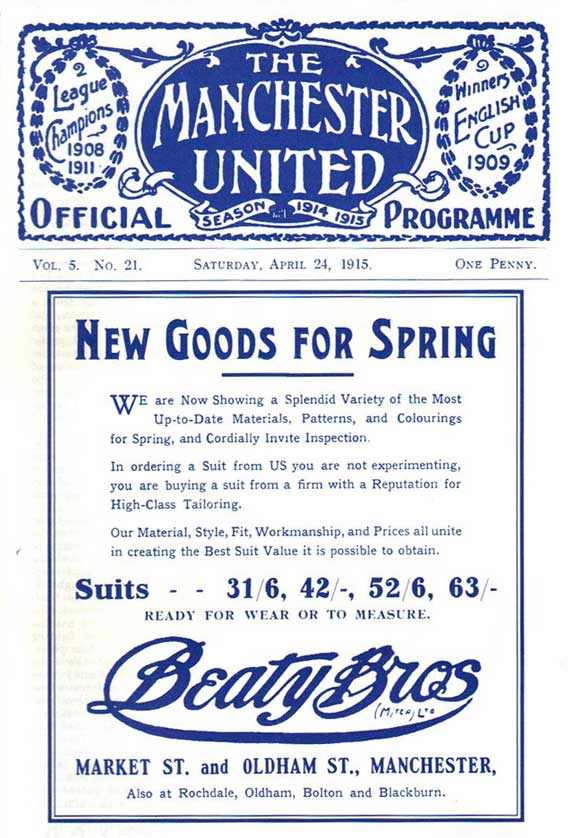
A challenging season for the game's reputation took a further turn for the worse when it was discovered that a Manchester United-Liverpool match at Old Trafford on April 2, 1915 had been fixed in United's favour. Seven players were found to have participated in the scandal and were banned for life, although most had their bans overturned in due course. For the record, Everton were the winners of the First Division in 1914/15 pipping Oldham Athletic to the title by a single point. Sheffield United beat Chelsea 3-0 in the FA Cup Final of April 24, 1915 meanwhile.
At the end of the 1914/15 season, the Football League was cancelled. Clubs continued to play on, but only in minor regional leagues - such as the London Football Combination - prior to the resumption of the Football League in 1919/20.
When World War II began in 1939, the 1939/40 Football League season was cancelled immediately after just three rounds of fixtures. Blackpool were leading the old First Division at the time. The war ended on September 2, 1945 and the Football League got back underway for the 1946/47 season on August 31, 1946.
During the campaign, and with the United Kingdom suffering economically from the cost of fighting a war, the British government sought ways to improve worker productivity. This brought about the cancellation of mid-week football matches from March 1947. Given that many fixtures had already fallen foul to the weather during a winter of heavy snow and flooding, there were many matches of the season still to play. In a similar dilemma to football leagues around the world right now, the Football League considered whether to reward teams based on their current position, declare the season null and void or extend the season. They chose the latter option.
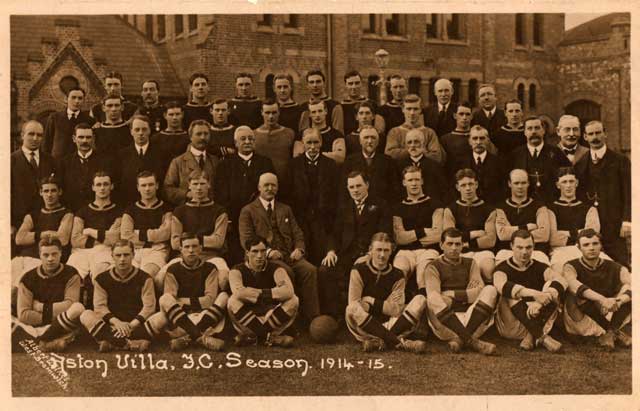
Wolverhampton Wanderers led the First Division table when the potential cancellation of the campaign was discussed, but after all 42 matches of the season were completed, it was Liverpool who came out on top. With the Reds currently just six points from claiming the Premier League title - after a 30 year wait to be champions of England - the Merseysiders will hope that the 2019/20 season can be concluded or at the least, cancelled with the current league positions recognised and rewarded.
It is likely that, as in 1914/15 and 1946/47, the current season in England and elsewhere will be completed, despite the unprecedented social backdrop. Whatever happens, this particular campaign - like those around the two World Wars - will no doubt be discussed throughout the annals of time.
© Andy Greeves & Soccerphile.com
Buy tickets for soccer matches around the world