
Silver Linings: Bobby Robson's England - Book Review
Sean O'Conor
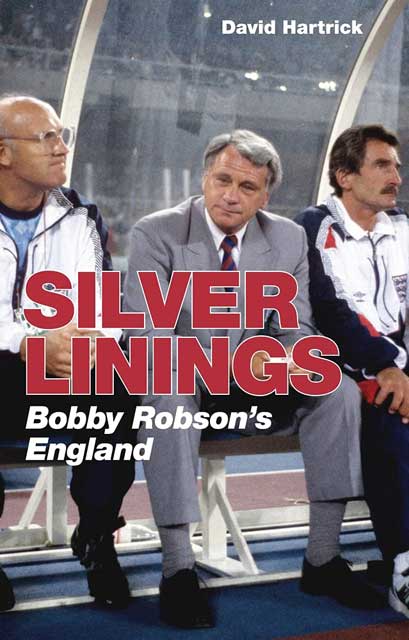
Bobby Robson's England was eight years of tears which ended in a smile.
Two disastrous European Championships and two fruitful World Cups made for a tumultuous ride, chronicled in a new book Silver Linings by David Hartrick.
With a chapter for each year, Hartrick dissects every England performance from 1982-'90 under Robson, a welcome reminder of a colourful manager and some eventful nights.
The wider context of Robson's tussle with the rabid dogs of Fleet Street amid the fires of eighties Britain is touched upon briefly, but the football is the focus. The author has scoured the autobiographies, match reports and newspapers and the meticulous reviews of each 90 minutes are impressive.
Despite a couple of typos - Graham Six and Caligiuri for Cagliari, the facts are pinpoint, though I would have preferred more detail on some matches and less on others. The extraordinary World Cup quarter final against Cameroon in Naples and the climax against West Germany in Turin are given barely a couple of pages.
I thought I recalled Robson's men stealing a win against an Enzo Scifo-inspired Belgium in Bologna at Italia '90, rather than "a match where both sides had managed to parry and riposte," but as an Italian friend of mine opined, when the Azzurri are playing in the World Cup, it is a night of 60 million managers.
There are a few gems unearthed. I remember England playing bizarre friendlies against Aylesbury United and a Sardinian eleven but they also took on the US Air Force Academy in Colorado before Mexico '86, cruising to an 11-0 win.
The book's timing is pertinent. At Russia 2018 England also reached the World Cup semi final and brought the feel-good factor back home with them.
Unlike Gareth Southgate however, Robson navigated choppier waters before taking the eventual winners to within two spot kicks of the final and he did it all to a persistent drum beat of hooliganism and tabloid pillorying, two sides of the same epochal coin.
Memories of Robson's England are framed by the mood music of the 1980s in Britain, when fashion, politics, pop music and sport were bursting with colour, creativity and personality.
Robson at the time appeared a little eccentric in the way most of his successors have not, telling the cameras to ridicule that the future "argues well" and warning his players not to celebrate too much in case it set off the hooligans, while plucking Steve Bull from the third division to face Ruud Gullit and Marco Van Basten in the World Cup.
Perhaps he was just not a man of his age, articulating the mores of a different era, which were lost in translation.
His reign became a tale of rebirth and redemption. English football had reached its nadir at Heysel in 1985 and suffered a debilitating five year exile from the continental cups it had previously dominated.
Then it endured two domestic stadium tragedies in Bradford and Sheffield which would precipitate the end of the beloved terrace culture which had embodied the sport since its Victorian birth.
English club football had entered 1990 traumatised by Hillsborough, plagued by a hostile government and locked out of Europe, its identity ravaged. Six months later the Taylor Report and Italia '90 sparked a rejuvenation, seeding the moneybags Premier League of today.
Had Nessun Dorma not rang out joyously in British households that summer, would Rupert Murdoch have brought big money into English football to knock Serie A off its perch? Robson's role as one of history's little men should not be overlooked.
Hartrick's tale starts with an in-depth study of England under Alf Ramsey, the benchmark for having won the ultimate prize and like Robson, a man who had cut his teeth at Ipswich. Stands and statues commemorate the pair today at Portman Road but bad blood flowed after Ramsey had slated his successor in the tabloids.
Robson, who cut a kind and decent figure in public if not always in private, responded by taking aim at the sacred cow and duly titled a chapter of his autobiography, "Thanks a lot, Sir Alf."
With his first squad Robson had got off on the wrong foot and given the media their first sniff of blood, ineptly dropping talisman Kevin Keegan without having told him first. Before long the hacks had it in for him and the mutual suspicion and hostility remained for the rest of his reign.
After a pointless three matches against Australia down under, Robson's England honeymoon got worse with a competitive loss to Denmark at Wembley and failure to make it to Euro '84.
His tenure might have ended there and then but his offer to quit was turned down, presumably because the F.A. were as scared of the people's favourite Brian Clough as much as they rated their chosen man.
Missing out on the eight-team Euro '84 was disappointing but not a tragedy, whereas the debacle of Euro '88 was genuinely depressing. England had arrived at the finals much fancied before they collapsed to three miserable defeats, shipping seven goals to boot.
In the aftermath, heads were scratched ubiquitously to work out just what could have gone wrong, yet two years later largely the same team might have won the World Cup. As Jimmy Greaves said to Ian St John every Saturday, "It's a funny old game."
When Robson had offered to resign in '88, the F.A. again said no, a decision which was vindicated by Italia '90 but at the time seemed brazen. It is difficult to imagine that an England manager today would be handed the reins for a fourth campaign having missed the boat for one finals and fired a barrel of blanks at another.
In the words of veteran journalist Brian Glanville, "It was initially hard to regard Robson as anything but a busted flush, a mere survivor, so badly exposed at Euro 88 that there was no logical case for his remaining."
For the tabloids he was a northern bungler, a caricature the rags gleefully wheeled out again for Graham Taylor and Steve McClaren, yet this tomfoolery hid the fact his job was quite safe because he had been working the association corridors for years.
The Football Association Chief Executive Graham Kelly went so far as to say he could have stayed up to the 1994 World Cup if he had only been aware how much he was valued.
Hartrick might have explored this a little more with some insight on the F.A. at the time, a still essentially amateur outfit fiercely protective of its in-house traditions and only somewhat connected to modern reality.
The English game's governing body might have bitten the bullet and hired a foreign coach in 2001 but in the eighties seemed aloof to managers who had gained valuable experience overseas like Malcolm Allison and Terry Venables, let alone maverick winners like Clough.
Instead they valued domestic servants like their directors of coaching Allen Wade, who applied for the England job without having managed a professional team, and Charles Hughes, aka the high priest of the long ball, who preached dogmatically the questionable 1950s theories of Wing Commander Charles Reep.
While the rest of the world guffawed, these men seemed to have imbibed Alf Ramsey's infamous quote about the 1970 World Cup winners - "We have nothing to learn from the Brazilians."
Mercifully Robson diverged from their rigid orthodoxy, but the prevailing philosophy at Lancaster Gate meant when he left his job in 1990, the keys were handed to Reep acolyte Graham Taylor, with disastrous consequences.
The gutter press, particularly The Sun, had decided as far back as 1984 that Robson should be toast and mounted a determined campaign for his dismissal, going as far as distributing 'Robson Out' badges to fans.
The fact he survived seven years of relentless muck spreading is testament enough to his inner steel. As Gary Lineker notably recalled in the 'More than a Manager' documentary, there was also "an edge" to the grandfather persona which the public never saw.
I knew Robson had a genial way of treating his players so it was interesting to learn he tried to get a team into the Olympics and welcomed new entrants to the England squad with a speech and a round of applause to make them feel right at home.
His man management with England was underrated, drowned by the din of tabloid heckling.
It is also largely forgotten that in 1982 at a time when racism was alive and kicking on the terraces and possibly even at the F.A. as well, Robson picked six black players for a squad which had boasted only one the previous summer and said he would pick eleven if they were good enough. Bravo, Bobby.
Though immortalised for the night of tears in Turin, his greatest achievement was arguably the transformation he made mid-tournament at the 1986 World Cup.
After the first two games in Mexico, England sat demoralised on only one point and no goals. The Monterrey heat was sapping everyone, skipper Bryan Robson had been lost to injury, Ray Wilkins to suspension and some players angrily denounced the manager's tactics to his face. The campaign ran the real risk of imploding beyond repair, like France's did in 2010.
The fact that Robson then hauled them from rock bottom to a joyous 3-0 win over Poland and an energised cup run speaks volumes. Only a leader blessed with sound emotional intelligence could have achieved that, or as some have suggested, a flexible coach who listened to players begging for a change of formation.
When recalling how his team had been robbed by Diego Maradona's manipulation in Mexico City, Robson always insisted on blaming the match officials and not the Hand of God, stating that "players will always try things".
Another explanation for the press vendetta was that Robson the man seemed out of time - exuding 1950s working class civility from a position of power throughout a decade when what Peregrine Worsthorne called 'bourgeois triumphalism', vulgar individualism and just plain boorishness were ruling the roost.
Old-fashioned perhaps, but his charm still worked and the disgraceful press campaign for his head undoubtedly said more about an uneducated nation needing scapegoats for its decline. Qui accuse, s'accuse.
In his autobiography, Robson rationalised his treatment by the tabloids purely in terms of a circulation war at work, apparently maintaining a benevolent view of people in general, though at one point in 1988 he let slip his true feelings:
"I am having to work in a hostile environment and that is not easy," he complained. "The attitude of the press has changed, they are much more volatile than they were and there are sections generating hate...They can brainwash the public."
His disdain for the scribes remained largely hidden from public view but was evident to anyone who attended his England conferences, where the press pack were always on a war footing.
Hartrick's trawl of the archives rightly shows the disrespect for Robson was not limited to a circle of now-forgotten red-top hacks but was felt across Fleet Street.
While the Mirror and Sun sprayed words like clown, fool and plonker around, the 'quality' newspapers thumped the same punchbag, albeit with more literate broadsides like 'bereft of ideas', 'short on inspiration' or 'road to oblivion.'
Spend time in any press room and you soon realise they are all one pack of merciless, morality-free hounds who revel in any manager's mishaps and have no deep love for their national team, whatever they claim.
Fleet Street's rank hypocrisy over England was proven, case-closed, by their zero to hero volte-face over Robson once Italia '90 had enraptured the nation.
With no internet, social media or multi-channel television in England in the eighties, the newspapers wielded an inordinate power to direct debate and influence opinion on the England manager, an unnatural privilege they gleefully abused.
Whatever his achievements with England Bobby Robson's reign will forever be tied to the parallel narrative of the 'off with his head' frenzy in Fleet Street. In England the pen, for a while, did seem mightier than the sword. But perhaps he drew on all their negative energy and it motivated himself to prove all the keyboard cowards wrong.
Only in the last chapter does Hartrick delve into this running battle as part of the wider cultural conversation, which could be the subject of a book in itself. In Eighties Britain, yob was a seminal word, the tabloids embodied the zeitgeist and Robson was perhaps a mere innocent jaywalker in their crosshairs:
"The sport, more than any other," Hartrick writes, "is often a reflection of the circumstances and society around it...Robson's time in the 1980s was one of huge societal unrest...Football's violence, death and despair was merely a reflection of the England in which it lived."
It is sobering to remember how every England away match that decade was accompanied by a boorish entourage of louts kicking, punching and smashing up whichever foreign culture they encountered, apparently unevolved from the crusaders who sacked Constantinople in 1204.
The off-field violence meant Robson's England had trouble organising friendlies away from Wembley and was part of the reason the historic annual match with Scotland, the world's oldest international fixture, was scrapped. Conversely it also handed England an undeserved seeding for Italia '90 ahead of the European champions, Holland, so the rowdy fans could be isolated in Sardinia.
Robson was concerned England's playing style might atrophy without access to the UEFA club competitions, yet despite two successful World Cups, he was often considered rigid in his tactics and a bit of a slow learner.
The general consensus was that he was excessively devoted to an English 4-4-2, albeit using wingers unlike Ramsey, and failed to make mercurial stars like John Barnes and Glenn Hoddle replicate their club form for the Three Lions.
With his orchestrational talents, Hoddle could have been what Michel Platini was to France but he fired only sporadically. Frustrated as a lyrical artist born in a land of prosaic yeomen, Hoddle left the international stage prematurely aged 30 in 1988 with 53 caps, but would return as England manager a decade later.
On the other hand, Gary Lineker flourished wearing the Three Lions and won the Golden Boot at Mexico '86 and a ticket to the Camp Nou. Under Robson he scored 35 times and his strike partnership with Peter Beardsley was possibly England's finest.
On the famous switch to a sweeper at Italia '90, Hartrick follows the official line that Robson had indeed planned it after the painful defeat to the Dutch at Euro '88 and had picked Mark Wright ahead of Tony Adams specifically for that reason.
Nevertheless, the fact Chris Waddle and others have said they approached Robson and persuaded him to change tack suggests that player power at least played a part. Assistant Don Howe later said the sweeper was an option they had discussed before the tournament but stopped short of saying it had always been in the works.
Robson had publicly dismissed the libero as a concept unfamiliar to English footballers and when he reverted to 4-4-2 with 17 minutes to go against Cameroon and England scored twice, he was quick to tell the press, "A flat back four saved us."
Even if it was not his first choice, the sweeper returned in the semi-final and in Wright, Robson had an excellent purveyor of the craft. As Hartrick rightly says, England lost to the better side in the semi-final but ran them mighty close.
It was a suitably fortissimo finish to a symphonie fantastique. Every male I knew cried that cathartic night. So near and yet so far, but so proud. A heroic English failure to go down in history with Dunkirk, the Charge of the Light Brigade and the deaths of General Gordon and Lord Nelson.
At the end of a decade of mayhem - Heysel, Hillsborough, Bradford, the dreadful ban on away fans by Luton and the egregious Colin Moynihan's stillborn ID card scheme, English football had felt in the words of Pete Davies' seminal book about Italia '90, all played out.
But then a Durham-born gentleman unexpectedly guided the original football nation back to the top table where it belonged. A heroes' welcome in Luton when the squad touched down from Italy said it all.
Just as the eighties had begun with industrial decline and the Cold War, but ended in the fall of the Berlin Wall and the release of Nelson Mandela, England started in the doldrums but finished with the nation blissed out and the Three Lions roaring again.
Robson came the closest to finding the Holy Grail since Ramsey. For that much, he will stay an English football legend forever.
Buy Silver Linings: Bobby Robson's England from Amazon USA | UK | Japan
© Sean O'Conor & Soccerphile
Buy tickets for soccer matches around the world