
The sun has surely set on Spain's golden age

Sean O'Conor
Memories of Spain's abject surrender of their world crown are still fresh in Iberia. A hammering of lowly Macedonia in September helped ease the pain a little, but La Roja's cracked record resumed after stumbling to a 2-1 defeat in Slovakia this month.
"Spain are still in the World Cup", ran one of many gloomy headlines. Three days later, a 4-0 win away to Luxembourg provided another minor tonic, but the suspicion remains that Vicente del Bosque's Spain are fast becoming a spent force at international level.
Spain's starting eleven which fell to the Slovakians in Zilina was made up of four players from Barcelona, two from Chelsea and Atletico Madrid and one each from Manchester City, Napoli and Real Madrid. So on paper at least, they still have the stars. Slovakia by contrast featured unheralded journeymen from Al-Ain, Lekhwiya and PAOK.
Yet the keener East Europeans took the game to their big-name visitors, proving that fortune indeed favours the brave. Juraj Kucka and Miroslav Stoch's goals had the stuff of legend about them in downing the European champions.
Kucka's missile of a free-kick took a nick off teammate Vladimir Weiss, enough to force the much-criticised Iker Casillas into flailing at the ball as it raced unerringly past him into the net.
Stoch's winner with three minutes to go, a header on the run to cap an energetic counter-attack, was just reward for a team who never quit trying: Slovakia were clearly thirstier for victory.
Although they have handed on their world mantel to the Germans, Spain are still the reigning European champions, though in the light of three competitive defeats this year, their stunning 4-0 thrashing of Italy in the Euro 2012 final suddenly seems a long time ago.
All empires decline of course, yet Spain's golden age is unravelling excruciatingly slowly. The selección should qualify for Euro 2016 from a weak Group C, but the chances of retaining their trophy in France look slim.
Coming to terms with the underachievers' tag once again is a bitter pill to swallow for anyone who remembers the barren eternity between Spanish European Championship victories in 1964 and 2008, but an acceptance of hard truths is better than a life in denial.
With players like David Silva, Cesc Fabregas and Andres Iniesta still wearing the red and yellow, or indeed Santi Cazorla and Juan Mata, there is no reason to believe Spain are heading inexorably for abject mediocrity, but there are still many reasons to sense an unmistakeable decline.
Firstly, Del Bosque has kept his job. As likeable as he comes across and as glowing as his record remains, perhaps it is time for change as he has nothing new to win. Faced with humiliating results in two of three group games, most coaches of the World Cup holders would have already faced the axe.

Some winning faces have left the building: Xavi, that 5'7" Barça ball wizard, hung up his Spanish boots aged 34. Another pass master Xabi Alonso, at 32, has also quit the selección while Alvaro Arbeloa, 31, and golden boot winner Fernando Torres, a year younger, have slipped out of the reckoning.
The rest of the Euro 2012 winning side remain in place however, which perhaps is the nub of the problem. It is never easy handling the transition between generations or the unavoidable dismantling of a great side.
The holders displayed an extraordinary lethargy in Brazil which could only be attributed to being bored by winning all the time.
Tiki-taka, that revolutionary style of attacking with short passes through the middle, went to all intents and purposes through the exit door with Xavi. While Barcelona are still worshipping the holy passing trinity of him, Iniesta and Messi, Spain are yet to find a new tune to dance to.
David Silva has taken on much of the onus of creative attacking, but acts more as an inventive individual than as a cog in a humming, telepathic team-machine.
Co-opting the seleçao-reject Diego Costa into the side as a classic centre-forward has been a disaster. Despite his healthy tallies for Atletico Madrid and now Chelsea, Costa's embarrassing failure to find the net, or many of his colleagues, in his first six games for Spain has turned into a farce, providing rich fodder for the soccer hacks.
When Costa finally tapped in a chance in the easy 4-0 win over Luxembourg, ironic laughs resounded. If his use of a false number nine is over, then Del Bosque has yet to find an effective alternative.
The striking options are tenderfeet: David Villa has quit the national set-up while Fernando Llorente and Alvaro Negredo, who missed out on the final 23 for Brazil, have not featured since.
The reins have thus been passed precipitously down to Barça teenager Munir and the young Valencia pairing of Rodrigo Moreno, like Costa Brazilian-born, and Paco Alcácer. The 21 year-old Alcácer has responded the best so far, netting three in four games for his country.
While the Spanish press made Costa a convenient scapegoat for Del Bosque's confused new order, they have also been extremely tough on goalkeeper Iker Casillas, jumping on the inoffensive Real custodian's every slip and moment of doubt as the seed for the team's wider malaise.
David De Gea and Pepe Reina are worthy goalkeeping understudies who probably deserve more chances, but the faults for Spain's mediocre year cannot rationally be put down to their last line of defence.
If new blood is the only solution, then the Spanish U21s' capture of the UEFA trophy in 2011 and 2013 and the U19s' victory in 2012 should have given comfort that the future was in safe hands.
Indeed, Barça's Marc Bartra and Atletico's Koke have stepped up into the national team, but a handful of talented youngsters have not, including Sevilla's lively attacker Gerard Delofeu, who impressed when on loan to Everton, Real Madrid's Isco, whose hat-trick won the U21 final last year, Liverpool defender Alberto Moreno and Juventus forward Alvaro Morata.
 |
 |
|
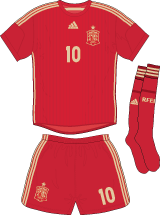
Spain Kit 1 |
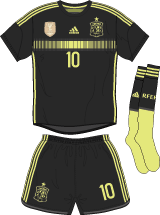
Spain Kit 2 |
Hopes of a seamless transition were dashed only two days after the selección had got back to winning ways in Luxembourg.
Needing a home win to reach the 2015 Euro U21 finals, Spain succumbed to two Serbian sucker punches in Cadiz, closing the book on a 35-game unbeaten run. In the words of the daily sports paper Marca, the youngsters relinquished their crown "like a dethroned prince." Their loss also means Spain's men will not compete at the 2016 Olympic Games in Rio de Janeiro.
Certainly, despite Spanish clubs' continued prowess in club competitions, the national team has no right to feel a sense of entitlement. As the sun has started to set on La Roja, other nations have stepped into the void and the reins of football power are changing hands once again.
Slovakia are no mugs either and rightfully occupy the top spot in Group C with maximum points from three games.
Elsewhere in Group A, the Czech Republic and Iceland have also bagged three wins on the trot, leaving World Cup semi-finalists the Netherlands languishing in third, six points behind.
And even Germany, the world champions no less, have just lost away to Poland and drawn at home to the Republic of Ireland. For the times, they are a-changing.
Spain's golden age began when the national team won Euro 2008, the same time Pep Guardiola's Barcelona got into their tiki-taka stride and the nation entered a steep recession.
Five years of global footballing dominance was not bad going for a country seemingly jinxed to underachieve for so long. And two European crowns and one World Cup will not be forgotten in a hurry.
But quite clearly, it is all over now.
Buy tickets for soccer matches around the world