
Graham Taylor & the Impossible Job
Sean O'Conor
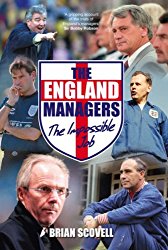
Graham Taylor, who died last week, had a distinguished club career overshadowed by four problematic years in charge of England, a remarkably rocky spell immortalised by a famous documentary.
But leaving 1990-'94 aside, his managerial record remains one of an exceptional coach.
Taylor took modest Watford up three divisions in his first spell at Vicarage Road and then up two in his second there.
Under his tutelage, the Hornets finished second in the league and were runners-up in the F.A. Cup Final. He had another second-place finish with Aston Villa, proof enough that he was an effective communicator with winning ideas.
He is still particularly treasured at Watford, where he went to great lengths to involve the local community, so that as he put it, away teams would feel like they were up against a whole town.
He did have his critics long before he managed England however.
Taylor, along with Dave Basset at Wimbledon and John Beck at Cambridge United, was one of the totemic figures of the long-ball craze which had gripped English football in the 1980's, a retrograde change of course from Liverpool's passing paradise which had conquered Europe a few years earlier.
While Lincoln manager, he was captured on camera saying how much he hated 'sophisticated football' and lamenting how the long ball was not called the long pass.
The Football Association preached the same gospel of direct and physical football, bypassing the midfield and eschewing individual technique and invention.
But that labelling now looks somewhat inaccurate given how Blackburn and Leicester won the league using swift counter-attacking and channel balls and how closing-down as close as possible to the opposition goal (gegenpressing) is used to effect by league-leaders Chelsea amongst others.
Taylor enjoyed direct play but not religiously and his teams did not merely 'play the percentages' like Wimbledon or Sheffield United. While he favoured big target men like George Reilly or Peter Crouch, he also liked penetrative wingers like John Barnes and Tony Daley and his direct Watford matured into an Aston Villa more interested in pressing and manned by fine midfielders like Gordon Cowans and David Platt.
By the time he took charge of the national team, there were no long balls to be seen, although one of his memorable outbursts in the "An Impossible Job" documentary saw him urging an unnamed England player to "Hit Les over the top!"
Although continental football was moving streets ahead of England in the 1990's with the advances of Arrigo Sacchi's Milan and Louis Van Gaal's Ajax, Taylor at least always favoured positive attacking football with the aim of turning opposition defences and getting the ball into the danger areas.
The call from England made some sense given his domestic achievements but in his four years in the job, the Three Lions were eliminated at the group stage of the eight-nation Euro '92 and failed to qualify for the 24-team 1994 World Cup finals.
A 47% win ration is not bad but he lost key matches and failed crucially to make the World Cup.
This sustained inability to match the heights of Italia '90 where England finished fourth, coupled with the tabloids' sense of invincibility meant Taylor was subjected to extreme levels of personal abuse, some of it being regional snobbery by the London-based hacks against another northern English manager following Bobby Robson.
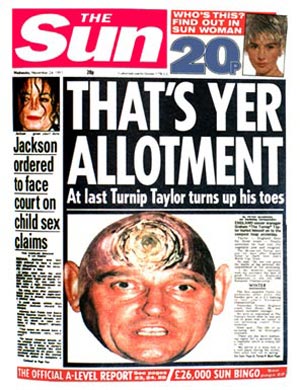
Taylor's unexpected demise however has allowed Rupert Murdoch's The Sun amongst others to perform an exquisite volte-face.
In ubiquitously praising Taylor's gentlemanly qualities the press have only magnified their immense hypocrisy, having made the former England manager's life a misery with their hyperbolic treatment of him over twenty years ago.
True, Taylor failed with England, not least in becoming the only Three Lions boss since Don Revie not to qualify for the World Cup finals, a nadir no subsequent coach has matched.
But the excessive level of printed abuse hurled at him (there was no internet in those days) not only upset England's ultimately doomed road to USA '94 but also caused a huge amount of personal distress to an intrinsically decent man.
When he struggled with Wolves after leaving England, some fans kept up the verbal tirade. After one game, the otherwise level-headed and dignified Taylor tried to perform a citizen's arrest on one assailant until the police intervened.
He also reported years after his England nightmare being attacked by two yobs in the street who threw beer over him, using the same 'turnip' tag The Sun had popularised.
Bravely Taylor went back into club management after leaving England, which had not been done before but since then has become the norm. The demanding status of the top job had been deemed to extract all remains of life from managers at the end of their careers.
Having taken Aston Villa to second in the league the year before England's glorious ride at Italia '90, and having long been friendly with the men who mattered at the Football Association, he was the favourite to replace Bobby Robson, even if many fans at the time thought him an underwhelming choice lacking the star factor of certain managers.
Terry Venables, who had coached Barcelona and had the vital knowledge of European football which Taylor lacked, might have been a better choice but F.A. Chairman Bert Millichip was sold on Taylor as soon as he had interviewed: the Worksop-born man always talked a good game, and so made an excellent pundit after retiring.
Robson had achieved more than anyone had expected in coming within a penalty shoot-out of the World Cup final which set Taylor's bar unusually high.
Wisely his first squad, for a tepid 1-0 friendly win over Hungary, was identical to Italia '90's, but he knew the honeymoon would not last.
His first qualifying competition, for Euro '92, saw six games unbeaten but only three wins. The fact that Jack Charlton's Eire managed to draw four of their six games and finish one point behind them handed Taylor a somewhat fortunate passage to the finals.
There however, England were found out, drawing twice 0-0, with Denmark and France, before losing 2-1 to Sweden and heading home with few admirers.
Later that year, qualifying for USA '94 started adequately with a draw and a win at home but then 1993 became Taylor's annus horribilis.
England threw away a 2-0 lead at home to the Netherlands in April before escaping from Poland in May with a point after a late Ian Wright goal rescued a game they really should have lost. The Poles had terrorised England and missed a hatful of chances before the Arsenal man came on as a sub to spare Taylor's blushes.
Five days later however England plumbed the depths deservedly losing 2-0 away to Norway in a crunch fixture. Not only was playing two tough away games within a few days insane scheduling, but Taylor had gambled on an experimental 3-5-2 formation with central defenders playing full-backs.
It was about the worst England performance in living memory. Yet there was no time to lick wounds as the F.A. then jetted out to the USA for a summer World Cup warm-up tournament.
Only a week after the debacle at the Ullevaal Stadium in Oslo, Taylor's England then lost 2-0 to the USA in Boston and reached rock bottom. By now Taylor was about the most hated man in England, routinely ridiculed as an imbecile in the tabloid press.
With the team nowhere near the standard expected, the manager was a sitting duck for the hacks of Fleet Street.
A confidence-boosting 3-0 home win over Poland in the autumn restored some hope before the do-or-die trip to the Netherlands arrived in October.
England fought hard in Rotterdam but nothing went their way that night. Tony Dorigo hit the post, Paul Merson shot narrowly wide, David Seaman let a Dennis Bergkamp shot slip under him and Ronald Koeman received only a yellow card for hauling down a goal-bound David Platt with a professional foul, before scoring himself at the other end.
In Taylor's final match he must have felt the gods were against him as minnows San Marino scored sensationally after seven seconds and then held their lead for twenty humiliating minutes. England won 7-1 in the end but had missed the boat to America and Taylor resigned.
Norway had risen from nowhere to win their group and qualify for the World Cup for the first time, leaving England and the Netherlands to scrap it out for the second qualifying spot.
England lost 2-0 away to the Dutch in their make-or-break match but had crucially thrown away a 2-0 lead at home to them earlier in the campaign.
They had also let slip a lead to draw 1-1 with Norway, and Taylor said those two home results sealed his fate.
Yet the Dutch had drawn twice at home too, but had a superior away record than England, bagging two more points on the road.
Both had lost in Norway but England had struggled desperately away to Poland and the Netherlands won comfortably 3-1.
There were some mitigating factors. The F.A. had also made Taylor's job harder by signing off a schedule which made them play tricky away games in Poland and Norway within the space of four days.
By 1992 England were caught between generations as well which made Taylor's task harder. Talisman Gary Lineker was waning and after the manager had openly complained about how hard it was to criticise a national treasure, he effectively retired him after Sweden '92.
This and his recorded fear of substituting Paul Gascoigne, revealed how much power the press wielded over the England manager.
At the other end of the field, Peter Shilton had gone, Chris Woods was a sub-standard replacement and David Seaman was not yet at the height of his powers.
Des Walker, so imperious in the late 1980's, had suffered a serious decline in form since an unfortunate move to Sampdoria and Gascoigne was short of fitness and form as Gazzamania took hold and he missed 16 months after his crazily self-inflicted F.A. Cup final injury.
Taylor had trouble finding a team that gelled and took to capping a host of players not of international standard such as Keith Curle, Carlton Palmer and Andy Sinton as well as fielding many of his former players.
Bizarrely and inexcusably he ignored Chris Waddle who was working wonders at Marseille, which seemed to confirm accusations of him having a little Englander footballing philosophy and suspicion of flair, an impression not helped by his dropping of Peter Beardsley.
Taylor's Watford played direct football based on the conclusions of Charles Reep and Charlie Hughes, whose 'the fewer passes the better' philosophy forced the FA to eschew ball skills and possession for years, endorsing instead what they saw as "The Winning Formula".
His England did not play a long ball game and were more akin to his Aston Villa side, but without talented or in-form senior players, his national sides never looked that convincing.
The trauma from his England disaster might have marked him for life and maybe it did but to his credit Taylor went back into club football and rarely if ever let his pain show in public.
To everyone who came across him he was an honest and well-meaning man, as all the tributes have confirmed. It is a great tribute to him that he left Aston Villa in his second spell because he refused to sign a confidentiality agreement not to criticise the club's senior management.
More recently it was alleged the F.A. lent on him not to pick too many black players for England, a plausible claim which he denied and if his player selections are anything to do by, he ignored anyway.

"An Impossible Job" - the fly-on-the-wall documentary of Taylor's traumatic England experience is still compelling viewing and possibly the best football doc yet made.
Although the protagonist comes across as an overpromoted yeoman, flailing around in deep water in desperate hope of a divine life raft, his obvious pain in the face of unbeatable odds as well as his avuncular outbursts such as "Do I not like that?" and "Can we not knock it?" won him back a lot of the public sympathy which had been lost in the previous tabloid onslaught.
The evident schadenfreude engendered by the video made people genuinely warm at last to a man who appeared all too human as the tragedy unfolded around him and his years of honest toil crumbled before his eyes.
Even if those England years defined him in the eyes of the public, the people who met him and worked with him, particularly those from Watford, will remember him as a warm and decent man passionate about his football.
To his credit, he did not let bitterness or a desire for payback get the better of him. The yeoman picked himself up, dusted himself down and soldiered on.
© Sean O'Conor & Soccerphile.com
Buy tickets for soccer matches around the world