
UK Stadiums: Pittodrie, Aberdeen, Scotland
Joji Imamiya
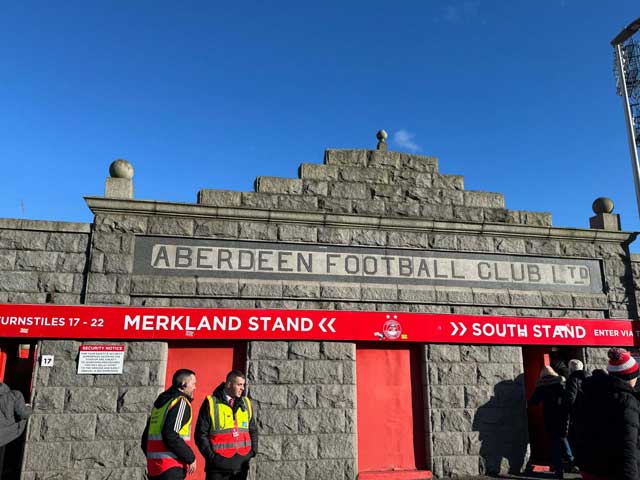
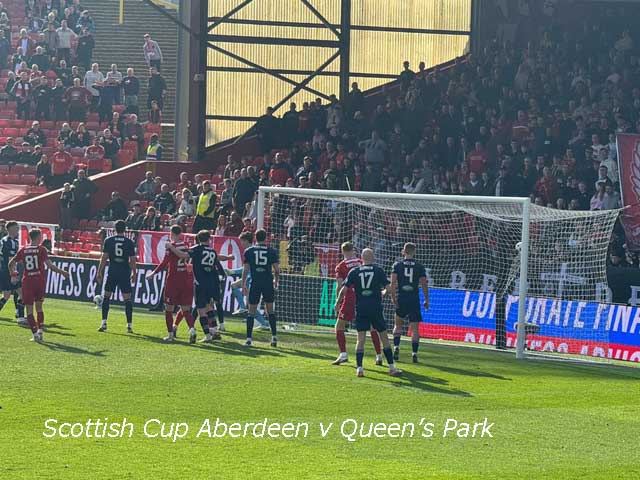
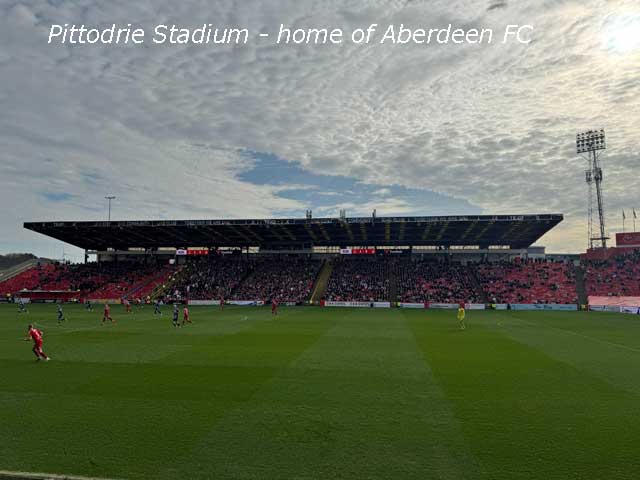
Pittodrie Stadium in Aberdeen, Scotland, is a 20,866 all-seater stadium. It is the venue of Aberdeen Football Club. Aberdeen have called Pittodrie its home since its inception. The arena is the fourth largest in Scottish club football and the largest ground in Scotland outside the Central Belt. Pittodrie has been known for innovation, as in 1978, it became the first all-seater arena in the UK.
The Scottish national football team have used the ground sporadically over the years. It has also staged rugby union matches. Inverness Caledonian Thistle were also tenants of Pittodrie during the early parts of 2004-05.
The ground is one of the coldest in the country as it is situated just 550 yards from the North Sea, with only a windswept golf course in between.

Stands
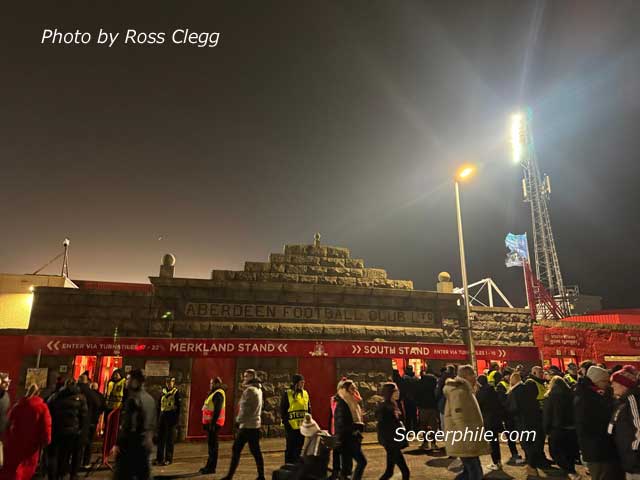
Pittodrie has four designated stands: The Main Stand, the Richard Donald Stand, the South Stand and the Merkland.
The Main Stand works as the original grandstand of Pittodrie. Almost all day-to-day facilities are located here. In keeping with the name, the stand accommodates VIP members with padded seating and the executive boxes at the rear.
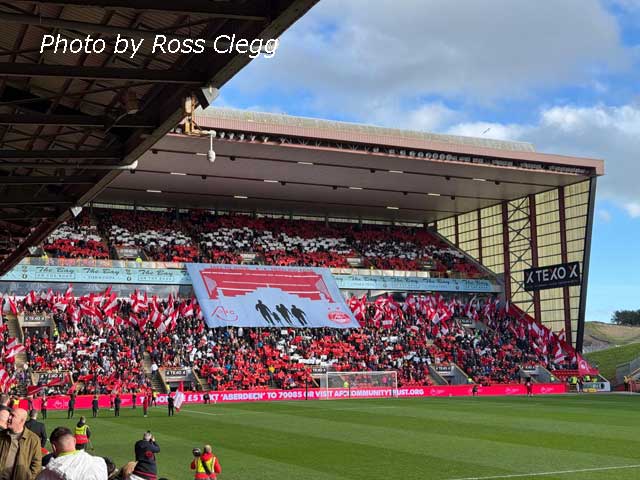
The Richard Donald Stand, often shortened to "RDS", has a capacity of 6,000. It is dedicated to the immense contributions of former chairman Dick Donald and opened in 1993. The stand also has several banqueting rooms.
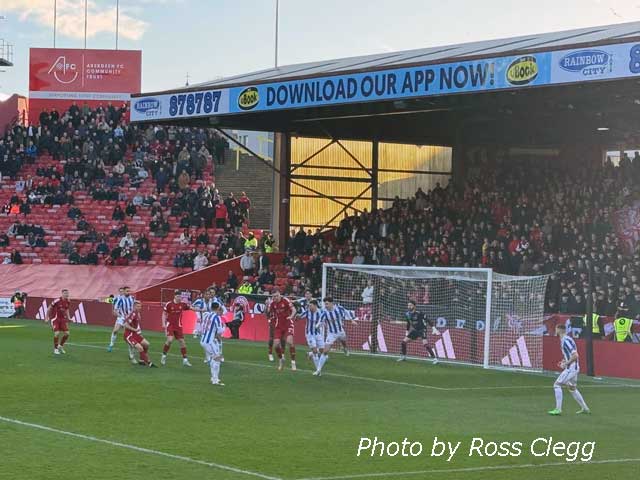
The South Stand was originally an undeveloped embankment. Although a cantilever roof has been installed, some seats are uncovered. The television gantry can be found in this section.

The Merkland is synonymous with the granite façade. This stand accommodates fans coming as a family, with cut-price deals being the norm. A section is open for disabled supporters.
True Aberdeen followers may want to join AberDNA, a membership package offered by the club. Membership will provide perks such as reduced ticket costs, and depending on the type of the deal, fans may win free replica shirts.
Aberdeen is known for its Pittodrie Pie. There are many varieties of this classic, including steak and macaroni, but the go-to for most fans is the Scotch beef stuffing. Manufacturer Thain's Bakery makes the pies without adding musk, reducing enormous amounts of fat compared to a traditional recipe. Aberdeen were the first club in Scotland to trademark a half-time meal.

Non-Aberdeen Matches
As of February 2025, Pittodrie has hosted Scotland internationals on fifteen occasions. Aberdeen was the venue for two USA '94 qualifiers, a tournament where The Tartan Army failed to qualify. Since Scotland's qualifier with the Faroe Islands for Euro 2000, Pittodrie has only seen friendlies, the last being a defeat to the Netherlands in 2017.

History
Before the current iteration of Aberdeen Football Club, there was the original Aberdeen F.C., founded in 1881. This team played in a white jersey but dissolved in 1903 after a merger between Victoria United and Orion FC to form the Aberdeen (nicknamed The Dons) we know and love today.
A year after the merger of 1903, Aberdeen's application for election to the Scottish League went through and started playing in the second tier. At the end of its first season, Aberdeen earned the right to play at the top table despite finishing seventh. The club have not relinquished their top-flight status ever since.
Aberdeen established themselves as a middling force early on, making a Scottish Cup semi-final appearance in 1908 and 1911. But by this point, Celtic and Rangers were already head and shoulders above the competition.
World War I caused financial havoc. Alongside Dundee FC and Raith Rovers, Aberdeen were to drop out of professional football in 1917, returning two years later in a match with Albion Rovers. The lack of funds meant The Dons could not sustain a challenge to take on the Scottish big boys and win a trophy. However, in 1923, Aberdeen recorded their biggest victory to date with a 13-0 trouncing of Peterhead in the Scottish Cup.
Dave Halliday
In 1937, Dave Halliday, mentioned in our Dundee FC profile, took charge as manager, but competitive football was halted soon after the appointment. Halliday etched his name into the history books by bringing the club's first trophy, a 1946 Scottish League Cup. Aberdeen then claimed another title by winning the Scottish Cup the following year, defeating Hibernian.
Hallyday ended his Aberdeen tenure with a stunning league title in 1954-55. The Dons finished the campaign ahead of Celtic with a three-point margin. Paddy Buckley was the team's top scorer with 17 league goals.
In 1965, Eddie Turnbull was in the hot seat, previously a manager at Queen's Park FC. Turnbull led Aberdeen to a 1967 Scottish Cup final, but were denied by Celtic's Lisbon Lions team by a 0-2 scoreline. Thanks to this result, The Dons qualified for their first European competition, the Cup Winners' Cup. Aberdeen were eliminated in the second round after losing out to Standard Liege.
Aberdeen got their revenge in 1970 by winning the 1970 Scottish Cup against their old rivals Celtic. In front of a raucous Hampden crowd, Derek "Cup-tie" McKay became the hero by scoring half of the four goals he recorded as an Aberdeen player. The other two goals came in the quarter and semi-finals of the cup run. Aberdeen entered the Cup Winners' Cup once again but faced a challenging opponent right from the off in the shape of Budapest Honvéd. The tie finished 4-4, with the away goal rule unable to separate the teams. It meant Aberdeen were involved in a first-ever UEFA competition penalty shootout, coming out as losers. Bertalan Bicskei scored the winning penalty as Honvéd emerged victorious 5-4 (on penalties).
Alex Ferguson
The greatest era for the club coincided with Sir Alex Ferguson's tenure as manager. Fergie's first season, 1978-79, had many close calls, chiefly the League Cup final versus Rangers. Colin Jackson and Alex MacDonald were on the scoresheet for the Glaswegians as Aberdeen failed to claim a trophy. That all changed the following season as The Dons were crowned league champions for the second time.
Aberdeen had a fascinating mixture of up-and-coming young talent and experienced professionals. For Ferguson's first league title, he deployed the legendary Bobby Clark, but Jim Leighton was waiting on the sidelines, hoping for a chance. The team had a solid defence with the presence of captain Willie Miller, accompanied by Alex McLeish and Stuart Kennedy. The midfield had a terrific balance due to the midfield partnership of John McMaster and Gordon Strachan. A young Steve Archibald, soon to play for Tottenham and Barcelona, added flair to their attack.
1982-83 Cup Winners' Cup
The 1982-83 Cup Winners' Cup is Aberdeen's most cherished memory. Having qualified for the competition after claiming the Scottish Cup the previous campaign, Aberdeen faced Swiss side Sion in the first round. The Dons won the tie 11-1 on aggregate, later eliminating Dinamo Tirana and Lech Poznan. The quarter-final with Bayern Munich is the stuff of legend. Aberdeen secured a commendable 0-0 draw at the Olympiastadion in the first leg in Munich. The return match started badly, with the home side conceding a long ranger from Klaus Augenthaler. Bayern had talented individuals, especially in the forward line, with Karl-Heinz Rummenigge and Dieter Hoeness looking menacing. The Bavarians had looked like they were on their way to the semis when Hans Pflügler drilled in an excellent left-footed volley to make it 2-1 with fifteen minutes remaining. But this was Aberdeen's day, with two goals in 120 seconds, the winner coming from John Hewitt accomplishing a giant-killing.

Aberdeen brushed aside Belgian outfit Waterschei and had reached the last obstacle, a final against Real Madrid at Ullevi in Gothenburg, Sweden. Before the match, Aberdeen suffered a setback, losing Stuart Kennedy from a severe knee injury he sustained in the semi-final. Unbeknownst to Kennedy, the injury meant he would never play professional football again. Aberdeen opened the scoring only eight minutes in, but Madrid icon Juanito soon brought the Spaniards level. John Hewitt yet again delivered the winner in extra time after meeting a lifted Mark McGhee cross.
That win in Sweden earned the right to play Hamburger SV, the 1983 European Cup winners, in the UEFA Super Cup. Led by Ernst Happel, HSV were the favourites over the two legs, but The Dons' solid rearguard repelled captain Felix Magath and co. Goals from Neil Simpson and McGhee secured a second UEFA trophy in one calendar year. No other Scottish side has won two European competitions.

1990s
Scottish football in the 1990s was dominated by one club, Glasgow Rangers. Although Aberdeen struggled to recapture the magic from the 80s, it was a decade marked by some trophies. 1989-90 finished with two cup wins, defeating each of the Old Firm. 1994-95 was grim viewing for the supporters, finishing second bottom in the league and contesting a playoff versus Dunfermline Athletic to escape relegation. The Dons won both legs 3-1 to avoid what would have been a humiliating experience.
Aberdeen hired Danish manager Ebbe Skovdahl as coach in 1999, the first time a non-Scot took charge of the club. The Dons finished dead last in the league, but luckily an expansion was taking place, meaning they had to go into a three-team playoff. Falkirk, one of the sides taking part, did not meet the Scottish Premier League standards regarding their stadium capacity, and Aberdeen escaped unscathed.

Ex-Manchester United player Steve Paterson replaced Skovdahl following the Dane's resignation, but his spell was marred by crippling alcoholism. He failed to turn up at the dugout in a fixture versus Dundee in March 2003 after a session of binge drinking the night before.
2009-2013 Seasons
2009 to 2013 was a struggle, never finishing higher than 8th in the league. But fortunes changed drastically after the appointment of Derek McInnes in 2013. McInnes brought Aberdeen their first trophy in the 21st century, a Scottish League Cup in 2014, by getting the better of Inverness CT on penalties at Celtic Park. Aberdeen finished second in the SPL for four seasons straight from 2014-15, finding the might of Celtic too much to overcome.
These successes made supporters dream of Europa League adventures but saw elimination in the third qualifying round four times in a row. After ending in second place again in 2017-18, Aberdeen took on Burnley for the second qualifying round of the Europa League the following campaign. The first leg at a packed Pittodrie ended 1-1, with Sam Vokes rescuing the Clarets with a late equaliser. The tie went into extra-time at Turf Moor in the return match, Lewis Ferguson cancelling out Chris Wood's opener. The quality of the Premier League side told in the end, however, with Burnley winning 3-1 on the night.
A strategic alliance between The Dons and Atlanta United was formed in November 2019, as the MLS outfit bought a less than 10 per cent stake for US$2.57 million. The then-Atlanta president Darren Eales became part of the board of directors at Aberdeen.
The 2020s in the Scottish Premier League have been characterized by instability, with managerial merry-go-rounds being the norm. The situation got so dire for the latter half of 2023-24 that the club sought the services of Neil Warnock on an interim basis, managing a Scottish side for the first time in his career.
Players
Aberdeen fans made their thoughts clear about the greatest players discussion in a November 2015 "best team" vote.
The most recent entry was centre-back Russell Anderson, who had two spells at Pittodrie. Anderson featured for over 300 games in his first term and captained his side for four years from 2003 before his transfer to Sunderland. He became Aberdeen's sixth captain to lift silverware when The Dons defeated Inverness to win the 2014 Scottish League Cup.

Jim Leighton was Scotland's best goalkeeper in the 1980s and 90s. He was the first choice for The Tartan Army in World Cup '86, '90 and '98. Sir Alex Ferguson, who rated Leighton highly, acquired his services for £750,000 in 1988. After unsatisfying loan spells at Arsenal, Reading and Sheffield United, Leighton thrived back in Scotland with Hibernian. He later ended his career at Pittodrie.
Gordon Strachan was another of Ferguson's favourites. He was signed by Aberdeen from Dundee FC as a promising youngster. A technically gifted player, he was capable of holding possession in tight spaces. The Edinburgh native was an integral part of Leeds' top-flight winning team in 1991-92. As a manager, Strachan won three Scottish Premier League titles at Celtic and led Southampton to the 2003 FA Cup Final, losing to Arsenal 0-1.

Access - Getting To Pittodrie
The ground is 33 minutes away from Aberdeen train station on foot. Buses to the ground depart from Union Street.
The 33 bus service will drop visitors at Golf Road, with Pittodrie visible on the left. Services 1, 2, and X40 will take fans to King Street.
As a general rule, parking near the stadium is reserved for disabled badge holders only.
Aberdeen Station has services to Edinburgh Waverley Station via Dundee Station, Glasgow Queen Street in Glasgow via Dundee, Perth and Stirling and Inverness via Keith and Elgin.
There are also trains to Euston Station in London from Aberdeen via Preston and Crewe as well as services to London King's Cross via Newcastle and York Station in York. Trains to Plymouth go via Haymarket in the Scottish capital, Edinburgh.
Additionally, Aberdeen has one train per day to Leeds.
Address: Pittodrie Stadium, Pittodrie Street, Aberdeen AB24 5QH, UK

Nearby Hotels
If you wish to stay in Aberdeen try the 4-star Sandman Signature Aberdeen Hotel & Spa, located on St Andrew Street. Also highly-rated are the Leonardo Hotel Aberdeen in Union Square and the 3-star Britannia Hotel Aberdeen.
See here for a complete listing of hotel accommodation in Aberdeen.

More UK Stadiums
Kirklees Stadium (John Smith's Stadium)
Photographs of Pittodrie



©Soccerphile.com
Buy tickets for soccer matches around the world