
UK Stadiums: Tannadice Park, Dundee, Scotland
Joji Imamiya
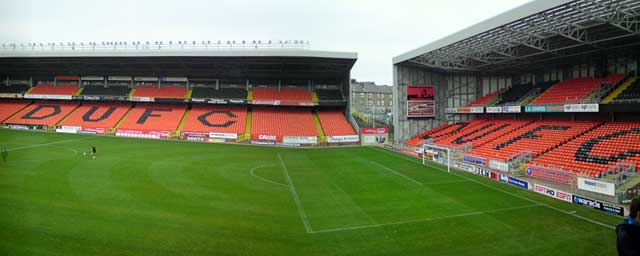
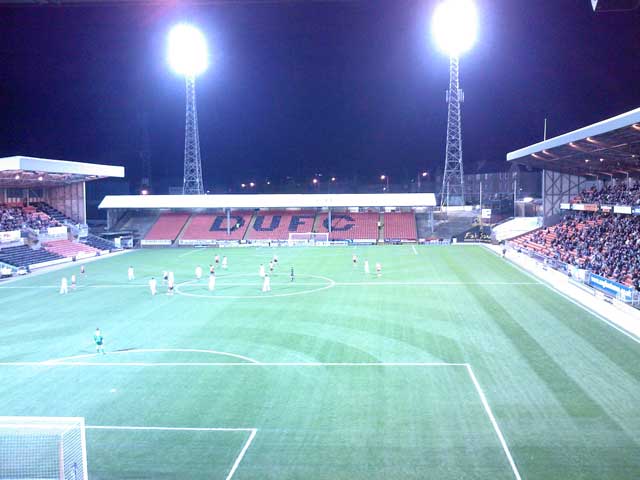
The 14,223-capacity Tannadice Park (known as the CalForth Construction Arena for sponsorship reasons) is the home of Dundee United in the Scottish Premier League. Known as Clepington Park in its earliest days the site first staged football way back in the 1870s making it one of the oldest grounds in Britain. Dundee United (then known as Dundee Hibs and representing the Irish community in the city) began playing games at the ground in 1909. The club changed its name to Dundee United in 1923. Major renovations took place at the venue in the wake of the Taylor Report in the 1990s.
Stadium Overview
The ground that would become Tannadice was initially Clepington Park, with the surrounding area largely being open countryside. The first club to claim the land as its regular home was Dundee East End, the antecedent of Dundee FC, in July 1882. The club would soon move to Madeira Park, however.
By the mid-1890s, the area had grown increasingly urbanised, with a distinct street layout beginning to take shape. Streets like Provost Road, Arklay Street, and Clepington Road came to define the unique character of that part of the city. The name "Tannadice" comes from the Neish family of Tannadice and Clepington, who had owned the land. Their legacy is also commemorated on Neish Street.
In 1891, Johnstone Wanderers FC, a club that would fold three years later, decided to enclose Clepington and install a modest grandstand. It was a simple wooden structure that had a capacity of less than 500.
Johnstone Wanderers merged with Strathmore FC to form Dundee Wanderers FC in 1894, and quickly applied for Scottish Football League membership. It meant Clepington Park was to host a professional match, with Motherwell being the visitors on 25 August 1894. Dundee Wanderers fared poorly at the top level and dropped a division as they were not elected. The construction of Dens Park, approximately 200 yards away, created more problems for Wanderers, as competition for local engagement became fierce. Other than the grounds of BKV Előre SC and MTK in Budapest, no two grounds are as closely located as Tannadice and Dens Park.
Stadium Stands
Tannadice has been an all-seater venue since 1994. Depending on who you ask, the ground has either four or five stands.
The Jerry Kerr Stand: Built in 1962, it is the first cantilevered stand at a football ground in Scotland. Famous for its unique L-shaped construction, the stand was the only seated area before the post-Taylor Report redevelopment began. Until 2003, it was simply known as the Main Stand but was renamed to pay respects to the achievements of Jerry Kerr, who had a 12-year association with the club as manager. Kerr was also on the books as a player from 1939 to 1947. The stand usually houses away supporters.
The Jim McLean Fair Play Stand: Although Wikipedia lists the stand as a separate entity, it is in effect an extension of the Jerry Kerr Stand. Unless United face the big boys of the Scottish Premiership, the Jim McLean stand is big enough to house the away supporters. It is named after Jim McLean, the most beloved figure to take charge as manager.
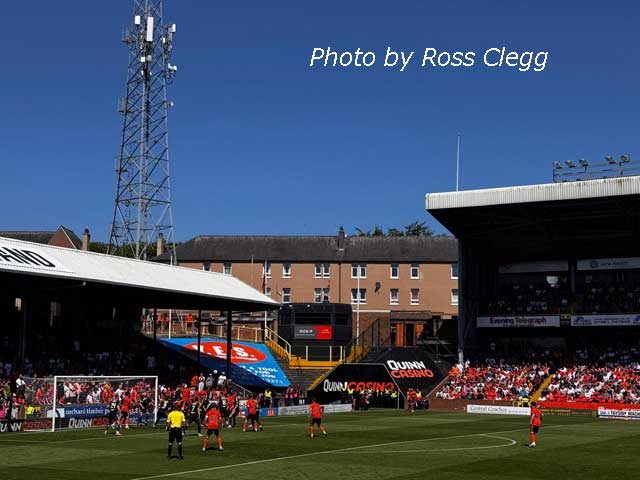
The West Stand: Referred to by its historic nickname, The Shed, this stand still holds the original roof constructed in 1957. Though seating has been added since 1994, some of the terracing is visible. The Shed has a flexible nature, accommodating home or away fans depending on the fixture.
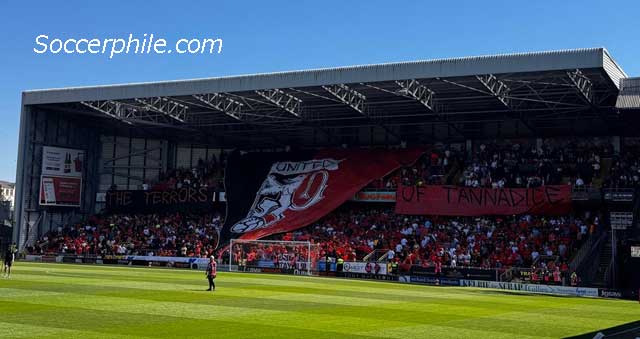
The George Fox Stand: Named in honour of a long-serving club director, this two-tier stand was constructed during the 1991-92 season along the north side of the ground. It marked the first phase of Tannadice Park's transition to an all-seater stadium. It is designated for home supporters.
The Eddie Thompson Stand: It has a similar design to the adjacent George Fox Stand. The stand is named after Eddie Thompson, the chairman who bought the club in 2002 until his death in 2008. He earned his wealth by founding the convenience store chain Morning, Noon and Night in 1991. He sold the company for £30 million in 2004. Thompson was awarded the OBE in June 2005 for his contribution to the Scottish grocery industry.
Rivalry with Dundee FC
Scotland's fourth-largest city has two clubs based yards away from each other. Dundee FC's Dens Park is just 200 yards from Tannadice. This makes the two stadia the two closest senior football grounds in Britain. Dundee FC have a longer history, as Dundee United came to being in 1909 after Dundee Harp dissolved. Although United's origins stem from Irish immigration, sectarianism is not an issue in this fixture.
Dundee FC had more prestige in the early stages, winning one Scottish Cup and three League Cups before United won anything major. But as Jim McLean entered the fray in the United dugout, fortunes changed dramatically. In 1983, United secured their only top-flight title to date and established themselves as a major domestic force alongside Aberdeen. Aberdeen and United earned the title of "New Firm," a new era seemingly dawning in Scottish football.
The two clubs have a combined hooligan "firm" named the Dundee Utility, established to take on the larger firms in Edinburgh and Glasgow.
United overwhelm Dundee FC head-to-head, winning 82 matches compared to the Dee's 50.
Stadium Miscellaneous
As of July 2025, the official record attendance at Tannadice is 28,000 for a fixture between Dundee United and FC Barcelona in the Inter-Cities Fairs Cup in November 1966. It was United's home debut in a European tournament.
Over the decades, Tannadice has undergone significant transformations. In 1962, the Main Stand (now the Jerry Kerr Stand) was constructed, notable for being Scotland's first cantilever stand, allowing unobstructed views without supporting column. It is named after a former manager of the club.
Subsequent developments included the George Fox Stand (named after a former chairman of the club) in 1992, the East Stand (renamed the Eddie Thompson Stand in 2008 after a former player and manager of the club) in 1994, and the Jim Mclean Fair Play Stand in 1997, culminating in an all-seater stadium.
Jim Mclean is another former manager of The Terrors and 'Fair Play' is a reference to FIFA recognizing the Dundee United's fans behaviour in the 1987 UEFA Cup final with the first-ever Fair Play award.
The West Stand aka The Shed retains its original 1957 roof.

Early Club History
The establishment of Dundee United stems from the desire of the Irish community to have a team representing their identity. The club that would fulfil this desire was Dundee Hibernian. The club's first manager, Pat Reilly, was instrumental in the formation. Dundee Hibernian was officially established on 24 May 1909, at which point the club assumed the stadium lease and promptly renamed Clepington Park as Tannadice Park.
Dundee Hibs applied for membership of the Scottish League in 1909, but it was denied. They had to spend a season in the Northern League, which was a successful campaign, winning the Carrie Cup, a trophy contested by teams from Forfarshire. Their application was accepted in June 1910, starting a new chapter against Leith Athletic in a home game.
The commencement of The Great War ended the Scottish Leagues temporarily, and Dundee Hibs humbly continued their football in the Eastern League, but that too was abandoned in 1918. After the war, the club hoped to participate in the Scottish League, but since the re-instated league was only for the top level, Dundee Hibs had to find a league that would welcome them. The club competed in the 1919-20 Eastern League.
Hibs rejoined the Scottish League in the summer of 1920, but following the league's decision not to modify the promotion/relegation rules, the club broke away once again with other second-tier teams and entered the independent Central League. A year later, the Scottish League at last relented and re-formed the second division. For the first time, automatic promotion and relegation were introduced. All the Central League teams were admitted into the new league. But, there was a sticking point. The bottom two teams at the end of 1921-22 would drop out, and would you know it, Dundee Hibs was one of them. The club was outside of the establishment again.
For 1922-23, the directors of Dundee Hibs were adamant about their right to be reelected, but in doing so, almost missed the boat in competing in some form of a league. Facing extinction, the club was rescued by being accepted to play in the Scottish Alliance League, which was, in effect, the reserve league for the First Division sides. While drifting in the wilderness, they eventually clawed their way back by entering the Second Division for 1923-24.

New Identity
The 1923-24 season started as Dundee Hibs but ended as Dundee United. The hierarchy decided on a name change to give the club a wider appeal. The jerseys were also switched to black and white. Initially, the name "Dundee City" was proposed, but local rivals Dundee FC fiercely opposed it. Dundee United's first match after the rebrand was against Dumbarton on 27th October 1923.
The new identity proved to be a good omen, as they won the 1924-25 Second Division. Their maiden season in the top flight ended in safety, but they couldn't survive the second campaign. The 1920s were characterised by their yo-yo nature, winning the second tier thrice in six years. An important character in this period is a man from Blantyre, by the name of Jimmy Brownlie. He signed for the Tannadice club as a player-manager in 1923 but retired from playing goalkeeper three years later. He continued his association with the team as manager until 1931. Overall, he had three separate spells at Dundee United.
During the 1930s, Dundee United never found a way to escape the Second Division slog, and due to the depravity of the Scottish economy, were on the verge of bankruptcy at the end of 1933-34. Similar to the events of the early 1920s, they were saved at the eleventh hour by local businessmen William McIntosh and George Greig.
Hope abounded after the takeover, but financial difficulties remained. Just two years later, Greig was needed again to save the club. He relieved Brownlie of his duties and took charge as coach despite having minimal on-field experience. His sole noteworthy record was as a player for Old St Stephen's during the 1890s. The two-year spell was his only managerial role.
The Mundane Life Post-WWII, but Then…
After the Second World War, Dundee United had an unexceptional fifteen-year spell in the second tier. During this period, their best achievement in the Scottish Cup was the sixth round and did not get past the quarter-finals stage in the League Cup. One of the most memorable matches at this time was a tie with Glasgow Celtic in January 1949 in the Scottish Cup at Tannadice. The home side won an entertaining match 4-3, and could have been a wilder scoreline had it not been for three cancelled goals.
Their anguish of playing second division football was over in 1959-60 after overcoming Berwick Rangers by a scoreline of goal to nil. The club installed a new manager for that season, Jerry Kerr, who emphatically overachieved. But this success wasn't owed to one person. In the 1950s, the board formed the Dundee United Sportsmen's Club, copying the playbook of Nottingham Forest. It had a specific goal of generating funds to renovate the stadium and support player acquisitions. A steady flow of income was achieved by establishing "Taypools", which served as a fund accumulator. They now had enough money to build "The Shed", a famous area in the stadium covered by a roof.
United became a solid outfit in the top flight after promotion. Admirable performances in 1965-66 guaranteed a place in the Inter-Cities Fairs Cup for the following season. The whole continent of Europe was in awe when Barcelona were dumped out in the second round. The Terrors took on the might of Juventus next, but the Italian side did a professional job on the Tayside team. Still, the recognition they received from that performance got them a spot in the North American Soccer League to participate as the Dallas Tornado after an invitation. This experience was profound, as the club changed its colours to tangerine and black to pay homage to the Texas club.
Dundee United competed in the 1969-70 Fairs Cup but were outmanoeuvred by holders Newcastle United in the first round. The following campaign, which was the competition's last, also ended in disappointment after losing out to Sparta Prague in the second round.

Jim McLean's Arrival
The club ventured into a new era after Jim McLean replaced Kerr in December 1971. McLean emphasised the importance of youth development, but actively recruited senior players in the transfer market. Their progress was evident in 1973-74 when they reached the Scottish Cup final. In the showpiece match, United were unsurprisingly outclassed by a Celtic team brimming with individual talent. The squad containing Billy McNeill, Jimmy Johnstone and Kenny Dalglish was too strong for the underdogs.
After finishing fourth in the previous season, Dundee United had a chance to leave a mark in the 1975-76 UEFA Cup. But their European adventure was short-lived, as they were unable to overcome FC Porto.
From 1977 to 1979, the Tannadice club got third place twice in a row and became regulars in the UEFA Cup.
1979-80 will forever be a season to remember. United got their hands on a major trophy, in the form of the League Cup, for the first time by defeating Aberdeen after a replay. The initial match at Hampden Park was goalless, but the second game played in their home city, albeit at Dens Park, was a joyous occasion thanks to a brace from Willie Pettigrew and an effort from Paul Sturrock to ensure a 3-0 win. They retained the trophy the year after by defeating Dundee FC at their own backyard by the same scoreline in the final.
United were on the cusp of achieving an amazing three-peat at Hampden versus Rangers, but it was not to be, as late goals from Davie Cooper and Ian Redford secured the Glaswegian side their customary trophy. Although this result meant United were to be trophyless for 1981-82, the run to the quarters in the UEFA Cup gave them a belief that they finally deserved a seat amongst the big boys of European football. There were some iconic games, including a 5-2 hammering of AS Monaco at Stade Louis II in round one, and the five-star display in the second round versus Borussia Monchengladbach. FC Winterslag of Belgium, now known as Genk, looked to be tricky opposition after a 0-0 draw in the first leg in round three, but they were also dispatched 5-0 in United's home leg. Their dreams were shattered in the following round after their 2-0 first leg advantage was overturned at Čair Stadium against Radnički Niš.
The True Glory Days
The 1982-83 season yielded the same result in the UEFA Cup, eliminated at the quarters by succumbing to Bohemians Praha 1905. But that disappointment can be forgotten because it is still to this day the only time when the club were crowned league champions. Dens Park continued to be a happy hunting ground as they secured the championship at this ground on the final day by winning 2-1 against their fiercest rivals. The Scottish football landscape was shifting thanks to the emergence of United and Aberdeen, together dubbed the "New Firm".
United showed they had the mettle to compete at the biggest stage in the 1983-84 European Cup (now the Champions League). After brushing aside Hamrun Spartans and Standard Liege, they went toe-to-toe with Austrian powerhouse Rapid Wien. United scraped through on away goals. The semi-final against AS Roma was an ill-tempered affair, but United deservedly earned a two-goal advantage going into the second leg at the Stadio Olimpico. Roma, who were desperate to reach the final played at their home turf, turned on the screw. United's lead evaporated before the interval after a brace from Roberto Pruzzo. The capital club went ahead on aggregate when Agostino Di Bartolomei scored a penalty thirty minutes from time. The Scottish side cried foul play, but their appeals, especially from SFA secretary Ernie Walker, went unheard. Had United won the tie, they would have faced Liverpool, who ultimately won the competition.
From the start of 1983-84 until the end of 1986-87, United ended in third place four times in a row. The Tayside club reached multiple finals and semi-finals in domestic cup competitions, but none of them produced that elusive trophy. Always the bridesmaid, never the bride, United sensed they could change their trajectory in the 1986-87 UEFA Cup. After dumping RC Lens and Universitatea Craiova out in the earlier rounds, they faced Hajduk Split in the third round. Their Croatian adversary featured a group of young and dynamic talents, most notably Robert Jarni and Aljoša Asanović. A goal each from Jim McInally and John Clark secured a 2-0 home win in the first leg and ground out a 0-0 draw away at Stadion Poljud. Next came the Catalan giants FC Barcelona.
Barcelona
The La Liga club had familiar names for a British audience during this period. Led by Terry Venables, they could count on the goals of Mark Hughes and Gary Lineker, while Andoni Zubizarreta served as a reliable presence between the sticks. United ripped the script by winning both ties, famously keeping their 100% record against them. Venables was fired at the start of the following campaign. After that result, Borussia Monchengladbach stood between United and the final. The German side did not have the allure they once possessed in the late 1970s and early 80s, but they were nonetheless a respectable team. Although they were coached by Jupp Heynckes, who is noted for his ability to bring the best out of his attacking players, they couldn't muster a goal in the tie. A shocking 2-0 win for United at the Bökelbergstadion confirmed their place in the final.
The first leg of the showpiece occasion against IFK Göteborg took place at a packed Ullevi, where the Allsvenskan side emerged victorious 1-0. Göteborg may not be a household name compared to the likes of Barcelona and Monchengladbach, but they had an impressive European pedigree, having won the 1982 final of the same competition against Hamburger SV. Premier League fans of the 1990s will probably recognise the names of captain Glenn Hysén and Roland Nilsson, but there is no doubt the team was built on cohesion, not individual brilliance. A 1-1 draw at Tannadice was enough for Göteborg to claim their second title. United had to settle for a consolation prize, with UEFA giving them the Fair Play award.
Can't Buy a Win
The Terrors reached the 1988 Scottish Cup final. But they were punished by a sharp two-goal performance from Celtic's Frank McAvennie, extinguishing United's lead that they gained when Kevin Gallacher scored early in the second half.
United came second again in the 1991 edition of the Scottish Cup final. Their match with Motherwell is considered one of the best games ever to be played at Hampden, but that title doesn't mean much to United fans because they lost 3-4 after extra time.
McLean Departs
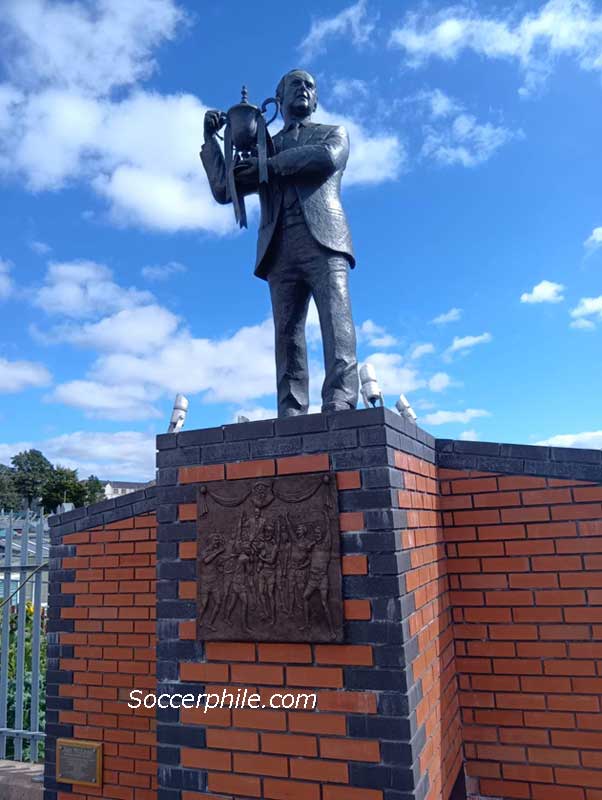
Jim McLean, who built a dynasty, handed over the managerial reins to Ivan Golac. The Serbian was the first non-British man to take charge as boss. He adapted to British football as a player by featuring for Bournemouth, Manchester City and most famously Southampton, where he had two spells. Bizarrely, he was sent on loan to rivals Portsmouth whilst playing for Southampton at the end of his career. He brought home a trophy, something they hadn't achieved since winning the top flight. Golac's first season in charge was to be evaluated in the 1994 Scottish Cup final against Rangers. Craig Brewster's goal and some heroic defending from Gordan Petrić ensured the end of the trophy drought.
However, United were brought back down to earth the following season, finishing bottom and having to play second division football. United couldn't keep up with Dunfermline Athletic in the title race, so they had to settle for the playoff spot. The tie against Partick Thistle was edgy throughout the two legs, both games ending 1-1. It was to be decided at Tannadice in extra time in the second leg, with Owen Coyle coming up with the goods. The Tangerines had achieved immediate promotion.
The 1996-97 season was a positive one. They finished third in the league, qualifying for the preliminary stages of the UEFA Cup and reached the semi-finals of the Scottish Cup. Their path to the final was obstructed by eventual winners Kilmarnock after a replay. It was a remarkable campaign by all accounts, especially considering United were languishing in second bottom, but the appointment of Tommy McLean proved to be smart. He acquired multiple Scandinavian players in the winter market, and the club became upwardly mobile.
The UEFA Cup in the following season started easily enough, demolishing CE Principat of Andorra 17-0 on aggregate. The opposition in the second round, Trabzonspor, were a much harder test. Hami Mandıralı proved to be the hero in both legs as the Turkish club won 2-1 on aggregate.
Silverware was on the line in the 1997 Scottish League Cup final at Ibrox Stadium, but they were brushed aside by Celtic 0-3. Henrik Larsson, unsurprisingly, was amongst the goals.
The late 1990s and early 2000s were a period of struggle, finishing second bottom in the league in 1998-99 and 2000-01.
The Unremarkable 2000s
Dundee Utd toiled through 2004-05. Ian McCall failed to find his team any sort of form, winning just three matches before the turn of the year. With The Tangerines facing impending doom, they looked to Gordon Chisholm. The turnaround was staggering, losing only one game from 12 April. They also got to the final of the Scottish Cup, seeing off Aberdeen and Hibernian on the way. A goal in the 11th minute from Celtic's Alan Thompson was sufficient to give Martin O'Neill the perfect send-off.
Despite poor results in the league, that cup run gave United a place in the preliminary rounds of the 2005-06 UEFA Cup. They were defeated by Finnish side Myllykosken Pallo -47 on away goals, a truly disappointing episode.
United were teetering on relegation many times during this period, but the hiring of Craig Levein steadied the ship. His accomplishments caught the attention of the Scottish FA, and he left the post in December 2009. His replacement, Peter Houston, filled the void admirably, winning the Scottish Cup at the end of the season by beating Ross County 3-0 in the final.
Testing the Waters in Europe
Excitement was palpable when they played AEK Athens in the 2010-11 Europa League Play-Off. Algerian striker Rafik Djebbour's early effort made United's task even harder going into the second leg at the Karaiskakis Stadium. It was played at the home of Olympiacos instead of the Olympic Stadium of Athens after UEFA deemed the playing surface unsuitable for football. The tie was to be played at the Nea Smyrni Stadium originally, but Panionios ultras vandalised the venue in protest. Panionios see AEK as bitter rivals. United's away game finished 1-1, so the dream of playing in the group stage was over.
United's Europa League adventure for 2011-12 started at the second qualifying round, but it was a short-lived experience. Śląsk Wrocław won the tie on the away goals rule.
They got their chance again in 2012-13, but had to overcome a strong Dynamo Moscow team. The first leg at home was marred by violence. Fisticuffs between the two sets of fans were seen in the corporate area and on the pitch level. Nonetheless, the game continued, with the sides having to share the spoils in a 2-2 draw. The return match at Arena Khimki was a lot more one-sided. Two Aleksandrs, Sapeta and Kokorin, dazzled for Dynamo in a 5-0 thrashing.
A Damning Relegation
Disaster struck in 2015-16. Poor early-season results gave the board no choice but to terminate Jackie McNamara's contract and install ex-Finland striker Mixu Paatelainen. Japanese goalkeeping icon Eiji Kawashima was signed in the winter to bolster the squad, but his performances were mixed. Ultimately, Dundee United couldn't escape bottom place and were in the second tier for the first time in two decades.
United were consistently one of the better sides in the second division, but promotion escaped them between 2016 and 2019. In 2019-20, in no small part due to the goals of Lawrence Shankland, The Terrors clinched first place. United achieved fourth place in 2021-22, earning a ticket to the 2022-23 UEFA Conference League. Their first challengers were AZ Alkmaar in the third qualifying round. After an impressive 1-0 home win, they were thumped 0-7, equalling the biggest loss in Europe for a Scottish team. This result, perhaps, should not be treated as a surprise considering AZ had Vangelis Pavlidis, Tijjani Reijnders and Bruno Martins Indi in their ranks.
The 2022-23 domestic campaign was overall difficult to endure, with the team finishing at the bottom of the table. Instant promotion was achieved by winning the 2023-24 Scottish Championship.

Players - Club Icons
Paul Hegarty started his professional career at Hamilton Academical, but was scouted by Jim McLean and signed for United in November 1974 for a fee of £27,500. Pairing up with Dave Narey as a centre-back, the two became an indispensable part of the solid United defence. Hegarty contributed immensely to the club's first major trophy, the 1979-80 Scottish League Cup. The Terrors would retain the title the following season. The Edinburgh-born player was indispensable in the 1982-83 Scottish League Premier Division, the only time the club reached the Scottish summit. He was part of the 1986-87 squad that made it to the UEFA Cup final, but did not feature in the showpiece tie against IFK Göteborg.
Another defender who deserves a mention is Maurice Malpas. Scouted at a young age, Malpas is Dundee United through and through, although his first club as a youth player was Dunfermline Athletic. He has a cerebral side to his character, initially pursuing an electrical engineering degree at Dundee College of Technology (now Abertay University), only turning fully professional in 1984, five years after signing for the club. Malpas enjoyed many memorable moments, but perhaps he would be most proud of leading his team as captain in the 1994 Scottish Cup final win against Glasgow Rangers at Hampden Park.
The one-club man also left an admirable legacy for his national team, featuring in the 1986 and 1990 World Cups and was part of the squad for Euro 92 in Sweden. He ultimately collected 55 caps, meaning no player has achieved as many whilst playing for Dundee United.
Club Miscellaneous
"Dundee United", or "Dundee", is often a Nigerian slang term for describing an idiot, especially common in the north. There are a few theories as to how it became a word that has been in usage for decades. The most popular theory is based on Dundee United's calamitous West Africa tour in May and June of 1972. They only pitted their wits against small teams, but their record was mediocre at best. They started with a 2-2 draw with Stationery Stores, followed by a 1-0 win against Benin Vipers. But this was as good as it got. United succumbed to Enugu Rangers, in front of 35,000 spectators, then tied with Mighty Jets. They rounded off the tour with an embarrassing 1-4 loss against Stationery Stores.
Reports suggest it was an idea conceived by previous coach Jerry Kerr, but by the time the tour took place, Jim McLean had been in charge for five months. Although McLean was not keen to travel, he did not have enough time to cancel the arrangements.
By the end, there was some tension between United and the Nigerian football community. United forward Kenny Cameron pointed out the many possible reasons for their insipid performances, but once he claimed they were met at the airport by "vultures and hyenas", the patience of the Nigerians had run out. Local media such as New Nigeria and The Renaissance were unrelenting in their criticism of the club, accusing them of degrading Nigerian football and dignity.
This humorous trivia was covered in both The Guardian and the BBC.
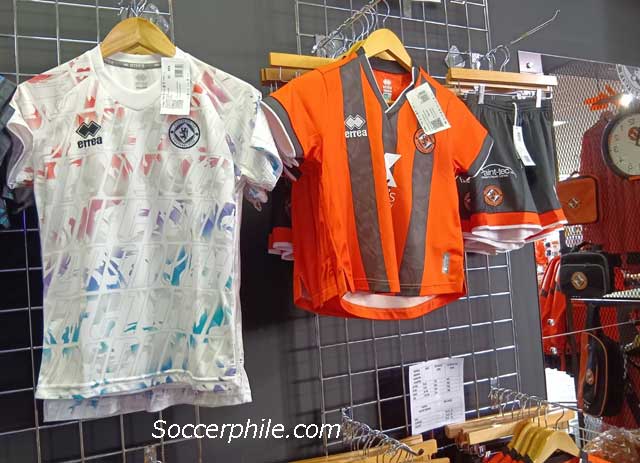
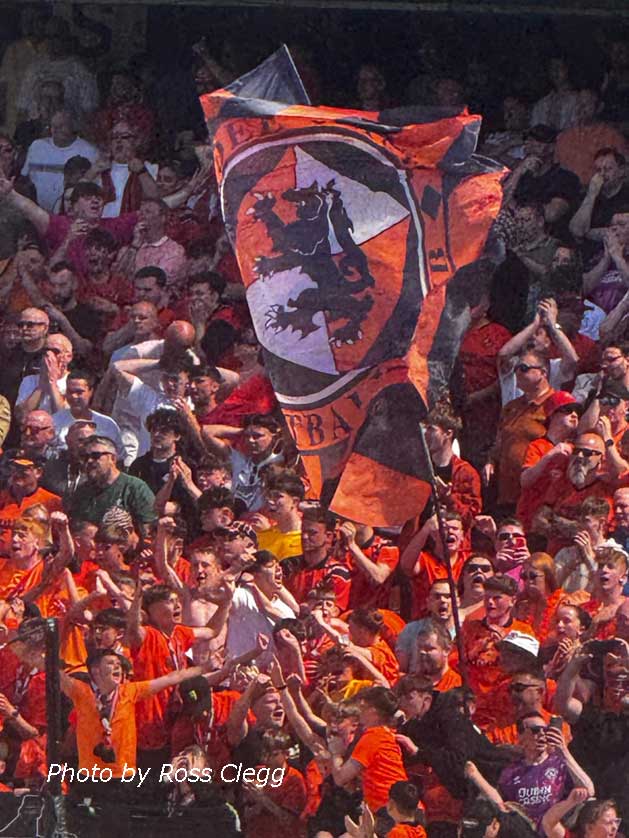
Dundee United are nicknamed 'The Terrors' or 'The Tangerines' (after their orange kit). The club's supporters are often referred to as 'Arabs'. The nickname 'Arabs' stems from a time when the team played on a Tannadice pitch covered in sand.
Major Honours
Leagues:
Scottish Premiership:
Winners in 1982-83
Scottish Championship:
Winners in 1924-25, 1928-29, 2019-20, 2023-24
Cups:
Scottish Cup:
Winners in 1993-94, 2009-10
Runners-up (8): 1973-74, 1980-81, 1984-85, 1986-87, 1987-88, 1990-91, 2004-05, 2013-14
Scottish League Cup:
Winners in 1979-80, 1980-81
Runners-up (5): 1981-82, 1984-85, 1997-98, 2007-08, 2014-15
The European Cup:
Semi-finalists in 1983-84
Accessibility
The club offers disability season tickets for both wheelchair users and ambulant fans. To buy a disability season ticket, applicants must receive Adult/Child Disability Payment Scotland at the Enhanced rate. In Scotland, there are two levels of support available under the Adult or Child Disability Payment schemes. This means not all people with disabilities will qualify for a season ticket. To apply or for further details, please contact Moira Hughes in the DUFC ticket office on (01382) 833166 or email moira.hughes@dundeeunitedfc.co.uk.
There are fourteen wheelchair spaces in the George Fox Stand Lower and eleven in the Eddie Thompson Stand, but acquiring a place here is virtually impossible as there is a long waiting list. If you plan to attend a game on a one-off basis, please apply in advance to ensure suitable access.
The lower tier of the George Fox Stand is where visually impaired supporters are accommodated. Commentary is available in all areas of the ground. The service is provided by the Dundee Blind and Partially Sighted Society (Tel: 01382 227101).
Access - Getting To Tannadice Park
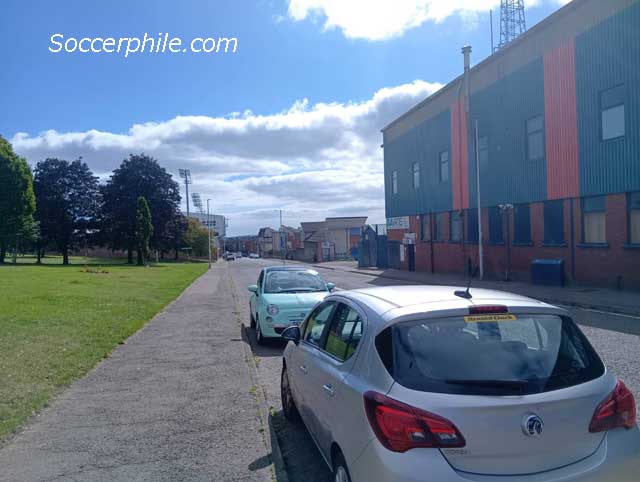
There are restrictions on parking in the vicinity of the stadium. But blue badge holders can park in designated locations on the east side of Provost Road between Sandeman Street and Dens Road.
If you are arriving via Dundee Station, the most straightforward path is to get on board the Line 22 bus service to Strathmartine Road and walk from there to the ground. Other convenient buses from the center include the 2, 18, 20, 23 and 5A services.
Dundee railway station has trains to King's Cross Station in London from Aberdeen via Edinburgh, Newcastle and York Station in York as well as more local ScotRail trains to Glasgow Queen Street in Glasgow via Perth and Stirling as well as connections south to Edinburgh Waverley Station and Haymarket in the Scottish capital, Edinburgh.
There are also trains to Leeds, Birmingham, Bristol Temple Meads, Aberdeen, Arbroath, Broughty Ferry, Dumbarton Central, Falkirk High, Galashiels, Inverkip, Kilpatrick, Lanark, Prestwick Town, Pollokshaws East, Prestonpans and other destinations.
Address: Tannadice Street, Dundee DD3 7JW, UK

Nearby Hotels
If you wish to stay in Dundee try the Sleeperz Hotel Dundee, located directly above the train station with three stars and views of the V&A Dundee. Also recommended are the Malmaison Dundee and Holiday Inn Express Dundee.
See here for a complete listing of hotel accommodation in Dundee.
More UK Stadiums
Kirklees Stadium (John Smith's Stadium)
©Soccerphile.com
Buy tickets for soccer matches around the world