
Gyeongbokgung Palace, Seoul 경복궁
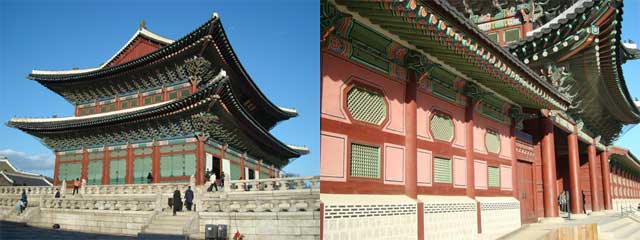
Gyeongbokgung Palace is the most popular tourist attraction in Seoul. The now restored and preserved buildings served as the main royal palace of the Joseon Dynasty (1392-1910). Unlike Changdeok Palace it is not classified as a UNESCO World Heritage site.
The palace is spectacularly situated with Mount Bugaksan to the rear and the spacious grounds hold both the National Palace Museum and the National Folk Museum.
The first palace was built in 1395 by King Taejo and destroyed during the Japanese invasion of 1592. The 330 palace buildings were rebuilt by the Prince Regent during the reign of King Gojong in 1868.
During the Japanese colonization of Korea (1910-1945) many alterations were made to the site, but these have been removed and the palace and its grounds now resemble the original buildings of the 19th century.

History
The buildings of the palace were built symmetrically on a north-south axis according to geometric principles. The gate at the southern axis is Gwanghwamun, proceeding north through the Heungryemun and Geunjeongjeon Gates is the beautifully-proportioned throne hall of Geunjeongjeon - the largest wooden structure in Korea.
Walking north again is the Sajeongjeon Reception Hall and to the east the residences of the Korean crown prices and princesses - Donggung. To the west is the delightful Gyeonghoeru pavilion set in square pond, which was used for royal banquets.
North again are the Gangnyeongjeon and Gyotaejeon - the residences of the Korean King and Queen respectively. Off to the left (west) are the Heumgyeonggak and Hamwonjeon buildings used for geomancy and Buddhist ceremonies.

Yet further north is the beautiful Geoncheonggung Palace built for King Gojong (1852-1919) and his consort, set within a small lake. It was here that the Empress Myeongseong (Queen Min) was assassinated by the Japanese in 1895.
Behind the lake are the buildings of the Jibokjae (Hyeopgildang and Parujeong Pavilions), which were used to receive foreign envoys. Taewonjeon to the east are the buildings reserved for royal funerals and ancestral rites.
There are free guided walking tours in English (11 am, 1.30 pm & 3.30 pm), Japanese (10 am, 12.30 pm & 2.30 pm) and Chinese (11 am, 1 pm & 3 pm) beginning at the information office at Heungryemun Gate.
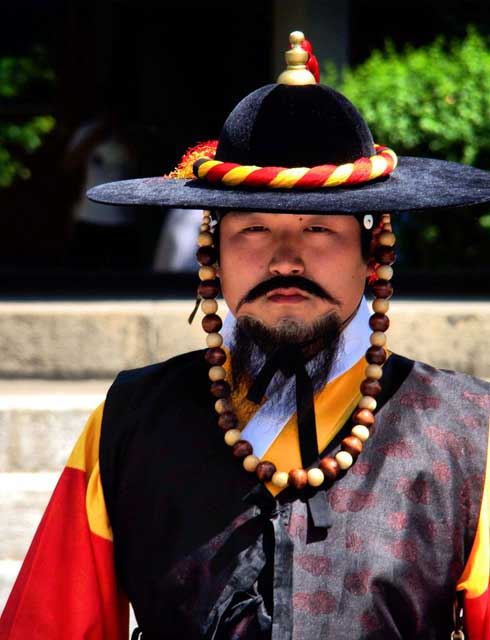
The colorful Changing of the Guard ceremony takes place on the hour from 10 am - 4 pm outside the main entrance. Visitors who are interested in Seoul's royal palaces and residences should also visit the excellent Changdeok Palace (Changdeokgung).
Changing of the Guard Video
Gyeongbokgung Access - getting to Gyeongbokgung
Take a Seoul subway Line 3 train to Gyeongbokgung Station (Exit 5). Gyeongbokgung Station is five stops from Seoul Station.
Book Hotel Accommodation in Korea
Hotels in Korea - Booking.com
Hotels in Seoul - Booking.com
South Korea Hotels - Agoda
Seoul Hotels - Agoda
Find Hotels in Daegu - Agoda
Hotels in Busan - Agoda
Book Daegu Hotels - Booking.com
Incheon Hotels - Agoda
Book Incheon Hotels - Booking.com
Pyeongchang Hotels - Agoda
Suwon Hotels - Agoda
Search Suwon Hotels - Booking.com
Ulsan Hotels - Agoda
Uncover Ulsan Hotels - Booking.com
