
Jeonju 전주
- Jeonju's population - 650,000.
- located in a fairly undeveloped part of Korea in Jeolla Province
- Jeonju retains some of its rich cultural heritage as the ancient capital of the Yi Dynasty.
- Jeonju is famed for its food and handicrafts: paper products in particular.
Things to see and do in Jeonju
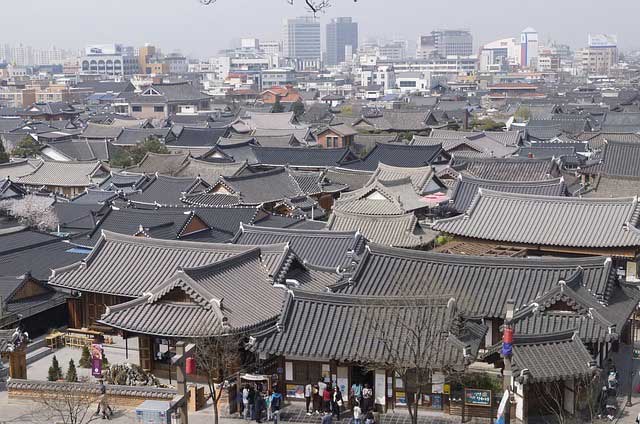
Jeonju's main attraction is the hanok district of traditional housing in the Gyodong area of the city. Over 800 traditional Korean hanok houses have been preserved here, with gracefully curving tiled roofs and ondol underfloor heating.
The area is similar in atmosphere to the capital's Insa-dong district. From Jeonju Station take any of buses #142, #211, #221, #231, # 241, #251 or #291 to Jeongdong Cathedral.

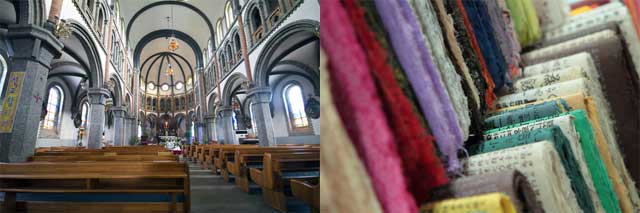
The Jeongdong Cathedral (전동성당) is one of the first cathedrals to have been built in Korea in 1914, and the Roman-Byzantine style church has a lovely interior. Nearby is the brick Priests' Quarters - accommodation built for the missionary priests in 1927.
Pungnammun is the historic western gate of the city, dating from 1768. It was here that the severed heads were displayed after anti-Christian purges in 1801. Opposite the cathedral is Gyeonggijeon Shrine. The shrine is set in a beautiful tree-lined park and holds a portrait of King Taejo from the 15th century. Jeonju Hyanggyo is a Confucian academy that dates from 1603 with a couple of the original buildings still surviving.

Deokjin Park near Jeonbuk National University is famous for its lotus flowers which bloom in the summer months.

Jeonju is known for its arts and crafts which you can see at the Traditional Crafts Exhibition Hall (closed Monday). The Korean Paper Institute displays examples of hanji -- traditional paper made from the bark of the mulberry tree.
Cultural Center for Oriental Medicine
The Cultural Center for Oriental Medicine offers treatments using traditional Korean medicine. Jeonju is home to Korean folk opera (pansori) and the Jeonju Traditional Cultural Center (Tel: 063 280 7000) offers performances as well as demonstrations of the tea ceremony, Korean cooking, fan-making and Taekgyeon (a martial art).

The Gangam Calligraphy Museum (Tel: 063 281 2768; 강암서예관) has displays of ink calligraphy by Korean masters. The Traditional Liquor Museum (Tel: 063 287 6350) explains the Korean wine-making process and has bi-monthly wine-tasting events. All these museums and cultural centers are in the hanok district.
Visitors can buy handmade paper (hanji) and fans at the Namwon Market.
Jeonju also plays hosts to the annual Jeonju International Film Festival (JIFF) with screenings at the many cinemas on Cinema Street.
Jaman Mural Village, a short distance from the center has some bright and colorful street art painted on its traditional houses. Seohakdong Art Village is home to several art galleries and shops selling local arts and crafts.
Jeonju Festivals
The city has several festivals throughout the year. These include the aforementioned Jeonju International Film Festival (JIFF) which began in 2000. Other festivals are the Jeonju Hanji Culture Festival and the Jeonju Dano held in Deokjin Park with various events celebrating traditional arts and crafts.
Nightlife & Eating Out
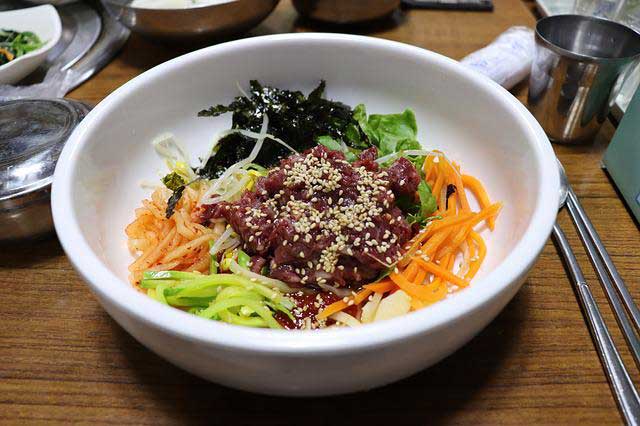
Bibimbap is a speciality. Try the city center restaurants or Namwon Tourist Complex. Classic Bibimbap is a delicious mix of vegetables served on a bed of rice plus a fried egg and meat but in Jeonju they go the extra mile by adding a variety of exotic ingredients.
Indeed, the city prides itself on its cuisine and is sometimes referred to as the "food capital of Korea." Centuries old Nambu Market is the place to head for for delicious local dishes as well as fresh fruit and vegetables.
Makkoli (makgeolli) is another Jeonju specialty, too. Try Hankookjib inside Jeonju Hanok Village for Bibimbap.

Getting to Jeonju
There are frequent trains to Daejeon, Seoul, Iksan, Suncheon and Yeosu. The quickest KTX train from Seoul Station takes 1 hour, 40 minutes.
Buses from Jeonju run to Daegu (3 hours, 30 minutes), Busan, Gwangju, Jinju, Mokpo, Muju, Seoul and Yeosu (4 hours).

Jeonju World Cup Stadium
Tel: (0652) 281 2477 more Jeonju stadium info
The 42,477 capacity Jeonju World Cup Stadium is one of Korea's best. The stadium is home to Jeonbuk Hyundai Motors. Take a bus from the station. Jeonju Sports Complex Stadium (pictured above) is a multi-purpose 30,000 capacity stadium in the city. Jeonbuk Hyundai Motors played at this stadium from 1995 to 2002 before relocating to the World Cup Stadium.

Accommodation - Hotels in Jeonju
Some recommended places to stay in the city include the four-star property Royal Room of King, the three-star Jeonju Lime Hotel and Laon Hanok Gguljam guesthouse close to Hanok Village.
Book Hotel Accommodation in Korea
South Korea offers some excellent hotel accommodation for the visitor or business traveler ranging from deluxe Western-style Five-Star hotels in Seoul, Busan and Jeju to more traditional and inexpensive rooms in Korean Yogwan or guesthouses.
Hotels in South Korea are available for all budgets and are of good international standard. Many of the top international chains have hotels in the big cities.
Most hotels in South Korea come with rooms with free Internet access. English is usually spoken in the more top level hotels. Rooms may be slightly smaller than those found in hotels in Europe or North America.
Hotels in Korea - Booking.com
Hotels in Seoul - Booking.com
South Korea Hotels - Agoda
Seoul Hotels - Agoda
Find Hotels in Daegu - Agoda
Hotels in Busan - Agoda
Book Daegu Hotels - Booking.com
Incheon Hotels - Agoda
Book Incheon Hotels - Booking.com
Pyeongchang Hotels - Agoda
Suwon Hotels - Agoda
Search Suwon Hotels - Booking.com
Ulsan Hotels - Agoda
Uncover Ulsan Hotels - Booking.com