
Democratic People's Republic of Korea (DPRK) 조선민주주의인민공화국
Dominic Al-Badri heads north of the 38th Parallel
A strong contender for the winner of the 'most misunderstood country in the world' prize, there is little doubt that the Democratic People's Republic of Korea has a serious image problem.
Blame for this in the West can be laid at the doorstep of any number of actors, from intellectually-challenged U.S. presidents to sensationalist Japanese media. Matching the rhetoric blow-for-blow, the DPRK's official Korean Central News Agency fires back in a struggle that has lasted 55 years, since the armistice that froze the partitioned Korean Peninsula in 1953.

Amidst the world's last remaining cloud of Cold War fog and confusion, it is sometimes difficult even for seasoned observers to remember that, inaccessible and remote as the DPRK may be, it is still a country that is called home by 23 million people.
Holidaying in the DPRK is not straight-forward, but nor is it as difficult as many think. In recent years, endless newspaper articles and media reports about the abduction of Japanese citizens in the 1970s, gung-ho U.S. government pronouncements about the Axis of Evil, the on-going hoo-hah over the DPRK's denuclearization process, and inevitable references to the demilitarised zone that cuts across the country as "the world's most heavily militarized border" have coalesced to give the impression that the country is a besieged garrison state on a permanent state of high alert, as prickly as a hedgehog.
Given that, it is little wonder that most people shy far away. Ironically, the DPRK may well be just about the safest country in the world for Western tourists to visit, partly because outside hotels tour groups must always be accompanied by their guide-minders who ensure none of their charges inadvertently breaks the law, and partly because the citizens are honest folk; in shops, for example, if the exact change is not available, customers may find packs of chewing gum or bottles of water replacing small denomination coins.

Pyongyang Attractions
Freedom of movement is, however, restricted. Part of this is due to the determination of the DPRK authorities to show visiting tourists the extraordinary achievements that the regime has accomplished since 1953 in the face of worldwide hostility. Whatever one might think of the regime's politics, it is hard to be unimpressed by the capital city, Pyongyang.
During the Korean War, the city was completely leveled. (More bombs were dropped on the DPRK by the U.S.-led U.N. forces in 1950-53 than on Japan and Germany combined during World War II.) It may not be the prettiest city in the world, and older apartment blocks are definitely showing their age, but the rebuilding from scratch of Pyongyang has been a commendable effort undertaken at "Chollima speed."

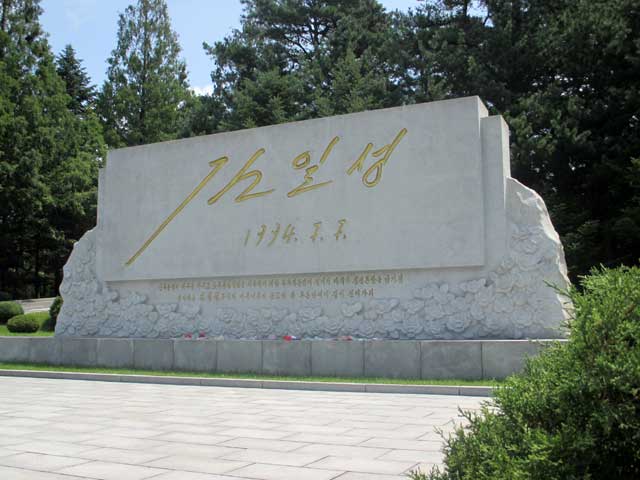
Dotted throughout the showcase capital are numerous monuments to the nation's father and Eternal President, Kim Il-Sung, who died in 1994. Justly revered as a skilled guerrilla fighter who played a pivotal role in organising and leading resistance to occupying Japanese forces in the later years of the Japanese occupation of Korea (1910-45), the elder Kim remains omnipresent in the form of avuncular portraits and grand bronze statues at various public points throughout town and country. He is also on the wall of every private house and government office, inevitably accompanied by separate portraits of his son, the Great Leader, Kim Jong-Il.
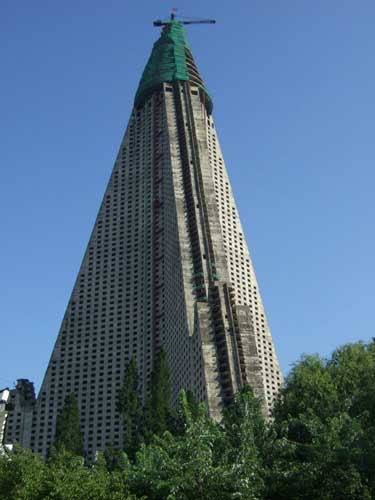
As magnificent as some of the architecture is, everything is dwarfed by one of the most grandiose building projects ever undertaken, the Ryugyong Hotel, a 6,000-bed pyramidal behemoth topped with five revolving restaurants that has only recently been awoken from a suspended state of construction. (It is due for completion in 2012, when there will be celebrations galore to commemorate the 100th anniversary of the birth of the Eternal President.) Clearly visible from every part of the city, it is best viewed early on a summer morning as it looms eerily out of the haze that hangs over Pyongyang while the capital wakes.
And yes, unlike Beijing or Tokyo, it is haze, not smog. One thing Pyongyang has got going for it, and which the state-run Korea International Tourist Service really should latch on to as an eco-friendly marketing tool, is pretty much the cleanest air of any capital city in the world.
This is due to the almost complete absence of private cars, the banishment to the outskirts of factories and the nearly 200 parks and open spaces dotted throughout the city. It is said that with 58 square metres of green belt per citizen, Pyongyang has four times the U.N.-suggested amount of greenery per person.
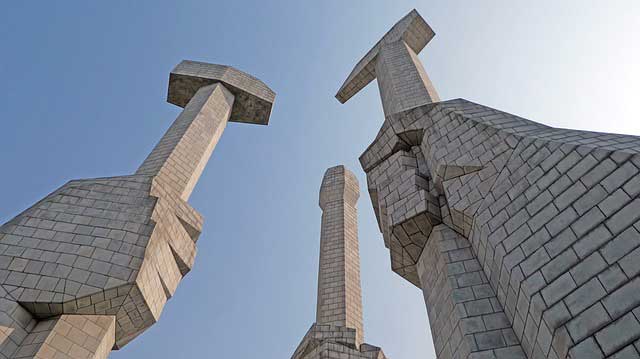
Arriving from Beijing - as one almost invariably will, on a glorious Soviet Union-era Tuploev jet operated by the DPRK state airline Air Koryo - the contrast could not be sharper. People walk to and from work, ride the metro or bicycles, or squeeze onto one of the bulging trolley buses or trams that ply the streets from early morning until mid-evening. Crossing main thoroughfares and highways on foot is a breeze. Want to stand in the middle of the road to take a picture of the highway-straddling Monument to the Three Charters of National Reunification? No problem! No cars!
The DPRK's ongoing electricity supply problems mean that light bulbs are either low wattage or long-life, contributing to another of the capital's most striking features: dark nights. Pyongyang rivals the Bangladeshi capital Dhaka for darkness come nightfall; the city is virtually pitch black, but unlike Dhaka it is also silent to boot. The combination of the lack of motorised transport, and the absence of all kinds of advertising and street lighting come as a welcome surprise, and the stillness which settles over the city as dusk falls means even faint sounds from far across the city float on the wind. The experience of poking your head out of a wide-open window on the 36th floor of a high-rise city centre hotel and seeing and hearing almost nothing of the surrounding metropolis is initially unnerving, but rapidly becomes addictive.
Tour itineraries are fixed prior to departure and inevitably include at least a few days in Pyongyang. There is little flexibility for improvisation; many museums, for example, are not open in the sense of having regular opening hours, but rather open for particular tour groups, involving extensive prior co-ordination on the part of the hosts to ensure guides and other staff are on hand. And it is not just museums; visits to schools and co-operative farms follow the same pattern. Model farmers and singing schoolchildren need to prepare for visiting tourists, who, technically are all invitees of the state-run Korea International Tourist Service - guide-minders bear full responsibility for the action of their charges, which helps explain the nervousness with which cameras are viewed.
Our guides told us that all citizens are required to report camera use outside of obvious tourist spots; snapping shots from inside buses, we were told, could cause grief for the guides. (Nor was this idle talk; when leaving the country by train across the River Yalu, which separates the DPRK from China, officials inspected all the photos on all the cameras of the members of our party, deleting those deemed "sensitive," such as pictures of soldiers or smiling children.)
North Korean Girls' Choir
Pyongyang, Democratic People's Republic of Korea (DPRK) 평양

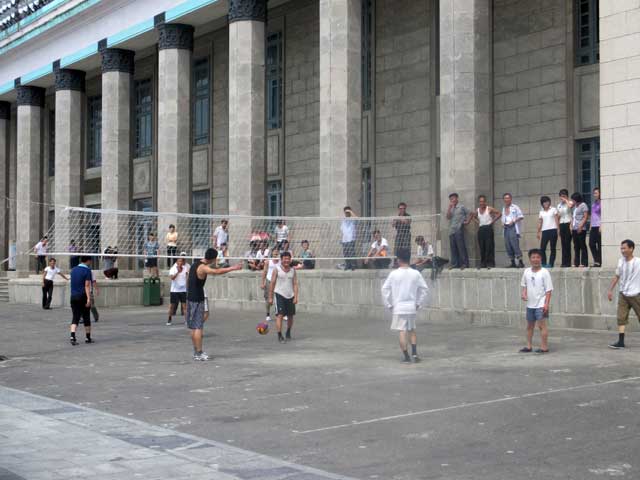
Visiting the DPRK is not all about regime-related monuments and museums, however. Holidays are celebrated with gusto. National Liberation Day (from the Japanese) is marked on 15 August, and it was quite clear that the locals did not need much of an excuse to hang out with friends in central park areas picnicking, playing cards, drinking soju, singing songs, and generally larking about.
Lucky tourists may be able to visit one of the city's theme parks and ride the Mouse Rollercoaster of Death, the Spinning Wheel of Death or the Hamster Wheel of Death after they've tried their luck at throwing beer-can sized corks into the bellies of U.S. military policemen. Trips to the state film studios also provide plenty of opportunities for dressing up as Korean kings, princesses or soldiers and strolling around an impressive film set, one part of which includes a replica-1960's Japanese street, replete with mock gambling dens and advertising hoardings for screenings of The Seven Year Itch.
Mass Games
The undoubted highlight of a visit to the DPRK is a trip to see the Mass Games, should it be the right time of the year. A visit to the games offers the opportunity to see the most spectacular show on the planet, bar none. Basically the history of the DPRK in 90 minutes, the show involves 100,000 gymnasts, acrobats, dancers, soldiers and children in the kind of sophisticated, synchronised routines that outdo even the recent Beijing Olympic ceremonies for audacious, mass showmanship. Although video snippets of the games can be found on-line, nothing beats witnessing their vainglorious pomp in person. London Mayor Boris Johnson could do worse than call on the DPRK authorities for assistance with planning the ceremonies for the 2012 Olympics.

As paltry as the number of cars might be in the capital, traffic is even more scarce once one heads out of town and hits the highways and byways. Locals have internal passports; without the correct stamps they cannot move freely - even tour guides - which means that anyone who is heading from A to B obviously has good reason to do so. It is while on the roads heading out of Pyongyang that one begins to get a clearer sense of things behind the veil. In the capital, there is little choice but to be taken from one worthy tourist spot to another, but this level of control invariably slips to some degree once in the countryside.

Reports of famine in the 1990's and early 2000's were backed by reliable information from impeccable sources, but the situation has improved to some extent since then, and though fat people were conspicuous by their absence (Chinese tourists aside) neither was obvious malnutrition a problem in any of the small villages and towns our bus passed through. Bashful kids stole glances and waved at the bus-bound foreign devils passing by fields full of crops: to the untrained eye the 2008 harvest seemed on course to be a bumper one, with maize, barley, potatoes and buckwheat growing in every spare square metre of bare earth.
That said, the DPRK's southern regions are its most fertile, and may not produce enough to support the entire population. (Following the 1953 armistice, the South was left with the best farmland but limited mineral resources, while the North suffered the reverse.) A clue to where problems may lie comes from the paucity of motorised transport and the almost complete absence of trains on the extensive railway network: it is all very well having bountiful crops, but if there is not an efficient food supply and distribution network, then even in the land of plenty there will be those who will still go hungry due to localised crop failures or flooding.
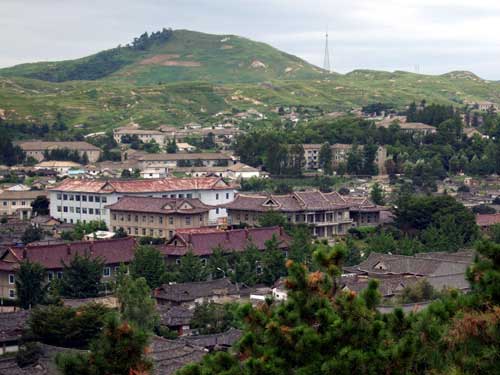
Something which seems to catch many visitors by surprise is the stunning scenery: huge tracts of the land are completely devoid of all signs of human habitation, compounding further the feeling of remoteness. Visits to, and glimpses of, lovely mountain views, remote waterfalls, stunning beaches on the east coast south of the port city of Wonsan, and beautiful lakes and rivers are often on the itinerary of more in-depth tours.
With all locals working eight hours a day, six days a week, you're sure to have many of the places to yourself if you visit on a work day. And if the prospect of a few hours hiking and swimming in such locations sounds agreeable, that can be arranged too, though the beach football between a scratch tourist team and mid-ranking, off-duty DPRK army officers was unplanned. Only when the officers loaded up their fairly recent model Mercedes and sped off did we realise just who we'd been playing - one of the Brits on the team suddenly regretted having "gone in so hard" when tackling. (For the record, the visitors won 5-0.)
Most visits will also include a trip to the demilitarized zone (DMZ) that wiggles across the country somewhere around the 38th parallel and the village of Panmunjom where visitors can temporarily step onto South Korean territory. While this a popular destination for visitors to, and inhabitants of, South Korea, fewer make the trip from the northern side.
For a region that is the most heavily fortified frontier in the world, there are surprisingly few obvious examples of military personnel or hardware on either side; indeed, the whole place is unnervingly peaceful. Several buildings where discussions aimed at ending the Korean War took place can be freely visited, as can the memorial hall in which the armistice was signed. Perhaps the biggest constraint is time: there is plenty to see and ponder, but one needs to move at a fair clip to keep up.
Wherever you go in the country expect to be fed the party line when visiting the various national monuments or museums (such as the impressive Victorious Fatherland Liberation War Museum) about all the great deeds the nation's leaders have done in the face of never-ending hostility from the Imperialist Americans which followed decades of rapacious Japanese colonialism. Even if one is selective in choosing what to believe, there are still some uncomfortable - and to some no doubt unpalatable - truths about the sorry history of the Korean Peninsula to be learned. This is particularly the case when it comes to some of the atrocities of the Korean War (during which the U.S. used both biological and chemical warfare) and the suffering endured during the brutal decades of the Japanese Occupation.
In a way, though, the historical focus is the saddest thing about a visit to the DPRK, for the feeling often hangs heavy that this is a country still frozen in a Cold War mentality, doomed to forever fight a war that has long since finished. At the same time, the learning process cuts both ways, for travelling to the DPRK reveals both a society unlike any other on the planet, and also that a lot of what is written about the country and the people by Western pundits is a load of hokum. Only through interaction and engagement with the DPRK's citizens - limited as the opportunities may be - can progress be made in helping the country slowly emerge from its deeply entrenched mindset, along the long road to acceptance as a full member of international society.
Pyongyang Travel Tips
Individual, independent travel in the DPRK is simply not possible. Solo travel is possible, but with the caveat that you will be always accompanied by a driver and guide.
All tourists must be part of a group; organised tour groups are the cheapest way to visit the country, but small groups can be arranged, too. Tour groups are mostly made up of EU nationals and a few Australians or New Zealanders. (The group I was on also included a 85-year-old Portuguese man who had visited every country in the world, save for the DPRK and Somalia.)
About 2,000 Westerners visited the DPRK in 2007; Chinese and Russian tourists are far more numerous. A one-week tour, including all meals, accommodation and transport costs, including Beijing - Pyongyang return, costs about $2500. Shorter visits are possible.
The DPRK's official foreign currency is now the euro, though the Chinese RMB and, to a lesser extent, U.S. dollar can also be used; foreigners are not allowed to use the domestic currency, the won.
U.S. and Israeli citizens can not visit the DPRK except during the period when the Mass Games are held. Although these took place in 2008, the next games are not scheduled until 2012. However, an improvement in DPRK-U.S. relations may lead to a relaxing of these restrictions. Japanese citizens can visit the DPRK and are welcomed.
A number of tour agencies arrange trips to the DPRK. I travelled with the experienced Beijing-based Koryo Tours (www.koryogroup.com) who arranged and staged the DPRK's first ever cricket match, held just outside Pyongyang in early 2008.
Tours usually involve flying into Pyongyang from Beijing and then leaving by overnight sleeper train back to the Chinese capital, although individual variations on this are available. At the time of writing the only other regular air route linking Pyongyang was with Vladivostock, Russia, making it possible for those leaving Japan for Europe to visit the DPRK before catching a ride on the Trans-Siberian Railway to Moscow.
Pyongyang Mass Games
North Korea Image Gallery
DPRK Related
The Great North Korean Picture Show
Book Hotel Accommodation in Korea
Hotels in Korea - Booking.com
Hotels in Seoul - Booking.com
South Korea Hotels - Agoda
Seoul Hotels - Agoda
Find Hotels in Daegu - Agoda
Hotels in Busan - Agoda
Book Daegu Hotels - Booking.com
Incheon Hotels - Agoda
Book Incheon Hotels - Booking.com
Pyeongchang Hotels - Agoda
Suwon Hotels - Agoda
Search Suwon Hotels - Booking.com
Ulsan Hotels - Agoda
Uncover Ulsan Hotels - Booking.com