Nations League: How Europe Transformed International Football
For decades, international football breaks outside of major tournaments were dominated by low-stakes friendlies - fixtures that rarely excited fans and often frustrated club managers. In 2018, UEFA permanently changed that landscape with the launch of the UEFA Nations League, a biennial competition designed to replace meaningless exhibitions with competitive, evenly matched fixtures carrying real consequences.
Since its debut, the tournament has evolved into a centerpiece of the European football calendar, complete with promotion and relegation battles, a coveted trophy, and a crucial safety net for major tournament qualification.
How the Format Works
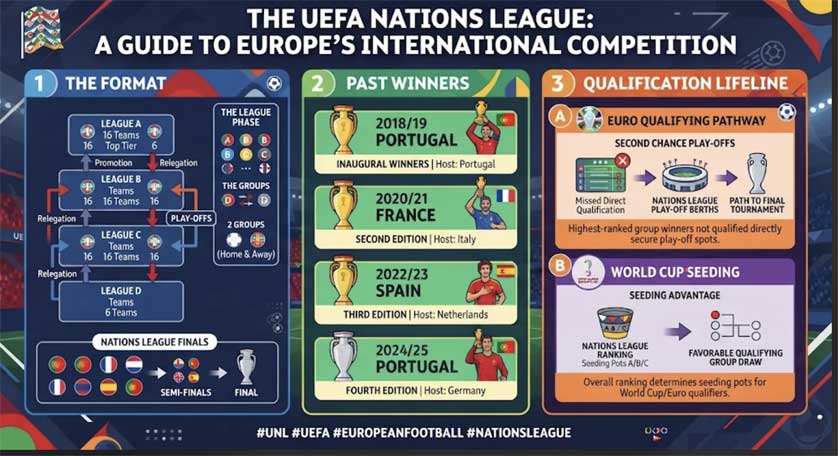
Unlike traditional qualifiers where European powerhouses routinely face minnows in lopsided matchups, the Nations League groups nations by relative strength. Teams are divided into four tiered divisions - Leagues A, B, C, and D - ;based on their prior Nations League performance:
-
The League Phase: Leagues A, B, and C each contain 16 teams split into four groups of four, while League D houses the remaining lower-ranked nations in two groups of three. Teams play each group opponent both home and away during the autumn international windows.
-
Promotion and Relegation: Movement between tiers keeps every match meaningful. Group winners in Leagues B, C, and D earn automatic promotion for the next edition, while the bottom-placed teams in Leagues A and B drop down. Following the format expansion introduced in the 2024-5 cycle, third-placed teams in League A also face League B runners-up - and third-placed League B teams face League C runners-up - in two-legged promotion/relegation play-offs.
-
The Knockout Stage and Finals: In top-tier League A, the four group winners and four runners-up advance to two-legged quarter-finals. The four winners move on to the Nations League Finals, a single-elimination mini-tournament featuring semi-finals, a third-place play-off, and a championship final hosted by one of the four finalist countries.
(Looking ahead, UEFA has approved plans to streamline the structure from four leagues into three starting in the 2028–29 cycle to further sharpen competitive balance.)
Past Champions
Across its first four editions, the Nations League has produced dramatic finals and established Portugal as the tournament's most successful nation - and the only country to lift the trophy twice.
| Edition | Host Nation | Champion | Final Score | Runner-Up | Third Place |
|---|---|---|---|---|---|
| 2018-19 | Portugal (Estádio do Dragão) |
Portugal | 1-0 | Netherlands | England |
| 2020-21 | Italy (San Siro) |
France | 2-1 | Spain | Italy |
| 2022-23 | Netherlands (De Kuip) |
Spain | 0-0 (5-4 p) | Croatia | Italy |
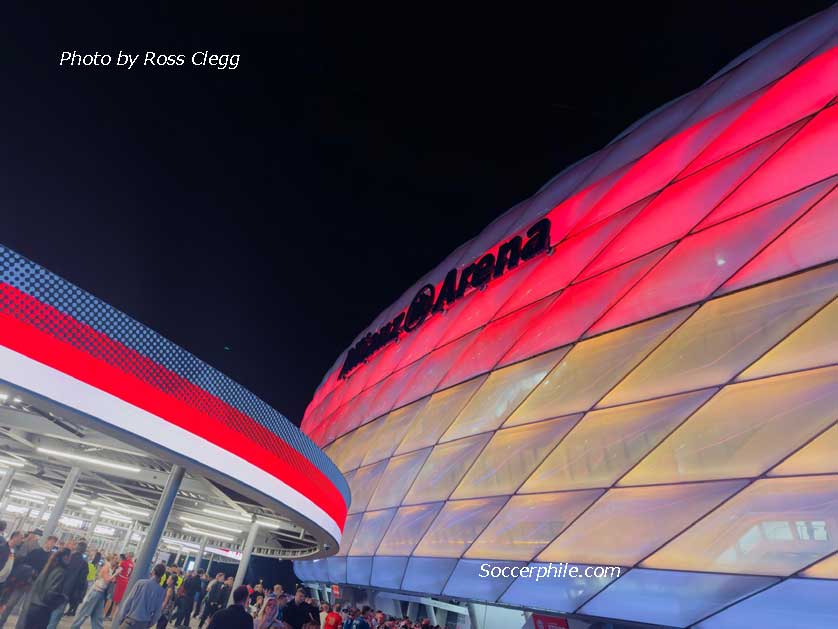
| 2024-25 | Germany (Allianz Arena) |
Portugal | 2-2 (5-3 p) | Spain | France |
The Qualification Lifeline
Beyond silverware and bragging rights, the Nations League is tightly woven into the qualification pathways for both the UEFA European Championship and the FIFA World Cup. It impacts major tournament qualification in two vital ways:
1. Second-Chance Play-Off Berths
Traditional European Qualifiers remain the primary route to major tournaments, but the Nations League serves as a high-stakes safety net. When nations fail to qualify directly through their traditional qualifying groups, UEFA allocates play-off spots to the highest-ranked Nations League group winners - or the next best-ranked teams in their respective leagues if those group winners have already qualified. This mechanism guarantees that even smaller footballing nations in Leagues C and D have a realistic path to the sport's biggest stages.
2. Qualifying Draw Seeding
Strong Nations League campaigns also pay dividends before traditional qualifying even begins. Overall Nations League rankings determine the seeding pots for the subsequent European Qualifiers draw. Climbing into League A or winning a group earns a nation higher seeding, allowing them to avoid Europe's top-ranked giants when qualifying groups are drawn.
By giving every international fixture competitive weight, the UEFA Nations League has succeeded where international friendlies failed - turning routine calendar breaks into compelling, high-stakes football across every tier of the European game.
More on World Football
Cuju - the origins of football in China
Chinese Grassroots Football - the boom
Thai League 1 - the new Thai League 1 replaced the Thai Premier League in 2017
Interview with Faridhian Anshari - Lecturer of Media Studies and Researcher on Football & Social Science
2007 Asian Cup in Jakarta - Bambang And Bintang In Jakarta
Peter Butler interview - John Duerden interviews the former Persiba Balikpapan coach
Uzbekistan's World Cup 2006 Qualification Campaign - it's a hard and long road to Germany 2006 and they don't come much rockier than the paths from the inhospitable terrain of Central Asia
Australia v Uzbekistan - World Cup qualifying 2010
BRI Super League Indonesia - the BRI Super League (Liga Super) is the top level of Indonesian football
Gelora Bung Karno Stadium - home of the Indonesian national side in Jakarta
Football in Vietnam - a soccer hotbed
Hanoi Travel Guide - Asian Cup 2007
Mỹ Đình National Stadium - Vietnam's 'Wembley'
Liga de Elite Macau - football in Macau
Thai Premier League - Thai soccer guide
Buy tickets for soccer matches around the world