UK Stadiums: Goodison Park, Liverpool, England

Goodison Park in Liverpool, northwest England, was the home ground of Premier League club Everton FC until 2025 before the club's move to the Hill Dickinson (Everton Stadium) at Bramley-Moore Dock on the waterfront. Goodison Park has hosted more top-flight games than any other stadium in England to date. The historic ground has also been the venue for an FA Cup Final and several international matches, including a semi-final match in the 1966 World Cup. Following the 2024-2025 season, Goodison Park will be demolished and the site redeveloped.
Capacity
The stadium had a capacity of 39,414 all-seater. The main stands at Goodison Park are named the Howard Kendall Gwladys Street End, the Sir Philip Carter Park Stand, the Goodison Road Stand, and the Bullens Road Stand. The Howard Kendall Gwladys Street End and the Sir Philip Carter Park Stand were named in honor of former Everton manager and player, Howard Kendall, and the former chairman, Sir Philip Carter, respectively.
History
Opened in 1892, the stadium replaced previous grounds at Stanley Park and Anfield, now the home of rivals Livepool FC.



Constructed following Everton's bitter departure from Anfield, Goodison became the first purpose-built football stadium in England, setting a precedent for modern football grounds. Over the decades, Goodison Park has been at the forefront of football innovation.
It was the first English stadium to introduce dugouts, undersoil heating, and also floodlights. It has also hosted numerous historic matches, including World Cup games in 1966 and FA Cup finals in its early years. Architecturally, the stadium reflects the evolution of British football venues, blending original Edwardian features with later expansions, such as the iconic Gwladys Street and Bullens Road stands.

Everton
Everton (nicknamed 'The Toffees') are one of the most famous clubs in English football though recently something of a fallen giant. The Toffees have nine league titles, the last back in 1987, five FA Cups and the European Cup Winners' Cup in 1985. Their highest finish in the Premier League was 4th in 2005. The club's last FA Cup win was in 1995, 1-0 v Manchester United.

Famous Everton Players
A listing of Everton's most famous players must include Dixie Dean (1925-1937), whose statue stood outside the gates, Alan Ball (1966-1971), a midfield dynamo who played for England in the 1966 World Cup final, goalkeeper and fan favorite Neville Southall (1981-1998), prolific striker Graeme Sharp (1980-1991), and Brian Labone (1958-1971), a one-club man who captained Everton to the league title in 1969-70 and an FA Cup win in 1966.
Howard Kendall was both successful player and manager, leading Everton to success in the 1980s. Kevin Ratcliffe (1980-1991) captained Everton during their most successful era, winning two league titles, an FA Cup, and the European Cup Winners' Cup in 1985. Trevor Steven (1983-1989) is remembered as a versatile and skillful player, providing flair and goals from midfield.

Left back Leighton Baines (2007-2020) whose left foot could 'open a tin of beans' made over 400 appearances for the club and Aussie Tim Cahill (2004-2012) is remembered for passion, goals and love for the club.
Other names associated with Everton include Roberto Martinez, Sam Allardyce, Sean Dyce and Carlo Ancelotti as managers, plus Gary Lineker and Romelu Lukaku up front and current England goalkeeper Jordan Pickford.
If you are in a pub quiz who else can you think of who has played for Everton and made something of a lasting impression?
Here's a list - Ross Barkley, Gareth Barry, Samuel Eto'o, Colin Harvey, Tony Hibbert, Phil Jagielka, Bob Latchford, Aaron Lennon, Steven Naismith, Leon Osman, Peter Reid, Richarlison, Wayne Rooney (of course), Gylfi Sigurdsson, Morgan Schneiderlin, John Stones, and Theo Walcott.
Managers
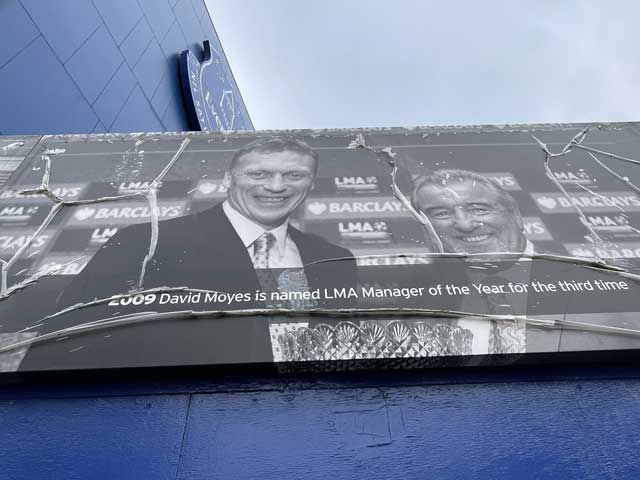
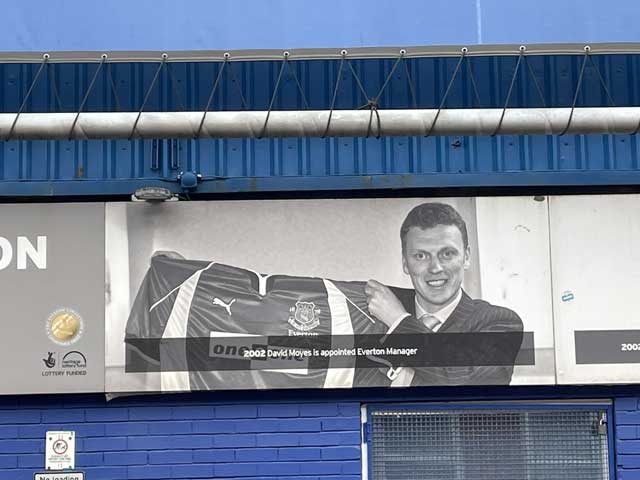
Since their foundation, Everton have had 27 managers beginning with William Edward Barclay back in 1888. Some noted men to have managed Everton include Harry Catterick, Billy Bingham, Gordon Lee, Howard Kendall, Joe Royle, Walter Smith, David Moyes, Roberto Martinez, Ronald Koeman, Sam Allardyce, Marco Silva, Carlo Ancelotti, Rafa Benitez, Frank Lampard and Sean Dyce. As of Easter 2025, David Moyes is back in charge after a second coming and hoping to resurrect the club's fortunes.

Stadium Facts
The record attendance at Goodison Park was 78,299 spectators for the Merseyside derby in 1948.
Stanley Park separated Liverpool and Everton before Everton's move away from Goodison.
Access - Getting There
The nearest major railway station to the ground is Liverpool Lime Street. From here you can take any of the following buses to near the ground: 17, 19, 20, 21 or 310.
Alternatively take a Merseyrail train from Liverpool Central to Kirkdale Station and walk 16 minutes.
Address: Goodison Road, Liverpool L4 4EL
Nearby Hotels
Some recommended hotels within easy reach of Lime Street Station include the 4-star Hilton Liverpool close to the Liverpool One Bus Station. The Liverpool Radisson Red Hotel is also a 4-star property and offers Wifi, a restaurant, and a 24-hour reception adjacent to the station's main entrance.
Holiday Inn Liverpool City Centre is directly opposite the station as is The Liner, a 3-star property on Lord Nelson Street.
See here for a complete listing of hotel accommodation in Liverpool.

More UK Stadiums
Kirklees Stadium (John Smith's Stadium)
Goodbye Goodison



©Soccerphile.com
Buy tickets for soccer matches around the world