
UK Stadiums: Selhurst Park, London
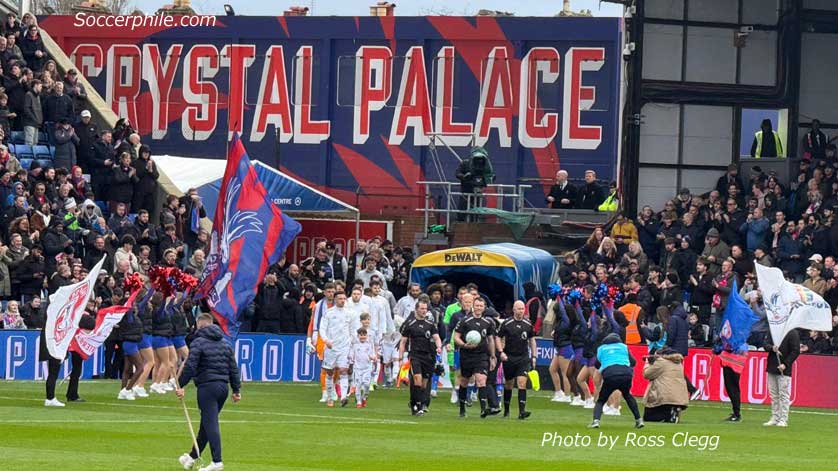
Selhurst Park, south of the River Thames in Croydon, is the home of Crystal Palace FC. Opened in 1924, it has been the club's base for over a century, making it one of the oldest stadiums in the English Premier League. The stadium has a seating capacity of around 25,486 and features a traditional football ground atmosphere with its distinctive stands like the Holmesdale Road End and the Arthur Wait Stand.
Crystal Palace have long-term plans to modernize Selhurst Park through the redevelopment of the Main Stand. The project is expected to increase stadium capacity to about 34,000, add hospitality and premium seating areas, include a club museum and improved facilities and expand accessibility for disabled supporters.

Stands
Selhurst Park consists of four main stands arranged tightly around the pitch.
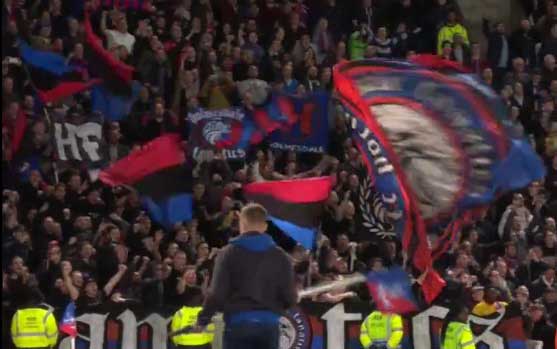
The Holmesdale Road Stand is the newest section of the stadium, completed in 1994 when the old terrace was replaced by a modern all-seater stand. It holds around 8,329 supporters and is home to the club's most vocal fans, including the "Holmesdale Fanatics." The stand is widely considered the heartbeat of the stadium's matchday atmosphere.
The Arthur Wait Stand sits opposite the Main Stand and was constructed in 1969 following Crystal Palace's promotion to the First Division. With a capacity of about 9,574 seats, it is the largest stand at the ground and usually houses the majority of away supporters.
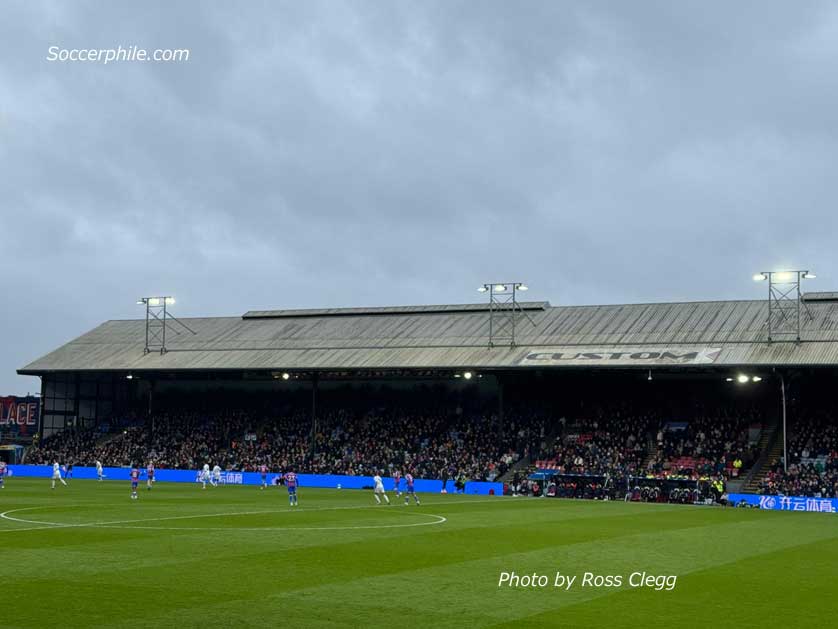
The Main Stand is the oldest structure in the stadium and dates back to the original 1924 construction. Designed by Archibald Leitch, it still features elements of his classic steel stadium design. The stand currently holds around 5,460 spectators, along with press seating, executive boxes, and club offices.
Plans have been approved to replace this stand with a new five-storey structure designed by KSS, inspired by the famous glass architecture of the historic Crystal Palace exhibition building. The redevelopment is expected to increase the stadium's capacity to more than 34,000 seats.
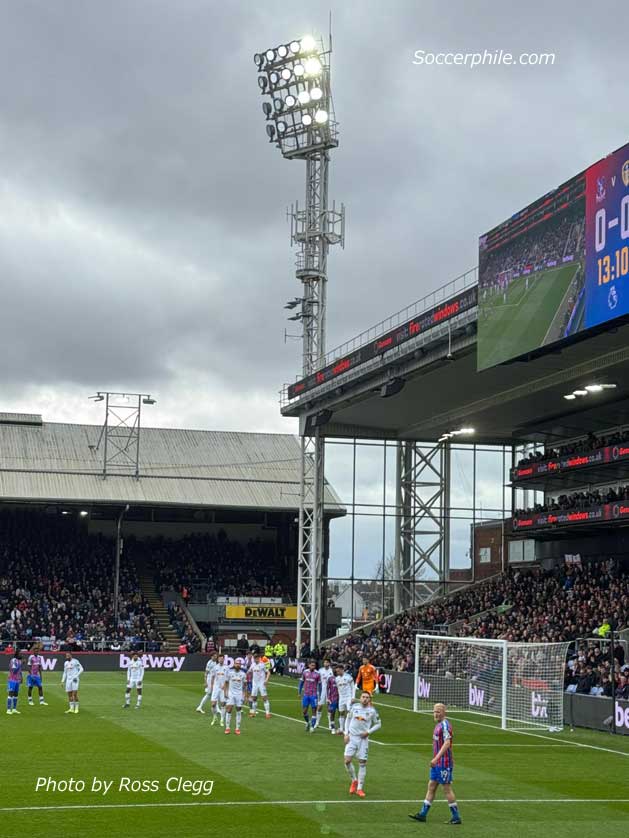
The Whitehorse Lane Stand is the smallest stand in the stadium, with around 2,200 seats plus executive boxes. It contains hospitality areas and corporate seating and sits behind one of the goals.
History
Selhurst Park was built in the early 1920s after Crystal Palace purchased a former brickfield site from the London, Brighton and South Coast Railway Company for around £2,750.
The stadium was designed by the famous Scottish football architect Archibald Leitch and constructed by the engineering firm Humphreys of Kensington at a cost of £30,000.
The prolific Archibald Leitch was involved or partially-involved in the design of Anfield, Celtic Park, Craven Cottage, Deepdale, Hampden Park, Ibrox, Old Trafford, Villa Park and many other grounds in the UK.
Selhurst Park officially opened on 30 August 1924, when Crystal Palace played Sheffield Wednesday in front of about 25,000 spectators. The visitors won 1-0 in the first match at the new ground.
Over the decades Selhurst Park has hosted more than just Crystal Palace matches. The stadium has staged international games, amateur England fixtures, boxing events, and even concerts during the 1980s.
Both Charlton Athletic (1985-1991) and Wimbledon (1991-2003) have shared the ground with rivals Palace at various times.
The Eagles
The origins of the club (nicknamed 'The Eagles' or before that 'The Glaziers') can be traced back to The Crystal Palace Company, which owned and operated the giant cast-iron and glass Crystal Palace on a 200-acre site in Sydenham after its move from Hyde Park following the Great Exhibition of 1851.
Various sports teams began using the facilities in the surrounding Crystal Palace Park. A cricket club formed in 1857, and an amateur football team was then established by cricket club members for winter fitness practice in 1861, playing their first game in 1862.
The club's crest now bears the date 1861 though there is some debate about the links between the original amateur football team and the subsequent professional outfit.
The club was, however, among the original members of the Football Association in 1863, helping to establish the first rules of the game and claims to be the 'world's oldest professional league club' challenging the claims of Notts County.
The original amateur team disbanded around 1876 and later in 1905 a professional club owned by the Crystal Palace Company was formally incorporated.
The team played first at the original Crystal Palace stadium from 1905 to 1915 before moving to Selhurst Park in 1924. Interestingly, FA Cup finals were held at the Crystal Palace stadium from 1895 to 1914.
The original Crystal Palace burnt down in a huge blaze in 1936 and was lost to history.
The club first reached the English top flight in 1969 under manager Bert Head and played their inaugural top-flight match against Manchester United.

Palace Managers
Some famous Palace managers must include ex-Man Utd and England winger Steve Coppell who had no less than three spells at the club (1984-1993, 1997-1998, and 1999-2000).
Steve Coppell led Palace to promotion to the top flight in 1989, reached the 1990 FA Cup Final against Manchester United and guided the club to 3rd place in the 1990-91 First Division, their highest-ever top-flight finish. His team featured both Ian Wright and Mark Bright alongside such players as Geoff Thomas, Alan Pardew, Nigel Martyn, Andy Gray, Phil Barber, and John Pemberton.
Malcolm Allison was appointed in March 1973 and quickly rebranded the club from "The Glaziers" to "The Eagles," changed the team colors to red and blue, and despite suffering relegations from the top tier to the third division, achieved 1976 FA Cup success by reaching the semi-finals. He returned for a second spell (1980-1981), before leaving to manage Sporting Lisbon in 1981.
Terry Venables had two stints in charge firstly from 1976 to 1980 after he took over from Malcolm Allison. Venables guided Palace to the Second Division championship in 1979 and returned to the club for a shorter period nearly two decades later 1998-1999.
Alan Smith (1993-1995) took over during a turbulent period after Coppell's first spell. He won the Football League First Division title in 1993-94 thus achieving immediate promotion back to the Premier League. The ex-Arsenal man stabilized the club during a time of financial and ownership uncertainty.
Neil Warnock managed Palace twice (2007-2010, 2014) and guided Palace to the 2008 Championship Playoff Semifinals, helping keep the club competitive during more major financial troubles.
Tony Pulis (2013-2014) had a short but hugely impactful spell, taking over with Palace bottom of the Premier League in 2013. he successfully avoided relegation in the 2013-14 season and picked up the Premier League Manager of the Season to boot.
Alan Pardew (2015-2016) is best remembered for Palace's cup run culminating in the 2016 FA Cup Final which Palace narrowly lost 2-1 to Manchester United after extra time and his viral disco moves after Palace took the lead.
Roy Hodgson had two spells (2017-2021, 2023-2024) and became a stabilizing figure. The former England boss took charge in 2017 when Palace had 0 points after 7 matches and avoided relegation. Hodgson then oversaw several comfortable mid-table Premier League finishes during his tenure.
Present coach Austrian Oliver Glasner was appointed in February 2024. He successfully led the club to its first-ever major trophy, winning the FA Cup in the 2024-25 season, and secured qualification for European competition for the first time in the club's history.
Honours
Second Division / First Division / Championship
Champions: 1978-79, 1993-94
Runners-up: 1968-69
Play-off winners: 1989, 1997, 2004, 2013
Third Division / Third Division South
Champions: 1920-21
Runners-up: 1928-29, 1930-31, 1938-39, 1963-64
Fourth Division
Runners-up: 1960-61
FA Cup
Winners: 2024-25
Runners-up: 1989-90, 2015-16
FA Community Shield
Winners: 2025
Full Members Cup
Winners: 1990-91
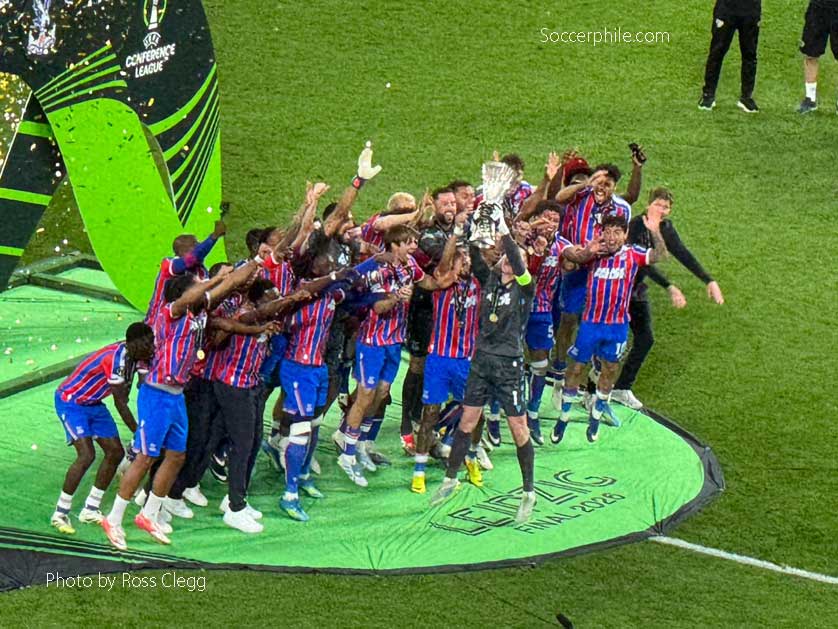
Europa Conference League
Winners: 2025-2026
Fun Facts
The club competed in the very first FA Cup in 1871-72, the oldest football competition in the world.
The club's then eagle mascot "Kayla" and the team nickname "The Eagles" became popular after the influence of former manager Malcolm Allison in the 1970s. He wanted the club to have a more exciting identity and introduced the eagle theme.
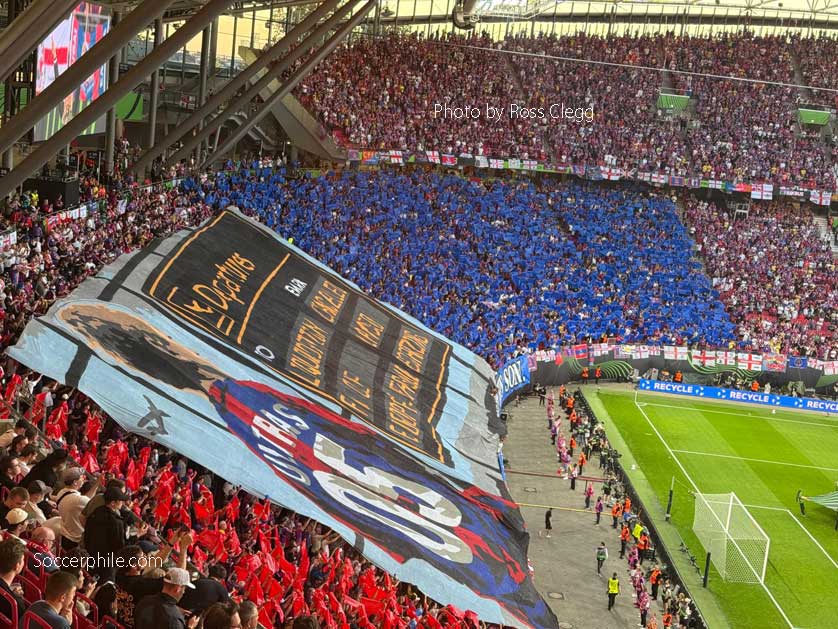
Before matches at Selhurst Park, a real eagle now 'Phoenix' who replaced 'Kayla' - who passed away in 2020 - sometimes flies around the stadium as part of the pre-match entertainment.
Celebrity Palace fans have included actors Liam Neeson, Bill Nighy, and Timothy Spall, along with comedian Jo Brand, TV presenter Susanna Reid, and Inbetweeners star James Buckley.
Christian Benteke scored after 7.69 seconds against Watford F.C. in 2016 - one of the fastest goals ever in the Premier League.
Pete the Eagle is the club's costumed mascot.
The lowest ever attendance for a Premier League match is 3,039, recorded when Wimbledon hosted Everton at Selhurst Park on January 26, 1993.
Macclesfield 2-1 Crystal Palace (2026) - an astronomical shock, with the underdogs sitting 117 league places below their opponents - FA Cup holders Palace.
Not to be confused with Selhurst Street - home of non-league Radford FC in Nottingham.

Brighton Rivalry
Despite being separated by roughly 40-50 miles, this rivalry stems from intense matchups in the 1970s, featuring strong animosity between managers and fans, rather than geographical proximity.
Historically, Crystal Palace has maintained rivalries with other local teams, including Millwall, Charlton Athletic, and AFC Wimbledon.
Club Legends & Cult Heroes
Ian Wright was one of Palace's greatest ever forwards, with 100 plus goals for the club and central to their run to the 1990 FA Cup final before later becoming a star at Arsenal.
Mark Bright was Wright's strike partner in the late 1980s and early 1990s, Bright's goals helped Palace achieve their highest top-flight finish (3rd in 1990-91).
Geoff Thomas was a tireless midfielder and captain who led Palace during their most successful early-1990s period and later became an inspirational figure after battling leukemia.
Jim Cannon is Palace's record appearance holder with over 650 matches, he spent nearly his entire career at the club from 1973 to 1988.
The Argentine goalkeeper, Julian Speroni, made more than 400 appearances and became a modern fan favourite for his loyalty and key saves during the club's Premier League survival years.
A product of the Palace academy, Wilfried Zaha became a club talisman in the Premier League era and was instrumental in keeping them competitive in the top flight.
Andy Johnson scored 21 Premier League goals in the 2004-05 season and was a key figure in Palace's promotion campaign in 2004.
Peter Taylor is a well-remembered winger of the 1970s, Taylor helped Palace rise from the third tier to the top division and later managed the club.
Kenny Sansom was a classy left-back who began his career at Palace and became one of England's most-capped defenders while maintaining strong ties to the club.
The stylish Italian winger, Attilio Lombardo brought international quality to Palace in the 1990s and briefly served as player-manager during a memorable time for the club.
The Eagles' all time record goal-scorer is Peter Simpson (1929-1935) with 165 goals. Besides Wright and Bright, both Clinton Morrison with 112 goals and Scot Dougie Freedman with 108 deserve honorable mentions.
Museum & Stadium Tours
The club offers a 90-minute, behind-the-scenes guided tour of Selhurst Park stadium on select days, allowing fans to explore areas typically closed to the public. The tour includes the dressing rooms, player tunnel, pitch-side dugouts, boardroom, press conference room, directors' box and the club's trophy cabinet.
Access - Getting To Selhurst Park
Selhurst Park is located in South Norwood in the London Borough of Croydon, surrounded by residential streets.
The nearest railway stations include: Selhurst, Norwood Junction and Thornton Heath. All three stations are within walking distance of the stadium. Trains from London Victoria stop at Selhurst Station and Thornton Heath, for Norwood Junction take a train from London Bridge.
Buses that stop near the ground include the 130, 468 and SL6 on Whitehorse Lane and the 130 on Park Road.
Address: Whitehorse Lane, London, SE25 6PU
Accessibility
Selhurst Park provides accessible facilities for disabled supporters, including 128 wheelchair spaces (raised and pitchside) with free personal assistant (PA) tickets. Accessible seating is available in all stands, featuring accessible toilets, sensory rooms, audio-descriptive commentary, and GiveVision headsets for visually impaired fans.
Nearby Hotels
Recommended places to stay close to Selhurst Park include the Crystal Lodge Hotel and also the London Croydon Hotel. The Cedars House Hotel is also nearby.
See here for a complete listing of hotel accommodation in London.
More UK Stadiums
Kirklees Stadium (John Smith's Stadium)
©Soccerphile.com
Buy tickets for soccer matches around the world