
Bottoms up Bonito: Sublime snorkelling and snake wine in Brazil's beautiful eco-town
Daniel Allen
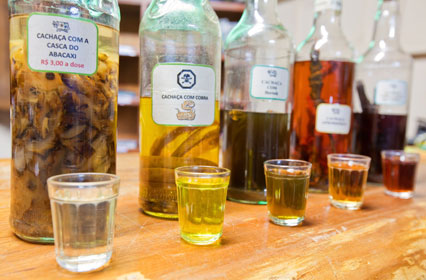
Ulli Braun, my amiable German guide, is watching me get drunk with undisguised amusement. "This, mein freund, is pinga de cobra," he explains with a grin, handing over yet another glass of home-brewed cachaca. "The people here also call it engasga gato, which means the 'cat choker'. It's supposed to be a pretty powerful aphrodisiac."
Peering closely at the bottle of yellow liquid that sits between us, which appears to contain some kind of bloated reptile, I decide I've had enough fermented sugar cane juice for the moment. Outside, the bucolic grounds of the Estancia Mimosa, a working farm situated close to the Brazilian town of Bonito, are calling. The dubious joys of snake wine will have to wait.
Bonito, which fittingly means "beautiful" in Portuguese, is a town and municipality clinging to the southern edge of the Pantanal wetland in the western Brazilian state of Mato Grosso do Sul.
Characterized by countless underground springs and porous limestone geology, the region is an eco-tourism paradise of turquoise-watered rivers and lakes, subterranean caverns and plunging cascades. I can't wait to dive in.

Waterfalls
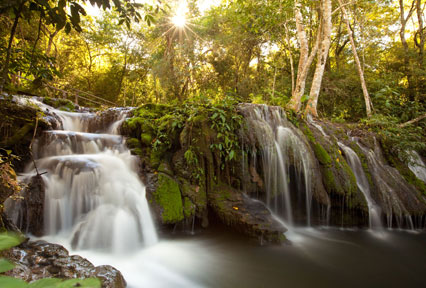
Waterfalls are the major draw at the Estancia Mimosa. Most visitors gorge themselves on a ranch-style buffet, with or without cachaca, before heading out to explore the nearby forest and river. As with most of Bonito's attractions and activities, which are also located on privately owned land, tour groups are kept small to maximize enjoyment and minimize environmental disturbance.
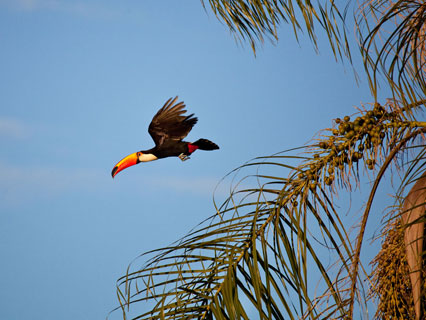
Leaving the estancia's picturesque farmhouse, I follow Ulli along a network of sun-dappled trails and wooden walkways. Overhead a couple of orange-billed toucans fly past, while a troop of capuchin monkeys swings by, chattering noisily.
We quickly arrive at the balmy waters of the Rio Mimoso, whose invigorating properties prove the perfect antidote to a boozy Brazilian lunch. Falling over moss-clad rocks into a succession of mirror-like pools, the river's gentle flow has blessed the Estancia Mimosa with the perfect aquatic hangout, and I while away a blissful hour soaking away the aches and pains of long distance travel. Life in Bonito is already living up to its name.
Buraco das Araras
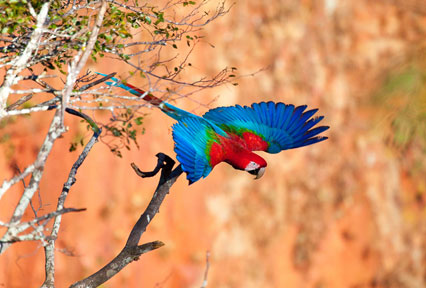
Early the following morning, supercharged on Brazilian caffeine, I find myself peering into a big hole. A short drive from Bonito, this is the Buraco das Araras - literally "the Hole of the Macaws" - which happens to be a giant doline (or sinkhole to the layman) over 100 meters deep and half a kilometre across.
Even if you're not into dolines per se, the Buraco das Araras boasts other, non-geological charms. Each day, with the rising sun warming its ochre walls, the sinkhole comes alive to the varied sounds of the red-green macaw, as formations of these exotically-plumaged parrots dive and wheel below the lip, periodically alighting en masse to bicker, preen and survey their private domain. It's a fantastic sight, and I'm suddenly glad Ulli banged on my bedroom door at quarter to six.

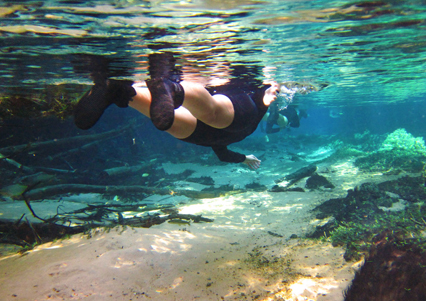
Following our strict itinerary, we're soon barreling down the local highway again, making a beeline for Bonito's premier attraction - the Fazenda Rio da Prata. This well-maintained property, which doubles up as a cattle farm, offers horseback riding, scuba diving and birdwatching, although the activity of choice is a three kilometer swim down the Rio Olha d'Agua. If you've ever wondered what snorkelling through a well-stocked aquarium might be like, this is the place where wonderment becomes reality.
After another sumptuous lunch and extended hammock session, I shoehorn myself into a rented wetsuit. Ulli and I board the tourist trailer with five other intrepid snorkellers, and we're soon bumping across the grounds of the fazenda, pausing to take in a nonchalant giant anteater, a brace of lethargic capybara and a rare hyacinth macaw.
Pulling up at the edge of the forest, we disembark and wander penguin-like through the trees, emerging at the limpid waters of the Rio Olha d'Agua. After a quick lesson from the guide, the eight of us begin drifting downstream, borne by the gentle current and hemmed in by overhanging foliage.
Kept afloat by a buoyancy vest, I quickly master manoeuvring, although kicking up sediment from the sandy bottom - considered poor etiquette - is harder to avoid.

Rio Olha d'Agua
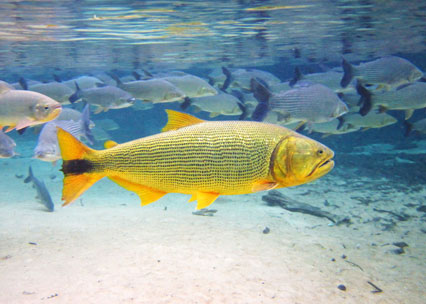
The submarine world of the Rio Olha d'Agua is a joy to behold. Triangular blue pacu, iridescent, fiery-finned pirupatanga and streamlined yellow dorado gather in shoals or slip effortlessly between weed-covered tree trunks, eyeing up the procession of ungainly human intruders with glassy eyes. We pass a family of rare giant otters, frolicking in the shallows with carefree abandon, while a juvenile caiman retreats into the shadows at our noisy approach.
Too soon its time to leave the water and towel off. Ulli's eager to show me his favorite Bonito eaterie, which serves up the finest pirupatanga in town. As long as there's no cat choking involved, I'm happy to oblige.
Way to go: How to get to Bonito
The nearest major airport to Bonito is Campo Grande, capital of Mato Grosso do Sul, which has numerous flights to both Rio de Janeiro and Sao Paulo. TRIP Airlines currently has direct flights from Campo Grande to Bonito departing on Thursdays and Sundays, while flights out of Bonito to Campo Grande go via Corumba, departing on the same days. There are numerous buses between Campo Grand and Bonito - the journey takes around 5 hours.
Reef and Rainforest (www.rainforest.co.uk) offer a 2-night, 3-day Bonito package for 575 GBP per person based on two people travelling in twin / double accommodation. This includes activities such as snorkelling, private transport, private English-speaking guide from arrival in Campo Grande to departure, entrance fees and various meals. This package is offered as part of tailor-made itineraries covering multiple Brazilian destinations.
UK passport holders do not require a visa to enter Brazil.

Accommodation in Brazil
Hotels in Brazil - compare and book hotels in Brazil's major cities and tourist regions including Rio, Belo Horizonte, Brazilia, Manaus, Porto Alegre and São Paulo.
Hostels & budget hotels in Brazil - find affordable, secure, low cost accommodation in all areas throughout Brazil.
Join us on Facebook and Twitter to keep up with the latest soccer news from Brazil and get the chance to win one of our regular free prizes.
Guides to Brazil & South America
Pantanal - home to a population of jaguars and the largest continental wetland in the world.
São Paulo architecture - this vast city has some of South America's most striking architecture.
Rio's economy - growth and investment continue to climb ahead of the 2014 World Cup & the 2016 Olympics.
Things to do in São Paulo, the biggest city in size in Brazil, for visiting soccer and travel fans.
Enjoy a trip to Lima - the Peruvian capital is the continent's best kept secret. Take a look!
The Best of South America - recommended places throughout South America for adventure holidays and eco-retreats: Machu Picchu, Fazenda Barranco Alto, Mashpi Lodge, Mt Cotopaxi, Mount Roraima and the Iguazu Falls.
Map of Brazil - see a map of this huge country showing the main towns and cities.
Map of Brazil

Buy tickets for soccer matches around the world