
On World Suicide Prevention Day, 2019, I reflect on Welsh footballer and manager Gary Speed and how football can lead the way on improving mental health.
Sean O'Conor
10 September, 2019
"He was the last person - I can't emphasise that enough - the last person who would have done this...I still think about this. I honestly can't get my head around this"
Chris Coleman
Like Diego Maradona's drug bust at USA '94, news of Gary Speed's death in 2011 was a Kennedy football moment where people remember the time and place of receiving the news.
I was in Hong Kong at a friend's wedding, taking a ferry across to one of the lush harbour islands when I casually checked the news on my phone and saw the horror. Like everyone else, I just could not fathom it.
Following three straight wins and having hauled his nation from 117th to 45th in the FIFA World Rankings in a year, the long-serving former Leeds, Newcastle, Bolton, Sheffield United and Wales midfielder had inexplicably hanged himself at home.
I had only known him as a spectator but felt the loss as part of the football family. We fans identify with players' characters and qualities and these human connections nourish our vicarious faith, so when Speed checked out without warning we were left hurt and astonished.
Football is a fantasy escape for us and as children we long to be footballers, imagining the top players are living the dream we probably cannot attain. Speed's death was therefore a shocking wake-up call to rouse us all from our fantasies.
We cannot ignore it. Suicide disproportionately affects young men - precisely the demographic who are passionate about football. In the UK it is the biggest killer of men under 45. So it is worth asking why we do not pour the efforts into preventing it that we do to combat heart disease or cancer in older adults.
The death of a football star contradicts sport's ideal of masculinity - young, virile warriors at the height of their powers, idolized by all.
The ethologist Desmond Morris proposed in his 1981 book The Soccer Tribe that football is a modern incarnation of hunting, the ancestral male bonding ritual and hunters kill others, not themselves.
He drew parallels between the necessary teamwork and shared ecstasy of scoring a goal, where teammates embrace each other in mutual bliss, with the way chimpanzees collaborate to hunt Colobus monkeys and celebrate slaughtering one for their troop to feast on.
Camaraderie is probably football's most powerful drug and like an army platoon who risk all to save one man, the loss of a comrade is deeply felt. Like war, team fandom is one for all and all for one.
What makes it a difficult subject to broach is not just the power of the stiff upper lip, indestructible 'man-up' alpha-male ideal which prevents men discussing their feelings, but that neuroscience is in relative infancy and suicide is often hard to comprehend to outsiders, particularly when apparently successful people take their own lives.
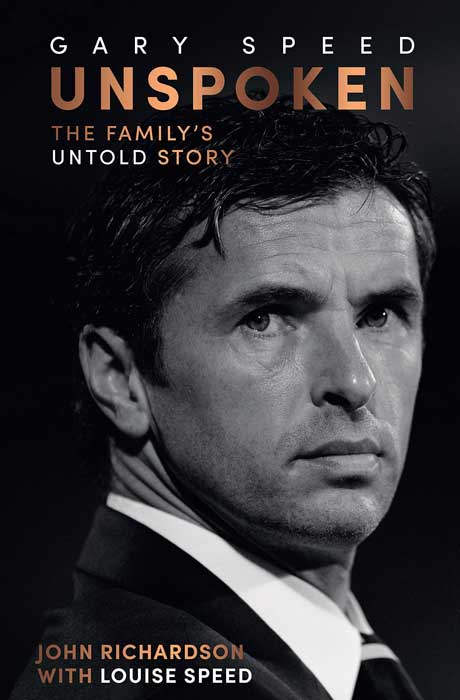
Seven years on, Speed's decision remains somewhat of an enigma, which made me reach for Gary Speed Unspoken by John Richardson as soon as I saw it on the bookshelves.
Speed originally asked him to pen his ghostwritten autobiography, but it ended up being an epitaph, although it rightly celebrates his footballing career through testimonies by several friends and teammates.
The sense of bafflement upon hearing the news of his death hit everyone like an express train and it is notable that all of his friends confess they saw no signs or had any suspicions he was about to end it all.
"We can't fathom it out. We go over and over it and we will never know now," said his father, Roger Speed, a typical response from those who knew him intimately.
But obviously there must have been reasons, which Speed did not communicate to others while he was alive. He had mentioned to Alan Shearer he was contemplating a break-up from his wife because of marital troubles, but that is nothing unusual and did not make Shearer think his friend was also considering killing himself.
When you read the time line of his last day on earth - social calls with friends, discussing upcoming arrangements, a TV appearance, lunch with friends and a party with wife and other friends in the evening, phone calls with his kids and work on future plans as Wales manager, there really is a mystery.
There simply were no clear warning signs, no threats made or any notes left.
To fill the gap of certain explanation, stories flew around. In the book, John Hartson dismisses rumours Speed was gay, adding,
"Even if he had been - and I know he wasn't - it wouldn't have mattered. Everyone loved him."
More worrying was an allegation that he had been abused as a youth by paedophile coach Barry Bennell, who has been blamed for three other footballers killing themselves.
At the inquest the coroner wondered if Speed had just made a dramatic statement after a domestic argument so his wife would take notice, but instead had nodded off having been drinking and committed an accidental suicide.
That seems the most plausible explanation, that he had been trapped in an unhappy marriage and that the final act was a capricious whim he surely would have regretted in the sober morning once he had realised the pain and damage it would cause.
The inquest revealed he and Louise had rowed after coming home from the party, that Speed then locked the doors to stop her leaving but she slipped out and unable to get back in, spent the night sleeping in the car. Meanwhile, realising his wife had walked out, he went to the garage and found a length of cable...
It seems to have been a cry for help after suffering emotional abuse more than anything else.
I once saw Speed up close in a Cardiff night club in the mid-1990's. He looked physically perfect and his body language was effortlessly smooth as he stood on a raised podium above the dance floor beside the more nervous looking Ryan Giggs and other Welsh international players relaxing on international duty.
His film-star looks, professional diligence, immaculate appearance and ubiquitous popularity crop up again and again in the tributes, which leads one to suspect no one can be that perfect. Speed hid his demons awfully well.
Until the inquest shone some light on his character, he had made many of us into amateur sleuths, scouring YouTube for footage in an attempt to find clues in his body language, expressions or tones of voice.
Suicide is the biggest killer of British men under 50 and affects three times as many men as women, it is important to remember. It happens to footballers too - Wikipedia lists over 80 victims for instance, while suicide among those at the top of their profession is not unusual either.
For that reason it is mistaken to react by assuming success at work equals happiness.
But while Marilyn Monroe, Kurt Cobain or Robin Williams exhibited warning signs loud and clear, Speed's exit was agonisingly un-signposted.
Even if it was a cry for help, the fact he went that far is a sign of huge inner turmoil he had locked away from public or private view. We are in the realms of neuroscience now, a field we know painfully little about.
Clarke Carlisle, former player and chairman of the PFA and a high-profile sufferer of depression who has attempted suicide more than once, admits,
"It's so hard to describe how illogical your thoughts are when you are in depression - it's just madness."
Roger Speed, Gary's father, put it this way:
"I think something suddenly switched in his brain and he did it on impulse."
Ex-Wales international Mickey Thomas, a close friend, had this to opine:
"Were there any clues to what was about to happen? No..but only you know what you are going through and it doesn't matter what you achieve. If you're vulnerable nothing will save you...They think your life is perfect. They don't see the other side..."
He postulated a player who played for so long leaving the game was perhaps like a soldier leaving the army who struggles with his mental health but concludes none of us will really know the full truth and the game as a whole needs to wake up about depression.
Shay Given also suggested retirement after such an exceptionally long career - over 900 professional matches, could have been to blame, explaining that daily training releases endorphins in the brain which promote wellbeing.
Players often struggle to start afresh after their careers finish in their thirties and Speed, whose immense professionalism kept him playing as an all-action midfielder until aged 40, is perhaps the extreme example of this problem.
His suicide left a mess, devastating those close to him, particularly his wife Louise, who bravely helped compile the book.
Wales, the nation Speed captained and managed, enjoyed their greatest moment since the 1958 World Cup by reaching Euro 2016 under Chris Coleman, due in large amount to the transformation Speed had enacted in only a year in charge.
We like to believe in miracles and it felt like Speed's spirit was with those red shirts in France.
We are left with memories of his sterling service for his country, winning the championship with Leeds United, an extraordinary 23 seasons across Leeds, Everton, Newcastle, Bolton and Sheffield United, and a life lost much too soon.
If there is a lesson from the tragedy it is the now familiar reminder for men to share their emotions, throw the stiff upper lip / macho ideal in the bin where it belongs and admit to mental health weaknesses just as much as you would physical problems as a natural part of being a human being. The stakes could not be higher - what could be more precious than one's life?
Since footballers like Tony Adams, Paul Gascoigne and Paul Merson started opening up about their inner demons and addictions, we can only hope British football is starting to get the message about the dangers of bottling up emotions. Yet it remains an unwon war which claimed another victim in Gary Speed.
There is a stigma to admitting to mental illness, as Stan Collymore and others have explained, but we have to be more open about it to employers, friends and family, for everyone's benefit.
Until neuroscience can convince everyone the brain is a part of the body which goes awry like any part of the anatomy, it will remain a struggle. But it is a fight we have to win.
Football can lead the way in changing our attitudes to mental health precisely because it has mass appeal to males already. It is trying to fight racism via match publicity so why not mental health ignorance?
It is surely football's duty too.
If you are experiencing mental health issues, remember you are not alone, it is perfectly normal like any other ailment and there is help out there. There is no need to suffer in silence.
Traditional masculinity is a big part of football but it needs to evolve. Football must help men and women stay healthy mentally as well as physically.
There is much to do but let us hope we are learning lessons so nobody in the future feels there is nothing left to live for, even the next match.
We are a global football family and good families look after their own.

© Sean O'Conor & Soccerphile