
The New Year Began With Three Bangs
Sean O'Conor

A trio of top club managers have bitten the dust in the past couple of weeks.
Chelsea, the FIFA World Club Cup winners, fired their manager Enzo Maresca on New Year's Day to start the 2026 sack race.
Four days later Manchester United parted company with Ruben Amorim to kill off an ill-starred 14-month reign which had promised much but never really got going.
Then on the 12th of January, Real Madrid, the No.1 club in the world in terms of annual revenue, said adios to manager Xabi Alonso after only seven months in charge.
There is nothing new about the managerial merry-go-round but a trio of high-profile casualties within the space of 12 days did seem unusual. I have been scratching my head to remember the last time three of Europe's top teams axed their leaders in such a short spell.
Amorim and Maresca took the total number of Premier League managerial changes to ten for the season at the halfway point, but that is still a long way off the record 32 during season 2022/23 (source: Transfermarkt.de).
Sackings Per Season
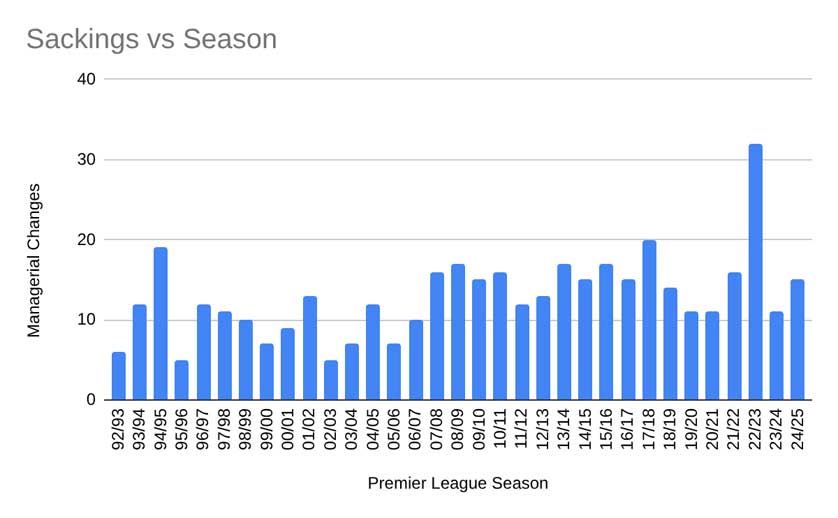
While it is common knowledge that a football manager needs time to bed in and establish his methods amongst a new cohort of players, it is also universally understood that owners are desperate for immediate success and do not have the patience to risk relegation or a failed promotion bid. Against that dichotomy, it is a wonder any manager can last more than a couple of seasons without showing a marked improvement in results.
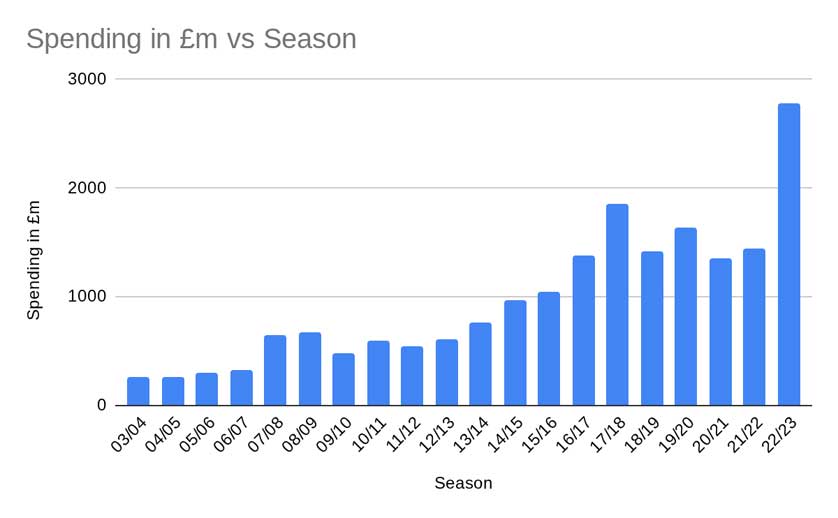
This slide towards opening the trapdoor can be seen in comparison to the total transfer fees in England's top flight, which show a more notable upward curve (data from statista.com).
Spending in £m Per Season
The turn of the year is a traditional time for sacking coaches of course, as winter breaks and an incoming transfer window turn owners' attention to where they want to be at the end of the season. A new face often does lift players, as Michael Carrick proved in the Manchester derby, although improvements are often temporary.
Nevertheless owners can feel more confident passing January transfer funds to an untested coach flush with new ideas than one who has struggled to prove himself and appears stuck in a downward spiral. Likewise, with relegation looming, owners feel throwing what American football calls a Hail Mary pass to a new man in the dugout is worth the risk.

Maresca Sacked At Chelsea
And yet, at the time of Maresca's firing, Chelsea were fifth in the Premier League and still in both domestic cups as well as the Champions League. Fifth might not be top, but is certainly in the frame for a European spot and return passage to the Champions League for the Stamford Bridge club.
Having won the UEFA Conference League and the FIFA Club World Cup (on paper the world's premier club tournament) the previous season, his leaving may have seemed bizarre, but the Italian had clearly fallen out with the board of directors, culminating in an alarming public announcement after a win at home to Everton in mid-December.
"Since I joined the club, the last 48 hours have been the worst because many people did not support us," he told the press, barely concealing his anger. Having opened fire on his employers in public that way, it is a surprise he lasted almost another three weeks in the job. The usual saga of interference from above regarding team selection and a failure to land desired transfer targets then emerged. With relationships having broken down irretrievably, a divorce between head coach and the directors had become inevitable.
Chelsea may have outspent all rivals the past few seasons, reviving the Abramovic model, but still march a clear step behind Liverpool, Arsenal and Manchester City when it comes to consistent winning.
As it happens, at time of writing on the 17th of January, Crystal Palace's hitherto placid Oliver Glassner, F.A. Cup Winner last year, has just launched an even more barbed tirade at his club's owners, claiming "We are being abandoned completely…we feel no support…if you get your heart torn out twice this season…". If Maresca wrote his own public resignation letter then Glassner has done it with a thick marker pen (though he still remains in post at time of writing).
Ruben Amorim
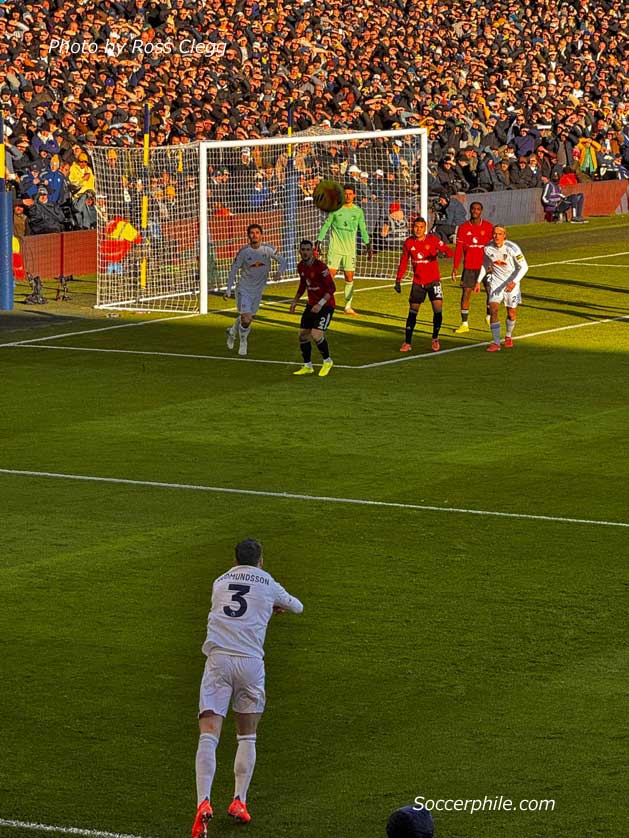
At Old Trafford, Ruben Amorim's departure was similarly down to a falling out with the board but he had enjoyed double the length of time Maresca had at Chelsea. Despite an outlay of almost £250 million, the United team had not improved but rather regressed from the tenure of Erik Ten Haag, who at least had won them the F.A. Cup and League Cup and finished 3rd and 8th in the league.
Under Amorim, United slumped to a dismal 15th in the table at the end of the 2024-25 season, 24 points adrift of the Champions League places. The Portuguese will be remembered for an almost demented insistence on a 3-4-3 shape that the players never got the hang of. Doggedly sticking to his philosophy, Amorim failed to prove it was the right shape for his players. There can be few mourners for his departure.

Amorim v Wilcox
Amorim's repeated negativity to the press and friction with United's director of football Jason Wilcox regarding his favourite formation led to the club finally pulling the plug to cut their losses, but the hairline crack in United's play had been evident for months.
While arrogance and confidence have a thin dividing line and the greatest managers have usually exuded an overbearing nature, the bottom line is the results do the talking. Winning matches is a get out of jail free card for any character faults in a manager.
And so the Red Devils' post-Ferguson curse continues, having claimed its tenth scalp since the legendary Scotsman retired in 2013. The club malaise seems endless, with pleas for a return to the club's 'DNA' - attacking football with flying wingers and great centre-forwards, sounding much like a religious movement's retreat into fundamentalism when it struggles to evolve with a changing environment. Having tried ex-players who were fan favourites, tried and trusted names who were also disciplinarians and finally young tyros brimming with promise but who turned out to be duds, it is impossible to know where England's biggest club should go from here - Sean Dyche or Neil Warnock?

Ratcliffe & Glazers
Given the turbo-charged revolving door at Old Trafford, Amorim was given generous extra time to prove himself by Jim Ratcliffe and the new ownership who had replaced the Glazers at the helm, but as time went by it was clear to everyone that the Portuguese was just another wrong choice for the hot seat. Like Chelsea's billionaire owners, the captains of industry in charge at Manchester United have proved themselves incompetent in recruiting and retaining top talent.

Alonso at Real Madrid
Alonso's fall from Madrid on paper made the least sense of the three big casualties. Real sat second in the league at the time of his firing and like Chelsea were still in all the cups. But there were four high-profile defeats to count against him - a 4-0 loss to PSG at the Club World Cup, a 5-2 loss to neighbours Atletico in the league, a 2-1 home loss to Manchester City in the Champions League and a 5-2 loss to Barcelona in the Spanish Super Cup, which was Alonso's last game in charge.
Beating Barcelona 2-1 in October, in what is the clásico of all clásicos, was more important than all those four games but not enough for Alonso to keep his impossible job.
Read the rabid Spanish football press and there is always 'una crísis' at the Bernabéu so it can be hard to determine the whole truth. A lot of talk surrounded Alonso's awkward relationships with Vinicius Junior and to Kylian Mbappe, but they alone were not enough to have cost him his job.
Vinicius Junior & Player Power
While the Brazilian visibly berated his manager when being substituted once and failed to publicly lament his passing, Mbappe on the other hand refused to criticise Alonso when teed up by the press, instead praising him as an excellent coach who had not been given enough time to succeed. What the football press tells you is not always the truth and when it comes to Real and Barça, concocting tales of tension is a full-time job in Spain's Fleet Street.
While most pointed to tension between Alonso and his overpaid pupils, some pundits cited a refusal to reemploy a popular fitness coach Antonio Pintus as pivotal in turning the club president against Alonso after his injury list piled up, a point seemingly proved when Alonso's replacement Álvaro Arbeloa wasted no time in reappointing Pintus. Equally, Alonso's faith in the club owners was damaged from the day they failed to capture his desired midfield anchorman Martin Zubimendi, who went to Arsenal instead. The end of the classic central pairing of Toni Kroos (retired) and Luka Modrić had left an unfilled gap in the Real Madrid side.
Groping instead for a gotcha explanation, some fingers pointed at Alonso's failure to replicate the mass-pressing, collective style that worked so well for him with a group of unsung players at Bayer Leverkusen onto established stars from a club whose DNA still carries the whiff of galáctico individualism. If that were so then the club erred in appointing him in the first place, much like United brought a man devoted to playing without wingers to a club with a rich tradition of them (George Best, Ryan Giggs, Cristiano Ronaldo etc).

Florentino Perez
The key reason for Alonso's brief stay must centre around the man at the top. Real's dictatorial owner Florentino Perez, who at the end of the day calls the shots in Madrid, simply appeared to have taken a dislike to his former playing employee, apparently privately lecturing him over selections, substitutions and tactics.
Word is that Perez was less sold on Alonso replacing the departing Carlo Ancelotti than his sporting director José Ángel Sánchez was in the first place, but had been prepared to give him a chance, yet felt angry he had not gone with his gut feeling, although Alonso's results did not justify such a swift dismissal.
Perez wields a sword that is a cross between Excalibur and that of Damocles, but swings it in a fickle and capricious way. Given that he has scythed down ten other managers in under a year at the Bernabeu, Alonso's exit was merely par for the course.
If Graham Taylor called his England appointment "in the end, an impossible job" then Real Madrid must be the premier mission impossible. And if your all-powerful boss just does not like you then your days are surely numbered. Plus ça change.

Gareth Southgate
Then, enter Gareth Southgate. Three days after Alonso's farewell the former England manager surfaced to note the fall in a manager's status from that of the fulcrum of the club to a replaceable component.
"Power structures either with club executives, club employees or players were ultimately the root cause of the end of each tenure," Southgate opined. "The erosion of a manager's authority has been a gradual process over many years."
To be fair, Southgate did accept evolution as inevitable as the media interest, sports science, data analysis and commercial importance of modern football have increased. The days of managers personally scouting players and dealing uniquely with other team managers surrounding transfer fees are in the past.
But at the same time he reminded us he had wanted to be called the manager, not the head coach of England, because people management was the key to his job's success.
"My belief is that we should embrace a modernised version of the traditional manager, where we recognise the people they lead, manage and coach."

Doing It Like Alex Ferguson No More
The days of an all-seeing, all-knowing manager who ran the club from top to bottom à la Alex Ferguson (27 years) or Guy Roux at Auxerre (41 years) ended in England with the retirement of Arsene Wenger at Arsenal in 2018 after 22 years.
A club's owners are more impatient for success than ever and their technical or sporting directors and performance analysts bring their own take on a manager's performance to their desks every week. Then there are the players, richer than ever, who feel they do not need to listen to the gaffer's imperatives like they used to.
Amorim cited this changing role as the reason he failed at Old Trafford, demanding to be "the manager, not just the coach," soon before his dismissal. Clearly he had had enough of being told by suits above him how to play football.
Southgate's remedy for the current malaise is nebulous. A people manager needs authority as does a head coach. How that is formalised by what increasingly look like corporations employing them is hard to know. While a return to the all-knowing and all-seeing manager of the past seems unlikely, the current models are hardly working well.
Despite the sum of professional knowledge, experienced manpower, data and millions of pounds available to them, the owners of the world's biggest football clubs are still making spectacularly bad decisions when it comes to hiring and firing their head coaches.
Achieving footballing success remains an enigma. So they sack their formerly favoured managers in whom they had invested so much and given time, transfer funds and votes of confidence.
And then it is on to the next fall guy.
Sean O'Conor & Soccerphile.com
10 Largest Football Grounds in Britain

Buy tickets for soccer matches around the world