
Football in Exile

The second leg of Celtic's UEFA Champions League third qualifying round tie will see The Hoops embark on a 5,000+ mile round trip to take on Azerbaijan Premier League champions Qarabag FK in Baku. The Atlılar (The Horsemen), as the club is nicknamed, have quite a story - not least that they haven't played a 'home' match for over 20 years, writes Andy Greeves.
31 July, 2015
Dedryck Boyata's headed goal for Celtic against Azerbaijani side Qarabag FK in the UEFA Champions League third qualifying round, first leg tie in Glasgow on July 29 gives Ronny Deila the most slender of advantages ahead of Wednesday's second leg. Despite watching video footage of their opponents and having now faced them in the flesh, the trip to Baku will still very much be a step into the unknown for the Glaswegians.
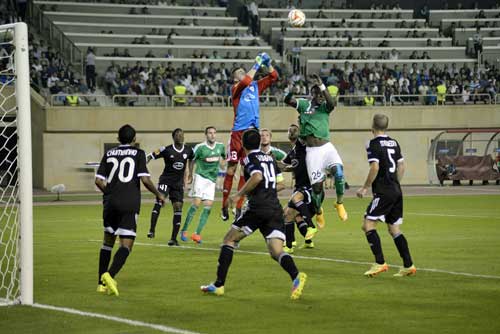
The one thing the Scottish Premier League club will be well aware of is Qarabag's pedigree in European competition in recent seasons. Since 2009, The Horsemen have beaten big names from across the continent including Rosenborg, Wisla Krakow, Red Bull Salzburg and Dnipro Dnipropetrovsk. Last season, they became just the second Azerbaijani team ever to qualify for the group stages of the UEFA Europa League and the 1-0 win over Dnipro (October 23, 2014) was the first ever victory for a club from the country in the group stages of a continental tournament. They also drew 0-0 with Inter Milan (December 11, 2014) - UEFA Champions League winners as recently as 2010 - during the same campaign.

While observers of European football might have heard of Qarabag's impressive scalps, few will know of the club's history, which is both fascinating and fraught in equal measure. Founded in the town of Agdam in 1951, the side first competed in the Azerbaijani championship in 1966 under the name of Mehsul and achieved an impressive fourth-place finish in its debut season as a professional team. A lack of financial support for the club saw them withdraw from the league between 1968 and 1977, before competing once again under the name of Shafaq, while Qarabag was known as the 'Cooperative Society' between 1982 and 1987. They won the title for the first time in 1988 under their current name of Qarabag.
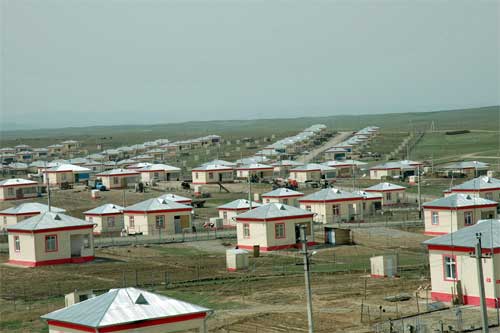
The challenging backdrop the club had faced for much of its history was elevated to a new level in 1993, when the town of Agdam came under Armenian control during the Nagorno-Karabakh war. The side had to move from their Imarat Stadium home to Baku and tragically suffered human loss when their head coach Allahverdi Bagirov died having driven over an anti-tank mine near to Agdam.
Despite the socio-economic problems the club encountered (they also had serious financial problems during the 1990s), they fought on through these hard times and in 1999, became the first Azerbaijani team to win away from home in a European competition with a 2-1 victory at Maccabi Haifa in the UEFA Intertoto Cup. To date, Qarabag have played an impressive 57 matches in European competition, winning almost half (21) of those ties.
Since 1993, the club has won the Azerbaijan Premier League on three occasions, the Azerbaijan Cup four times and the Azerbaijan Super Cup in 1994. Along with the nation's most successful side - Nefchi Baku - Qarabag are the only other side that have played in every season of the Azerbaijan Premier League since it was formed back in 1992.
Qarabag's triumphs amidst so many adversities makes for a fascinating story and it's little surprise the club has been the subject of both a film and a book in recent years. In 2012, Dutch freelance journalist and writer Arthur Huizinga released Offside - Football in Exile - charting the history of the team and the human tragedy of the conflict in the Nagorno Karabakh region that is a frozen but unresolved situation accounting for hundreds of thousands of refugees. Arthur and colleague Dirk-Jan Visser's photography is stunning and shocking - a true eye-opener into a geopolitical conflict that has received little attention from the West.
Last year, American author and journalist Thomas Goltz teamed up with Huizinga to put together a film also called 'Offside' - that can be viewed at vimeo.com/97095574 - shedding further light on Qarabag's sporting achievements and the war-ravaged city of Agdam they are exiled from.
"My interest in Azerbaijan started in the fading days of the USSR in the summer of 1991 when I was on my way to Soviet Uzbekistan on a two year fellowship," explains Goltz, who has an MA in Middle East Studies from New York University. "Azerbaijan was not even part of the (university) programme but thanks to an illegal visit there in July 1991, I got hooked! When the USSR collapsed later that year, I returned and have maintained a near constant contact ever since - some 24 years! (For more on this connection, read Thomas' book: Azerbaijan Diary (M.E. Sharpe, 1998)
"As for Qarabag FK, my interest is equally coincidental. I was visiting an important friend about something quite different in 2010 or 2011 and he suddenly said he had to break off our meeting because he had to go to a football game. He asked if I would I like to come. I had never been to a football game before, so I said 'yes' and off we went. It was Qarabag-Agdam playing some Polish club (Wisla Krakow). They (Qarabag) won, and after I went off to dinner with my host and several other folks from the stands. They turned out to be Taher Gozel, the Qarabag owner, and Elxan Mammadov, the chairman of the AFFA (Association of Football Federations of Azerbaijan)..."
Arthur Huizinga's interest in the Nagorno Karabakh began in 2006 as he travelled through South Caucasus for the first time with friend and award-winning photographer Dirk-Jan Visser. The aim of his trip, which took in Georgia, Armenia and Azerbaijan, was to gain an understanding of daily life in this volatile post-communist region.
"In Soviet times, Nagorno Karabakh was an autonomous region within the Azerbaijani Soviet Republic," comments Huizinga. "According to the last reliable census from this time, 76% of residents were ethnic (Christian) Armenians and 23% were ethnic (Muslim) Azeris. Although the two communities were never fully integrated, friendships and marriages across ethnic lines were not uncommon and the region was relatively peaceful.
"As the Soviet Union softened its hard-line rule and liberalised in the 1980s, the Armenian majority began to feel dissatisfied with its treatment by the Azerbaijani authorities and demonstrated to request a transfer to the Soviet Republic of Armenia. When the Soviet Union finally crumbled and dissolved during 1990 and 1991, the conflict escalated into an outright war between Karabakh-Armenian militias (covertly and then overtly backed by Armenia itself) and the Soviet Interior Ministry troops and, after independence, the newly-formed Azerbaijani Army and volunteer militia groups. The Armenians surprisingly won the war and not took control of the Nagorno Karabakh but also managed to take a considerable amount of territory surrounding the region, including the Azerbaijani town of Agdam.

"When the cease fire was negotiated in 1994, Nagorno Karabakh remained in local Armenian control and other captured territory outside the region became part of a militarised zone."
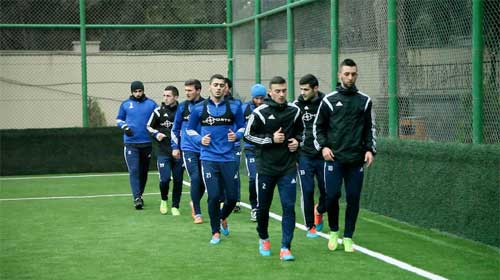
As Arthur's growing fascination with Nagorno Karabakh grew, he learnt about Qarabag FK of Agdam and with a keen interest in football also, the Dutchman returned to Azerbaijan in 2008 to meet the players and people behind the scenes at the club. The freelance sports journalist, who currently writes for NOS Sport and Voetbal International in the Netherlands, had a number of articles on the club in the Dutch media in 2009 and visited Azerbaijan a number of times thereafter with Dirk-Jan to capture the stories of the footballers, fighters, widows and refugees whose lives had been so affected by the conflict. Those stories would eventually form part of their book and travelling exhibition, both called Offside.
A meeting between Arthur and Thomas Goltz last year would then see a film on the same themes produced by Goltz.
"Arthur had contacted me a few years before we met to ask if I had any information on Qarabag - I had none to offer," says Goltz. "In 2014, he announced that he was in Baku and wanted to meet. We did so, and I decided to interview him for a different film I was working on that has the working title Azerbaijan Through Foreign Eyes.
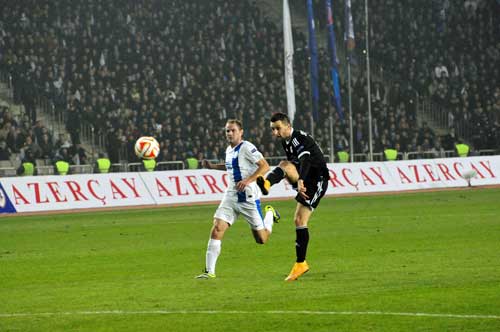
"We met at the Tofiq Bahramov Stadium (Qarabag's 'home' ground of recent years) just before the match on May 7, 2014 match that confirmed the destination of the Azerbaijan Premier League title. I did not even stay for the entire match. The next day in the studio, I took a look at the rushes. I determined that Arthur was no 'fit' for the Foreign Eyes film but that he was so utterly charming and serious about his passion that I decided to make a stand-alone, five minute mini-piece about him and 'his' team. Later that summer, I was given to understand that the Horsemen were contenders for qualification to the UEFA Europa League group stages. I assumed Arthur would be tracking the Horsemen, but he could not due to family concerns. So I just sort of fell into the team as Arthur's replacement because somebody had to do it… even a football ignoramus such as myself!
"Making the film was like a 'bildungsroman' for myself and contained so many discoveries they are difficult to list. I think the most profound of them all was the discovery that Qarabag had actually won the Azerbaijan Premier League title back in 1997, but had it stripped away by corrupt officials in Baku. No one had told me about this and no one wanted to talk about it. Everyone was in denial about this scandal. But my studio team of young Azerbaijanis were insistent that we put it in the film, and we did so, almost secretly. Everyone who had been in denial then thanked us for our courage."
The Azerbaijani-language subtitled version of the film was broadcast twice in July this year on the ANS TV channel - Azerbaijan's most-watched station and received a huge response, especially in the refugee community, with the version going viral on Azerbaijani websites and Facebook groups. (see www.myvideo.az/?video_id=2017463). The English language film has been shown in Montana and New York in the United States and the next aim is for it to be shown in Europe and on the film festival circuit.
In terms of 'what's next' for Qarabag meanwhile in the opening of a new, purpose built stadium in their adopted home city of Baku, though the date the construction will be complete remains unclear. More imminently, the target is to overcome Celtic in front of an expected 31,200 sell-out crowd at the Tofiq Bahramov Stadium on Wednesday that would incredibly see the team just one tie off becoming the first-ever Azerbaijani club ever to make it to the group stages of the UEFA Champions League.
"In terms of (Qarabag) players to watch out for (on Wednesday), Qara Qarayev, Namiq Yusifov and captain Rashad Sadyqov are refugees," comments Goltz. "I am also very partial to Maxim Medvedev, a Baku-Russian and Ansi Agolli from Albania. A lot of star players have recently been transferred over the last month or two, with the biggest loss being Muarem Muarem… arguably the Qarabag's player of the season in 2014-15."
Amongst an estimated 5,000-strong British community in Baku is 64-year-old Wolverhampton Wanderers supporter Ian Peart, who has been in the city for over 15 years. He enjoyed watching Qarabag at the Tofiq Bahramov Stadium and offers his take on the Azerbaijani team's strengths ahead of Celtic's visit.
"I think it would be fair to add a word about (manager) Qurban Gurbanov's work in creating a passion about the identity of the team and what it represents for Azerbaijan," said Peart. "The team's highly disciplined, possession-based style of play is clearly modelled on the Barcelona style. While there have been some big-name departures, Qurban has also brought in some good Azerbaijani players, as well as the foreigners and has just signed a big Dutch striker (Rydell Poepon). He'll be needed for matches when opponents 'park the bus'."
It's certainly in the realms of possibility that Celtic themselves will look to park the bus on Wednesday as they look to cling onto their one goal advantage in the tie. Win or lose, another historic and fascinating tale in the Qarabag story looks set to be written.
Related Football Articles
Buy tickets for soccer matches around the world