EURO STORIES - WALES 2016

Andy Greeves looks back on Wales' memorable qualification and run to the semi-finals of UEFA Euro 2016.
Yugoslavia 1976 and 1983, Scotland 1977, Romania 1993, Russia 2003…
And so, the list of heartbreaking qualification near-misses went on during an agonising 58-year wait between the 1958 FIFA World Cup and UEFA Euro 2016 for Wales to compete at a major international tournament.
As well as the 'oh so near moments', were the sustained periods where Wales were way off the qualifying pace. A 5-0 defeat to Georgia in a UEFA Euro 1996 qualifier can be cited amongst a vast list of humiliations for Wales supporters during the mid-1990s to early 2000s era.

There was a turnout of just 10,201 at the 72,500-capacity Millennium Stadium for a 2002 FIFA World Cup qualifier against Belarus in October 2001, with the Dragons long since out of contention for a place in the finals by then. Ironically, the only game of the 10-match qualifying campaign that Wales actually won was that 1-0 home triumph over Belarus in what was the final group fixture. Four years later, there was a 1-0 friendly defeat to Cyprus, described by then-manager John Toshack as "the worst international performance I have ever witnessed."
There was a brief flicker of hope during the UEFA Euro 2004 qualification campaign as Mark Hughes' side beat Italy 2-1 in Cardiff in October 2002 and finished second in Group 9. But a streetwise Russia denied Wales a place in the tournament finals with a 1-0 aggregate play-off victory. And the Welsh footballing malaise soon set in again as the Dragons finished second from bottom in their qualifying group for the 2006 FIFA World Cup and fifth in Group D - above only Cyprus and San Marino - in the race to get to UEFA Euro 2008.
A 2-0 home defeat to Finland, in front of a crowd of 22,604 at the Millennium Stadium in March 2009 all but ended hopes of qualification for the 2010 FIFA World Cup meanwhile, with captain Craig Bellamy summing up the apathy around Welsh football at the time after the match.

"They're not a good side," Bellamy told Sky Sports, commenting on the Finland side that had run out victorious in Cardiff. "I suppose you've just seen two poor sides trying to contest this group. None of us have a glimmer of hope of qualifying. That's a fact after what I've seen today. Where we go from here? God knows."
The short answer to Bellamy's rhetorical question, was things got even worse.
In August 2011, Wales dropped to an all-time record low 117 in the FIFA World Rankings. But it was around that same period that seeds of change were being sown by manager Gary Speed, as he looked to improve training facilities and make training camps more professional as well as changing the infrastructure of the Football Association of Wales (FAW) from top to bottom.

Speed installed 22-year-old Aaron Ramsey as national team captain and oversaw a 2-1 home win against Montenegro, a 2-0 home win against Switzerland and a 1-0 away win against Bulgaria in the autumn of 2011. Wales had moved up to 45th in the world rankings by October 2011 and were subsequently awarded the title of 'Best Movers' of the year having gained more ranking points than any other nation in 2011. What proved to be Speed's last game in charge of Wales - a friendly against Norway on 12 November 2011 - saw Gareth Bale steal the show with a thunderous opener and a magnificent display in a 4-1 victory.
With the qualifying campaign for the 2014 World Cup due to begin the following year, maybe just maybe this was Wales' time to make it to a major tournament with their bright young team and manager.
But on 27 November 2011, tragedy struck. Speed's death, at the age of just 42, was announced by the FAW to the shock and disbelief of the football world. Football seemed a complete irrelevance at this time but the fixtures would keep coming and the FAW ultimately had to appoint a new manager.

Speed's good friend Chris Coleman was ultimately the man they turned to. At a press conference, the ex-Fulham, Real Sociedad and Coventry City boss described his appointment as the "proudest moment" in his career whilst acknowledging the circumstances that obviously meant it was "bittersweet".
Within the first four months of Coleman's appointment, the hope Speed brought to the team and footballing public of Wales seemed to have evaporated. Coleman's first match in charge was a 2-0 defeat to Mexico in May 2012 and then the 2014 FIFA World Cup qualifying campaign began with a 2-0 defeat to Belgium and a 6-1 hammering in Serbia in Group A. Hopes of qualifying for a major tournament once again seemed to be over before they had even started. Wales finished in a familiar second from bottom position in Group A but they did at least end the campaign with an away win in Scotland, a 1-0 victory against Macedonia in Cardiff and a draw with Belgium in Brussels in 2013.
That same year, Gareth Bale - the star of a gifted Wales squad - completed a then-world record transfer to Real Madrid, where he would go on to win three La Liga titles, five UEFA Champions Leagues and three FIFA Club World Cups. With the world's most expensive player and the likes of Ashley Williams, Joe Allen and Aaron Ramsey all in their footballing prime, there was a feeling - as there had been under Speed - that the major qualification that had eluded past generations of Wales teams could finally be possible.
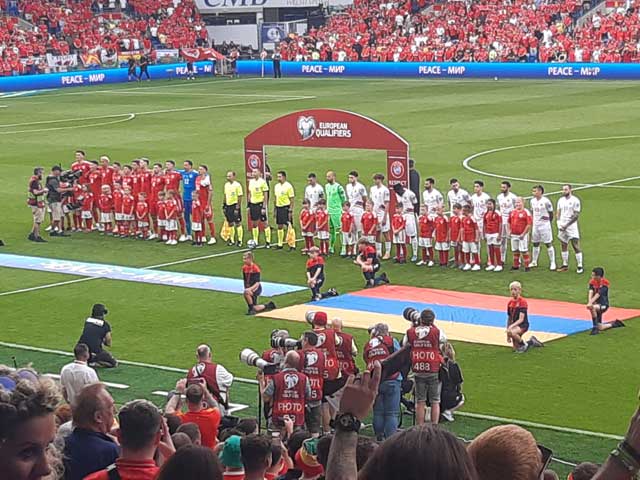
Going into the qualification campaign for UEFA Euro 2016, a growing unity between players and fans was reflected in a simple slogan created by the FAW - 'Together. Stronger'. The scenes of celebration after Bale's late free-kick got their Group B fixtures off to winning start in Andorra also perfectly illustrated this togetherness.

A goalless draw with Bosnia and Herzegovina and a 2-1 win over Cyprus in October 2014 carried on the momentum. And it was a resolute performance and another goalless draw with Belgium - then ranked fourth in the world - the following month that laid down a real marker.
A 3-0 win in Israel in March 2015 brought dreams of a summer in France in 2016 tantalisingly close for Wales fans. Then, on a balmy night at the Cardiff City Stadium on 12 June 2015, the Dragons beat Belgium 1-0 to go three points clear at the top of qualifying Group B. Bale's winner was roared in by a crowd of 33,280 that sounded more like 330,280. For any Wales fan fortunate enough to have a ticket that night, it is a performance and atmosphere they will never forget.
For supporters of other football nations, 14 points from six matches with four fixtures left to play might lead to assumptions that qualification was all but done. But even after a 1-0 win in Cyprus in match seven, the mental scars of past failures meant the champagne was well and truly on ice in Wales until a place at UEFA Euro 2016 was mathematically assured.
The Dragons hosted Israel in September 2015, knowing a win would deliver just that. But a goalless draw meant the search for a place in France would go on for at least another matchday. And when Bosnia and Herzegovina beat Wales 2-0 in Zenica in October 2015, the most optimistic fan could have been forgiven for fearing another qualification campaign might be about to have a cruel twist in the tale.

But not this time.
On the same night of Wales' defeat to Bosnia and Herzegovina, third-placed Israel were beaten 2-1 by Cyprus, sparking wild scenes of celebrations from the away fans in Zenica as Wales sealed an historic qualification. That same month, the Dragons rose to a country-record eighth in the FIFA World Rankings. True halcyon days indeed.
Tennis player Arthur Ashe once said; "Success is a journey not a destination. The doing is often more important than the outcome." And in Wales' case, the qualifying journey that took them to France - after a 58-year-absence from a major tournament - was every bit as important as the ultimate destination - a place in the semi-finals.
The achievements of Coleman's side in reaching the last four of a major competition after such a period in the footballing wilderness will be the stuff of Welsh folklore for generations to come. And it all started with a 2-1 win over Slovakia in their first appearance at a European Championships on 11 June 2016. Even though Wales went down to a stoppage time Daniel Sturridge goal in a 2-1 defeat to old rivals England in their next Group B match, there never seemed any worry that the Dragons would progress to the knockout phase. And as commanding a display as Wales had ever produced under Coleman came in their third group game as they beat Russia 3-0 to top Group B and set up a round of 16 clash with Northern Ireland in Paris.

That game against Northern Ireland was far from a classic - not that anyone with Welsh blood was bothered. A 1-0 win took Wales to a quarter-final meeting with qualification rivals Belgium in Lille on 1 July 2016. 55 minutes into that match, Hal Robson-Kanu's iconic turn and shot made it 2-1 to Wales. "Go and wake your kids up… something special is happening," wailed former Wales international Robbie Savage, who was on co-commentary duties for the BBC that night. Savage wasn't wrong.
Sam Vokes added a third in a memorable 3-1 win over Belgium before Wales lost 2-0 to Portugal in the semi-finals. While the defeat was painful, the overall feeling of hope and joy achieved by Wales' class of 2016 far exceeded it.
Like London buses, you wait ages for one to come along and then two arrive together. Or, as in the case of Wales and qualification for a major tournament, three. After UEFA Euro 2016, Wales returned to the delayed European Championships in 2020. And then, in 2022, the Dragons were back at a FIFA World Cup for the first time since 1958.
The qualification campaign for UEFA Euro 2024 ended in the kind of heartbreaking fashion Wales teams of decades past were used to, as they lost a penalty shootout in the play-off final to Poland. The nation is currently without a manager, while the talismanic Gareth Bale hung up his boots in 2022. But the hope generated by the 'Boys of 2016' still lives on. No longer are the images of Wales at a major tournament from a bygone age. The dragon has well and truly been awoken.
© Andy Greeves & Soccerphile.com
Buy tickets for soccer matches around the world