
UK Stadiums: bet365 Stadium, Stoke, England

bet365 Stadium in Stoke-on-Trent, Staffordshire, is the home ground of Stoke City Football Club.
It replaced the Victoria Ground, Stoke's home from 1878 until 1997. The ground, built on the site of a former colliery, was known as the Britannia Stadium until 2016 when it became the bet365 Stadium after the name of its owners.
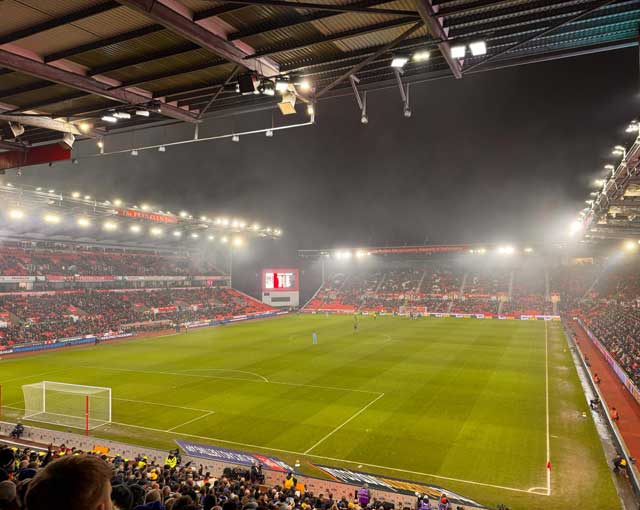
The all-seater stadium can hold 30,089 supporters in four cantilever stands. The four stands are: The Boothen End sponsored by Staffordshire University (North), The Franklyn Stand (West), The Tile Mountain Stand (East), and The Caldwell Construction Stand (South).
The Tile Mountain Stand has the biggest capacity at 10,720. The South Stand, accommodating both home and away supporters, has a capacity of 4,996. The club's dressing rooms, offices, boardroom, ticket office, and club store are located between the West and South Stands. To combat traffic congestion, a new underpass named Stanley Matthews Way was constructed.


History
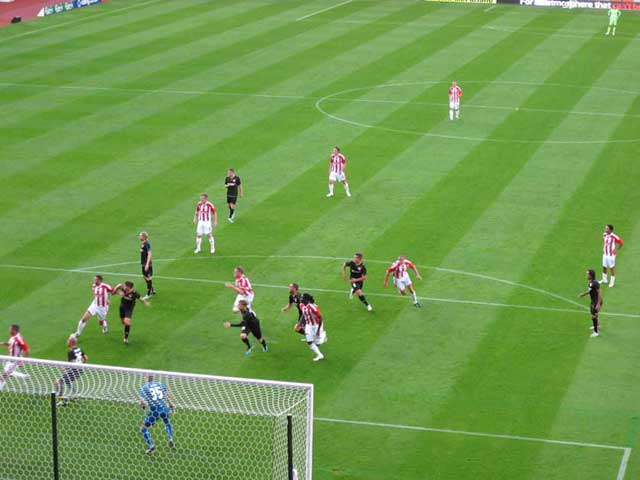
The stadium was built at the cost of 14.8 million British pounds. Stoke City great Sir Stanley Matthews officially opened the venue in 1997 and his ashes were buried beneath the centre circle following his death in 2000. In European competitions, the ground is referred to as the Stoke City Stadium due to UEFA's restrictions on sponsorships.
Initially founded as Stoke Ramblers in 1863, the club changed its name to Stoke City in 1925 after Stoke-on-Trent was granted city status. Before the opening of bet365 in 1997, Stoke were based at the Victoria Ground, which had been their home venue since 1878. Their fiercest rivals are Port Vale, with whom they contest the Potteries derby. West Bromwich Albion and Wolverhampton Wanderers are also seen as local rivals.
Stoke's first season (1997-98) at the bet365 (then called the Britannia Stadium) ended in huge disappointment, as a 2-5 home reversal against Manchester City condemned the Potters to the third division. Curiously, the Citizens were also relegated. This led to huge protests against chairman Peter Coates, who stood down, only to return in 2006.

The bet365 Stadium has been known for a long time for its open corners. Surveyors had been investigating the plausibility of filling in one or possibly two corners since 2009. Filling in one corner would roughly cost three million pounds, taking the capacity up to 30,000. However, the club's upper management were wary of expansion, as it would lose what Chief Executive Tony Scholes calls the 'sell-out' factor. That comment was made in 2011, but by the summer of 2017, the expansion work had been concluded. The arena now holds 30,089 spectators.
Before the 2023-24 season, Stoke upgraded their floodlighting system with advanced LED technology. The upgrade also enabled the stadium to host light shows, which have since become a regular feature at evening games. These pre-match displays have added to the match day atmosphere.
The bet365 previously hosted the Conference National playoff finals for three consecutive seasons starting from 2002-03.
Stoke City
Nicknamed the 'Potters,' Stoke was among the twelve founding members of the Football League in 1888. Their biggest glory came in 1971-72 when they defeated Chelsea to win the Football League Cup. The Potters are yet to claim the FA Cup trophy, though they came agonizingly close in 2011 when they faced Manchester City in the final.
In recent history, the success story of Stoke cannot be told without Tony Pulis, who led his team to Premier League promotion in 2007-08. Their FA Cup final appearance led to European football, which they experienced twice previously. After negotiating a qualifying round against FC Thun and a play off against Hadjuk Split, the Potters finished second in a Europa League group containing Besiktas and Dynamo Kyiv, before crashing out at the Round of 32 stage against Valencia. Stoke have not participated in UEFA competition since.
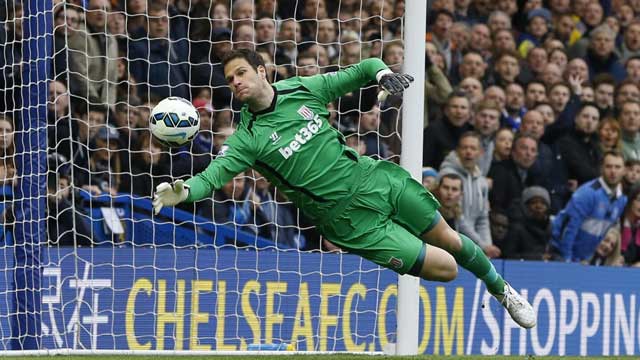
Statistically, Stoke's greatest season during the Premier League years was in 2014-15, when they amassed 54 points. Appointed in 2013-14, manager Mark Hughes bought in the likes of Marko Arnautović, Xherdan Shaqiri and Bojan Krkic to shift to a more continental play style. Asmir Begovic, Glenn Whelan, Jonathan Walters and Mark Shawcross were key figures in sustaining Stoke's success. However, fans will most fondly remember the cult heroes Rory Delap, Peter Crouch and Ricardo Fuller. Delap's throw-in techniques had become such a weapon that some teams were happier clearing the ball for a corner instead. Crouch made 225 appearances for the club between 2011-2019 scoring 46 goals.
Greatest Players
Some of the greatest Stoke City players include Gordon Banks and Sir Stanley Matthews. Legend for both Leicester and Stoke, Banks cemented his legacy with his outrageous one-handed tip-over denying Pele in World Cup '70. Stoke acquired Banks's services as Tony Waddington, who took charge of the Potters for over fifteen years, felt it was of the utmost importance to have a solid player behind the sticks. The two men subsequently built a close relationship. Banks' brilliance became immediately obvious one time in 1969 when after colliding with Sunderland's Malcolm Moore at Roker Park he had to be substituted for concussion. His replacement David Herd let in four goals in a 1-4 loss.
In a 2002 autobiography, Banks states that he made three of his best career saves whilst wearing the Stoke jersey. The first was when he denied a powerful header by Man City's Wyn Davies, the second also a header this time from Francis Lee, and the third saving Alan Gilzean's volley against Tottenham. Banks was part of the 1972 team that defeated Chelsea to win the League Cup. Peter Osgood's scrappy goal was sandwiched by efforts from Terry Conroy and George Eastham to give Stoke their sole major cup glory.
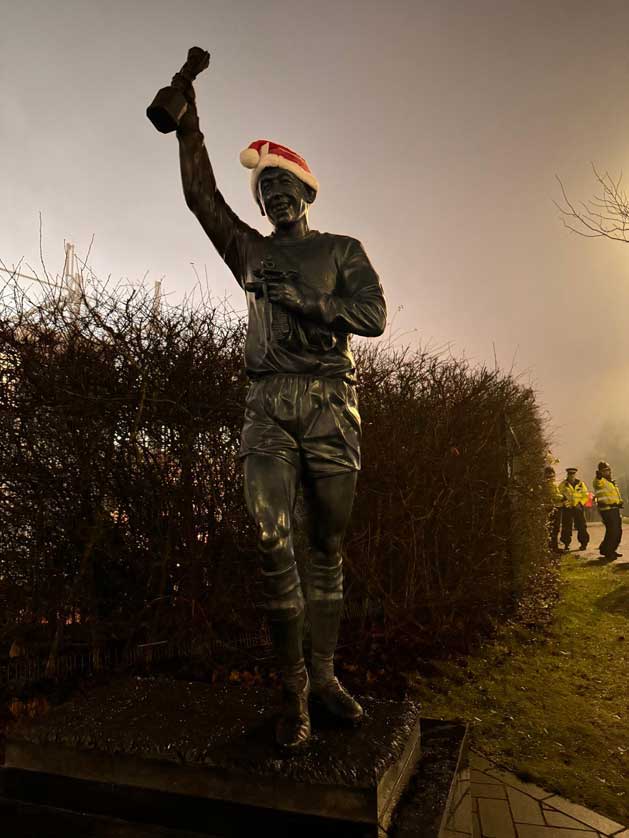
A life-size bronze sculpture of Gordon Banks by local sculptor Andy Edwards stands on Stanley Matthews Way outside the ground. He joined another former Stoke icon, Stanley Matthews, whose statues (three nine-foot figures showing Matthews at different stages of his career) are also at the stadium.
Sir Stanley Matthews, a local lad from Hanley, kept fit enough to feature at top-flight level until age 50. Although he had two spells at Stoke, he is mostly known for his exploits at Blackpool, where he won the inaugural Ballon d'Or trophy. Somewhat strangely, Matthews grew up supporting fierce rivals Port Vale.
His father wanted Stanley to follow in his footsteps and become a boxer, but by age 13 he chose to pursue a football career. From the ages of 24 to 30, World War Two got in the way of football. He joined the Royal Air Force, stationed near Blackpool with Ivor Powell as his NCO. He advanced to the rank of corporal but admitted in his 2000 autobiography to being one of the most relaxed and easy-going NCOs in the service. He eventually transferred to Blackpool as he was still based there following his time in the RAF.
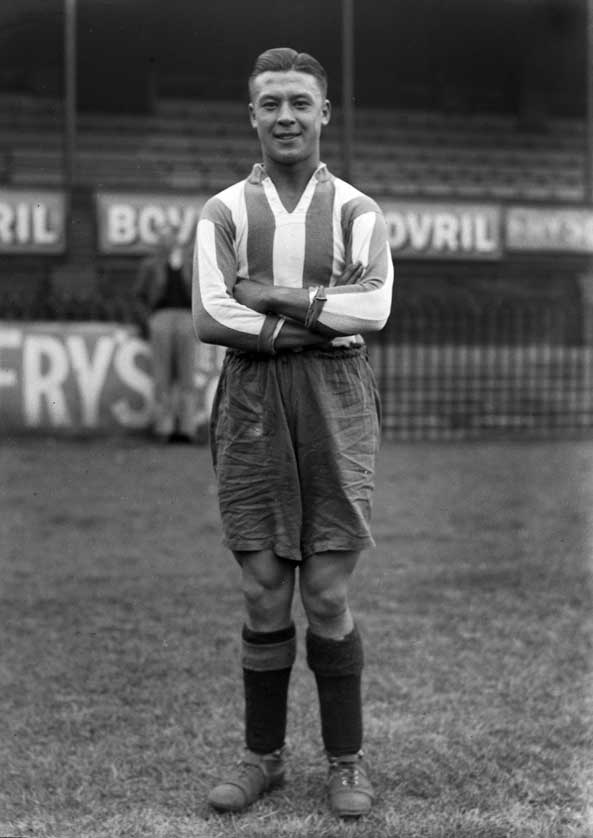
Frank Soo made his debut for Stoke City FC against Middlesbrough in 1933. Between 1933-1945, Frank went on to make 268 appearances, scored 20 goals, and was part of the great Stoke City team of the 1930s, alongside Joe Mercer, Neil Franklin and Sir Stanley Matthews. Frank was the first person of East Asian heritage to play in the Football League, the first person of colour to play for England (9 Wartime and Victory friendly appearances) and first person of East Asian heritage to manage in Europe.
Back to the present day, there is some fanfare with the South Korean number 10 Bae Jun-ho formerly of Daejeon Hana Citizen in the K-League, who earned all of his total caps in 2024. He has already amassed 60 appearances for the club since his move in August 2023. Though not as impressive as Bae, Japanese defensive midfielder Tatsuki Seko is the other Asian representative. The former Yokohama FC and Kawasaki Frontale player is yet to earn a cap for the Samurai Blue.
On 27th December 2024, Catalonian manager Narcís Pèlach was sacked as head coach after only three months. Stoke are currently mired in relegation trouble.
Stadium Facts
The record attendance at the bet365 was 30,022 v Everton for a Premier League game in 2018.
Access - Getting There
The nearest major railway station to the ground is Stoke-on-Trent Station.
Stoke-on-Trent Station has trains to London Euston, Birmingham New Street, Manchester Piccadilly, Derby and Crewe, among other destinations.
There are shuttle buses to the stadium from Glebe Street by St Peter's Church, a short walk from the station, on match days. The regular 14 bus also runs to the ground from the station, approximately twice an hour. The number 20 bus service is another option. It departs for the stadium from Stand N at the Stoke-on-Trent City Centre Bus Station (in Hanley) via Stoke-on-Trent railway station and Stoke town center.
By car leave the M6 at Junction 15 and take the second exit (straight on) at the first roundabout onto the A500. Then the A50 for the stadium.
Address: Stanley Matthews Way, Stoke-on-Trent, ST4 4EG
Nearby Hotels
A recommended hotel in Stoke close to the ground is the 3-star Holiday Inn Express Stoke-On-Trent right on Stanley Matthews Way.
The Hilton Garden Inn Stoke On Trent is a 4-star property in Hanley.
DoubleTree by Hilton Stoke-on-Trent is a 4-star hotel close to Alton Towers.
See here for a complete listing of hotel accommodation in Stoke.
Text by Joji Imamiya
More UK Stadiums
Kirklees Stadium (John Smith's Stadium)
©Soccerphile.com
Buy tickets for soccer matches around the world