
Fujieda Soccer Stadium, Shizuoka Prefecture

Fujieda Soccer Stadium (藤枝総合運動公園サッカー場), in Fujieda, Shizuoka, Japan, is a stadium with a capacity of 13,000. It is the home of Fujieda MYFC and opened in 2002. The ground is part of the Fujieda Sports Complex Park and is owned by the city council.



Stadium Overview
Inside the ground, there is a "soccer gallery". The exhibition commemorates the football greats born in the city of Fujieda, namely Makoto Hasebe, Gon Nakayama and Nobuhisa Yamada. Hasabe, who was captain of the Japan national team in the 2010, 2014, and 2018 World Cups, played for Fujieda East High School in his youth and subsequently signed for Urawa Reds, skipping university football entirely. Nobuhisa Yamada spent his entire career with Urawa playing 540 times for the club.
When the ground first opened, many of its facilities were below J2 standard, and needed petitions from local citizens to push for remodelling. Firstly, there weren't enough seats that had a roof cover. Secondly, the lack of floodlights meant there wasn't enough illuminance to host a high-level night game. In 2012, a total of 55,116 people signed a petition urging the city council to provide a better stadium capable of hosting J League teams.
The J2 league kept denying Fujieda's bid for election, but when J3 was formed in 2013, they joined the competition immediately. Until June 2022, the lighting standards were inadequate for J2.
In 2020, the city approved the plan to improve lighting and roofing for a budget of 113 million yen. Before the start of the 2021 season, MYFC secured its J2 license.
The aforementioned backstand is a new installation, completing its construction in January 2024. The stand contains a disaster prevention warehouse.
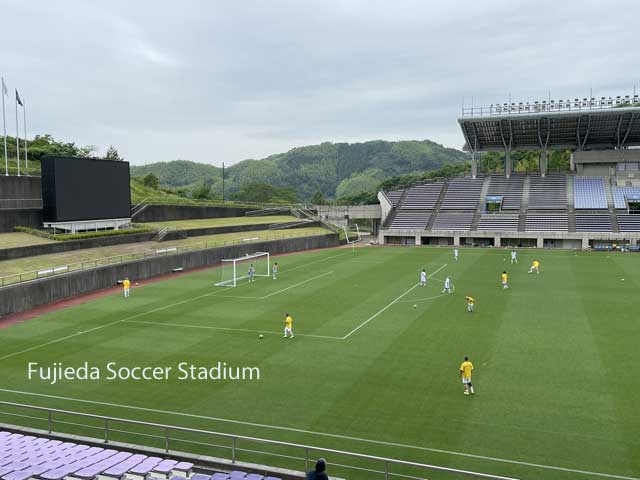
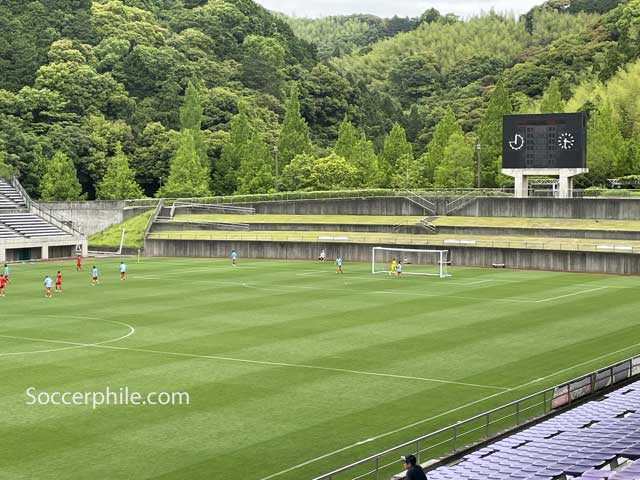
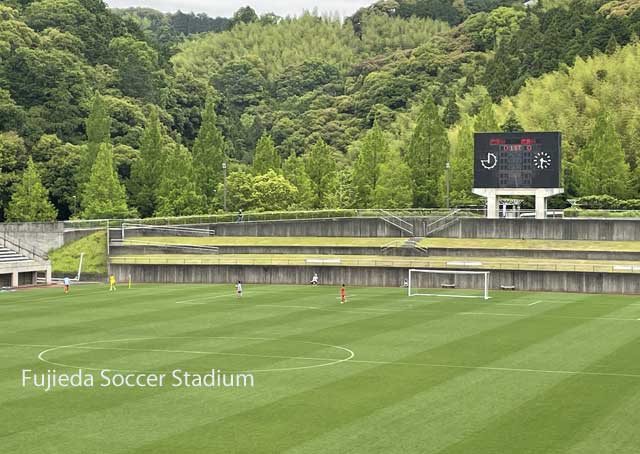
There is a single electronic scoreboard, which only displays the score and has no additional features.
The club has installed Tifton grass as the playing surface.

Stadium Stands
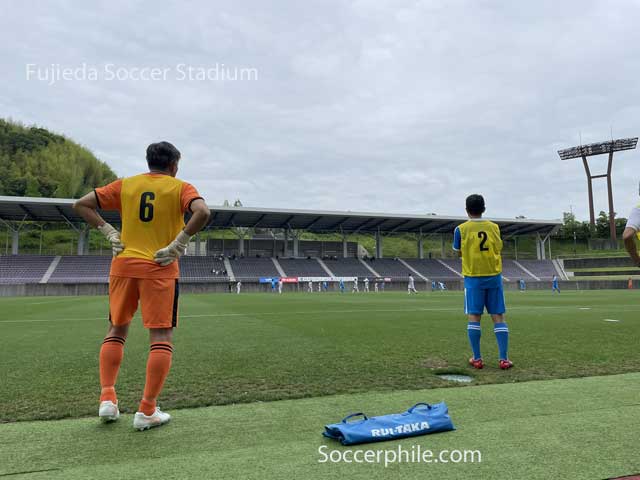
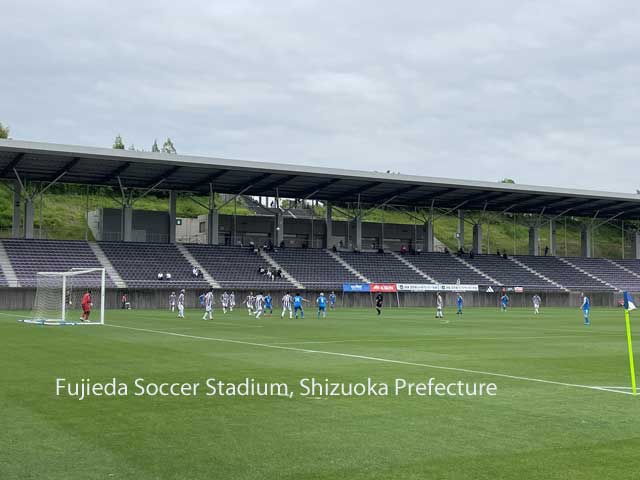
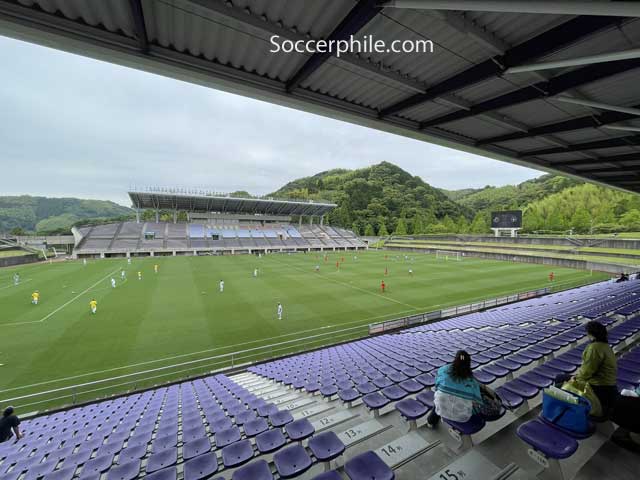
Three tiers of reinforced concrete stand tall on a 28,000 square metre area on the west side. This is the main stand, which has a capacity of 5,100. On the other side is the back stand, having a 3,860-sized capacity. Behind the goals are sloping turf surfaces, common in small Japanese stadiums.
The club states that the stadium's official capacity is 13,000. However, because the J.League does not count lawn seating toward official capacity, the venue is currently recognised as having a capacity of 10,057, including terraced standing areas.

Stadium Miscellaneous
Soon after the stadium's construction, the Senegalese national team used the arena as a training base for the 2002 FIFA World Cup.
Jubilo Iwata and Nagoya Grampus faced off here in February 2006 for a pre-season friendly. Unfortunately for all parties involved, heavy rain made the playing surface unsuitable for football, and the game was called off at half-time. Nagoya had been a goal ahead at the time thanks to Keita Sugimoto. After the episode, then-Grampus coach Sef Vergoossen stated the necessity of the cancellation and admitted it was not an enjoyable outing for the supporters. As for Jubilo, their reserve team's match scheduled against Albirex Niigata at the same arena was also inevitably cancelled. Jubilo and Grampus did not organise a rematch.
The Inception and Paying Homage to Nelson (Club History)
High-level football in Fujieda dates back to 1982, with Chuo Bouhan (Central Security) Football Club. They were one of the founding participants of the old JFL and had ambitions of joining the new J League in 1993. As Fujieda Brooks, they considered applying for membership, but the basic Fujieda City General Sports Park Soccer Stadium was unfit for hosting matches. With Brooks unable to find a spot, they negotiated with the city of Fukuoka, which was desperate to have their team. As a franchise, Brooks' success was materialised by becoming a J League member in Kyushu, but they were soon renamed Avispa Fukuoka and based at Hakata-no-mori Stadium.
In 2009, Fujieda challenged to join the Japanese elite once more, this time as Fujieda MYFC. They had been active as Fujieda Nelson CF before the rebrand. The club name commemorates the legend of Nelson Yoshimura.
Nelson Yoshimura was born in the state of São Paulo in 1947 and moved to Japan in 1967 as the first foreigner to play in the Japan Soccer League. He had been working as a lathe operator at the Brazilian branch of Yanmar Diesel before transferring to Japan, where he joined the company both as a footballer and an employee. Bizarrely, Nelson himself has denied this being the case, claiming he had been working as a refrigerator repairman.
Whatever the case, he illuminated the league with his silky touch and flair in the attacking midfield role. He combined with Kunishige Kamamoto to devastating effect, making Yanmar Diesel a powerhouse of Japanese club football.
Although ultimately he did not leave a legacy to the extent of Sergio Echigo, he is no doubt one of the key pioneers of the Japanese game.
Nelson made his debut for the Japan national team in 1970 against IFK Göteborg. He naturalised in December 1970 and registered his Japanese name, Daishiro Yoshimura. His national career lasted until 1976, winning a total of 46 caps.
He went on to manage Yanmar Diesel between 1990 and 1993.

Pursuing Professionalism
The aforementioned Kunishige Kamamoto was hired as coach to start the new chapter of Fujieda MYFC in 2009. Kamamoto acknowledged he was more of a supervisor than a coach, and most on-field responsibilities were taken care of by Toshihide Saito, a member of the France '98 squad for Japan.
MYFC finished first in the top division of the 2009 Shizuoka Prefectural League. However, after failing to fulfill their match-related responsibilities on their home day - such as providing kits and other essential equipment - they were penalized and demoted to sixth place. S・B・R were crowned champions instead.
In January 2010, the club merged with Shizuoka FC. The new name after the announcement was to be "shizuoka. Fujieda MYFC". Kamamoto left the post in April.
In 2012, they decided on another name alteration, this time Fujieda MYFC, which continues to be the name today.
The J.League approved Fujieda's provisional membership in September 2013. The league also admitted Fujieda's election in J3 starting in 2014. Saito revealed he was to resign as manager.

The J3 Adventure Starts
MYFC's first season in J3 was a hard grind, finishing second bottom, only above Y.S.C.C. Yokohama. Musashi Mizushima, who was appointed head coach ahead of the new campaign, was to leave the post after the final matchday.
They improved their form for the 2015 J3 season, placing 10th in a thirteen-team league. There was plenty to celebrate in the Emperor's Cup, too. They performed a miraculous comeback and an upset in the second round by defeating first division Shimizu S-Pulse 4-2 at the IAI Stadium Nihondaira. Yosuke Kawai and Hideki Ishige put S-Pulse 2-0 ahead with only 15 minutes on the clock but MYFC were level before the break thanks to a brace from Tsugutoshi Oishi. Two goals from Yuichiro Edamoto in the second half confirmed Fujieda's extraordinary progression.
MYFC took on Montedio Yamagata away at the ND Soft Stadium Yamagata in round three. Oishi's effort in the first half made the game nervy for Montedio but they completed the turnaround after Shota Kawanishi and Diego secured the Tohoku outfit's victory.
For the 2017 campaign, MYFC underwent a massive reshuffle of the squad. Fourteen players, four of which due to retirement, left the club. To qualify for the Emperor's Cup proper, Fujieda had to overcome Azul Claro Numazu in the Shizuoka district final. They failed to accomplish that task, meaning they missed the finals for the second season running.
Still, it was clear they were on an upward trajectory in the league. MYFC had become a more potent threat in front of goal, evident from the 25 goals scored by their strikers Edamoto and Keisuke Endo. The club concluded the campaign in seventh, matching their result from 2016.

The Ishizaki Era
Local research company Seikan Kensa Center Inc. became the largest shareholder of MYFC in 2018. They got busy in the transfer market, signing 20 players.
They got off to a decent start by beating AC Nagano Parceiro at home but would lose three of their next four games, one of them being a 1-4 loss against Gamba Osaka U-23 at the Suita City Football Stadium. MYFC accepted the departure of Atsuto Oishi as head coach at the half-way stage and appointed Nobuhiro Ishizaki. This was a coup for the small J3 outfit considering he had a wealth of experience managing teams such as Kawasaki Frontale, Kashiwa Reysol and Consadole Sapporo. But MYFC did not get to enjoy a new managerial boost, losing ten of the fifteen games Ishizaki managed in his first season. Fujieda settled for 16th, only Giravanz Kitakyushu behind in the table.
The Shizuoka-based club was active once again during the 2019 transfer window, making several signings - including Yasuhito Morishima, who had an outstanding track record at Oita Trinita. Although they were battered 1-6 at the Nagai Stadium against Cerezo Osaka U-23, they topped the standings on matchday seven after overcoming Nagano Parceiro. MYFC were never outside of the top four places post-matchday 14 and were competitive throughout the season. The campaign ended with third place, which was Fujieda's best at the time.
MYFC were granted a J2 license in 2020, providing the team with added motivation to deliver their best performance. The club were brought back to earth in this period, finishing a disappointing tenth. Ishizaki announced his farewell at the end of the season.
The Sudo Era and J2
Fujieda started the 2021 season with Yasuharu Kurata at the helm, but he only lasted months before Daisuke Sudo took over.
The promotion battle in the 2022 J3 league was ultra competitive, with MYFC having to stave off the fight from Kagoshima United FC, Matsumoto Yamaga, FC Imabari and Kataller Toyama for second place. The final standings show that Fujieda won promotion by a point. It also confirmed after the end of J1 that due to Iwata and Shimizu's relegations, three Shizuoka teams would participate in the 2023 J2.
The club's first game at the J2 stage was versus Iwaki FC at the Hawaiians Stadium Iwaki. The home side were slight favourites as they stormed the J3 the previous campaign. But Fujieda came out on top with a 3-2 win, thanks to the three goals they scored in the first half.
It was true that Fujieda found some of the games difficult, notably the heavy losses at home against Tokyo Verdy and Roasso Kumamoto. But as the season wore on, it slowly became clear they deserved their place in the second tier. They secured their 12th place on account of their good firepower, as Ryo Watanabe found the back of the net often. He would soon depart for Cerezo Osaka. MYFC overall scored 61 goals, which was the sixth-best record, but shipped 72 goals, which was the worst in the division. This was also the first time Fujieda were on equal footing with the giants of the Shizuoka game, Shimizu and Jubilo Iwata. MYFC created local headlines on matchday 37 when they did a professional job on S-Pulse at home by winning 2-0. They concluded 2023 with a 2-4 home loss versus Iwaki FC. As a sidenote, Fujieda acquired the J1 license in September 2023.
MYFC struggled in the early parts of 2024. It started with a 0-0 home draw with V-Varen Nagasaki. As March arrived, they were thrashed by JEF Chiba at the Fukuda Denshi Arena 0-4 and were dumped out of the League Cup after a defeat at the Okinawa Athletic Park Stadium against FC Ryukyu. The club was second from bottom after ten matches. They bounced back a little in the middle of the campaign, but six losses from their final seven games meant Fujieda supporters had to be happy in 13th. The home match against Shimizu in September drew 10,667 spectators, setting a new attendance record. On the Emperor's Cup front, Fujieda drew a dream tie at home to Kashima Antlers in July. There was no giant-killing on this occasion, however, as Aleksandar Čavrić and Hayato Nakama contributed in a routine 2-1 win for the visitors.
As of July 2025, MYFC sit in 13th, six points above the drop zone. On July 16, Fujieda had a chance to showcase their abilities in the Emperor's Cup with a home fixture against Sanfrecce Hiroshima, but they were soundly defeated 2-5.
Past Players (Kerlon)
Kerlon Moura Souza, or Kerlon for short, was one of the most talked-about youngsters in football in the 2000s. He first entered the limelight in 2005 at the South American U-17 Championship in Venezuela, scoring eight goals in seven matches and helping Brazil steamroll the competition. The fact that he stood out in a squad amongst the likes of Marcelo and Anderson, who later played for Real Madrid and Manchester United respectively, was an enormous sign of promise.
Kerlon was brought up in the Cruzeiro youth system, gaining prominence for his seal dribble technique. In the 2007 derby against Atletico Mineiro at the Mineirao, one of the venues for Brazil '14, Kerlon's unique dribbling style incensed Mineiro's right-back Dyego Rocha Coelho, as he manhandled the winger using his elbow. It signalled the cruel nature of the sport for the precocious talent.
He eventually earned a move to Europe by signing for Inter Milan, but he first had to learn his trade at Chievo Verona. After just four outings, he was called back to the San Siro, but then-Inter manager Jose Mourinho had no faith in the Brazilian. Kerlon signed for Ajax Amsterdam on loan in 2009. But his aspirations were seriously derailed in the Netherlands as he was only given opportunities to play for Jong Ajax, the reserve team.
A grave knee injury in the summer of 2010 ended all hopes of playing for a top European side. Next stop for Kerlon was Paraná Clube, based in the city of Curitiba. The lack of momentum in his career took a toll on his mental health, and he started to flounder badly.
Hoping for a change of scenery, Kerlon chose Japan in August 2012 to sign for Fujieda, who were still a Japan Football League (JFL) outfit at the time. The mercurial player enjoyed a mini renaissance in Shizuoka, scoring nine goals in 22 appearances. He made his debut in Japan in September, coming on as a substitute in a match with Zweigen Kanazawa. He got his first goal in the next game, helping Fujieda to a 3-0 win over Sony Sendai.
Kerlon was forced to return to Brazil for a knee operation, departing the club on 20 January 2014.
His nomadic career continued with stints at Miami Dade FC, Sliema Wanderers in Malta, and Villa Nova Atlético Clube. He called it quits in October 2017 after featuring for Slovakian club Spartak Trnava.
Brazilian wonderkids may attract a lot of attention across Europe, but the arrival of Kerlon was a hugely low-key affair in Japan. A few Japanese media outlets, if any, have reports on the state of the ex-boy wonder.
*Thanks to Charlie Carmichael of These Football Times for this section
Club Miscellaneous
The city of Fujieda sees the wisteria and its flowers as a hugely significant symbol. The wisteria flowers can be seen on the club logo and MYFC adopt the color purple for their home jersey.
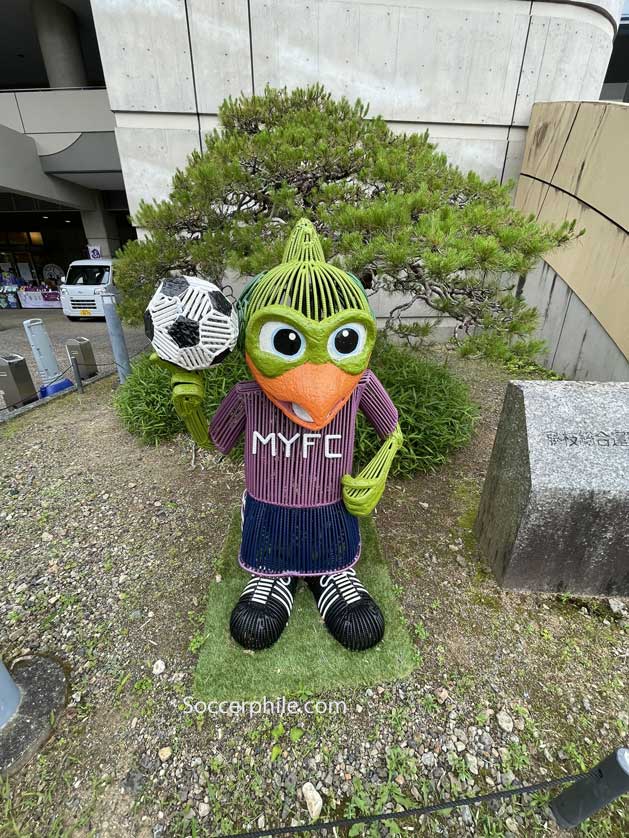
The official mascot is "Kettobashikozo", or "The kicking scoundrel" in English. It is a giant green bird but contrary to its appearance, it supposedly has a soft spot to its character. The mascot travels to local schools often to gain more future Fujieda supporters.
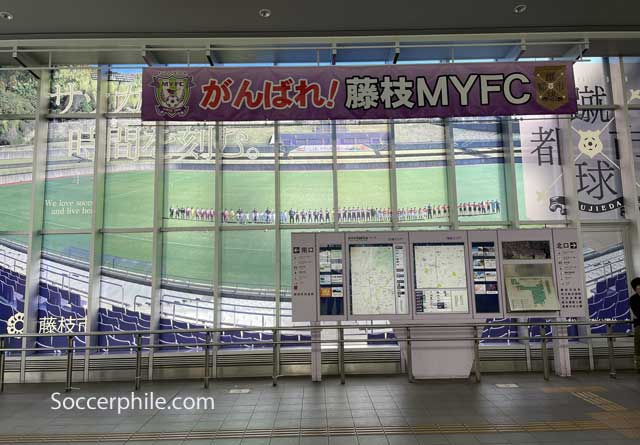
Head to the second floor of the BiVi Fujieda shopping mall to visit the official fan store. The mall is a three-minutes walk from Fujieda station.
Major Honours
Leagues:
Tokai League Division 1 (Fifth tier) winners in 2010, 2011
Accessibility
For persons using a wheelchair and their attendant, the club will subsidize 200 JPY per ticket.
Access - Getting There
Train & Bus
The nearest train station is Fujieda, located approximately five kilometers from the stadium. The most common public transport method is to use the Fujieda city community bus service, the vehicles of which are colored purple. Alight at Horinouchi-shita, then use the nearby stairs to climb up and access the highway. It is roughly a ten-minute walk from the bus stop.
Since mid-June 2025, shuttle buses on matchdays have begun charging fares.
If you are attending by car, access the Yaibana IC on route 1. There are 1,400 parking spaces, none of which are free and require a reservation.
Address: 100 Hara, Fujieda, Shizuoka 426-0086

Nearby Hotels
Shimizu Prefecture has a range of hotel and guesthouse options ranging from luxury 5-star properties to more affordable business hotels. The reasonable Hotel Trend Numazu Ekimae comes recommended and is close to Numazu Station and the town center.
J.League Stadiums
Tosu Stadium (Ekimae Real Estate Stadium)
Toyota Stadium Aichi Prefecture

©Soccerphile.com
Buy tickets for soccer matches around the world