UK Stadiums: Turf Moor, Burnley, England

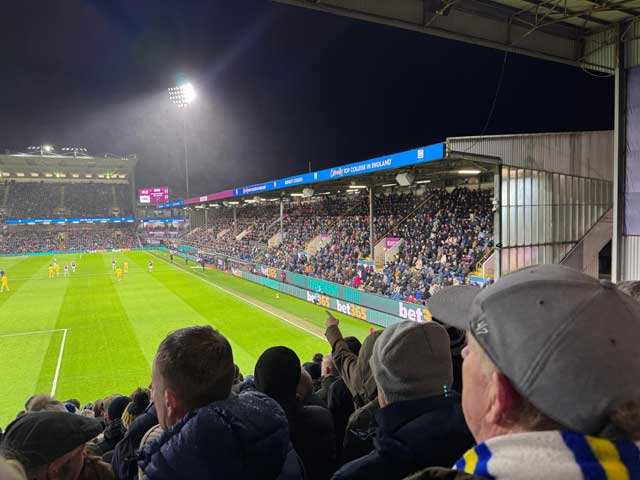
Turf Moor, in Burnley, Lancashire, England, has been the home of Burnley Football Club since 1883, making it the second-longest continuously used stadium in professional English football. Situated on Harry Potts Way - named after the manager who led the club to the 1959-60 First Division title - the stadium holds 21,944 spectators.

History
The arena features four stands: the Bob Lord Stand, the Cricket Field Stand (now the Barnfield Construction Stand), the North Stand, and the Jimmy McIlroy Stand. The North and the Jimmy McIlroy each feature two tiers, while the Bob Lord and the Cricket Field are single-tiered. The North Stand, built in 1996, can hold approximately 8,000 spectators and runs along the length of the pitch. The television gantry and press box are located at the rear end. The Jimmy McIlroy Stand, built in 1996, is located on the eastern side of the pitch and has a capacity of around 6,000. Along with the North Stand, it houses the stadium's corporate hospitality boxes.



Stands
Turf Moor made history in 1886, as the first football ground visited by a member of the Royal Family. Prince Albert attended a friendly between The Clarets and Bolton Wanderers. The stadium hosted its first Football League match in October 1888, with Fred Poland scoring the inaugural goal.
The Turf Moor site has hosted sports since 1843 when Burnley Cricket Club established it as their home.
In January 1883, the cricket club leased seven acres of land between the cricket field and Bee Hole Colliery to the east. The following month, they invited Burnley's association football team to relocate from their original home at Calder Vale to the pitch beside the cricket field. Burnley played their first match at Turf Moor on February 17, suffering a 6-3 defeat against Rawtenstall. A local newspaper reported that "a high wind made correct play impossible."
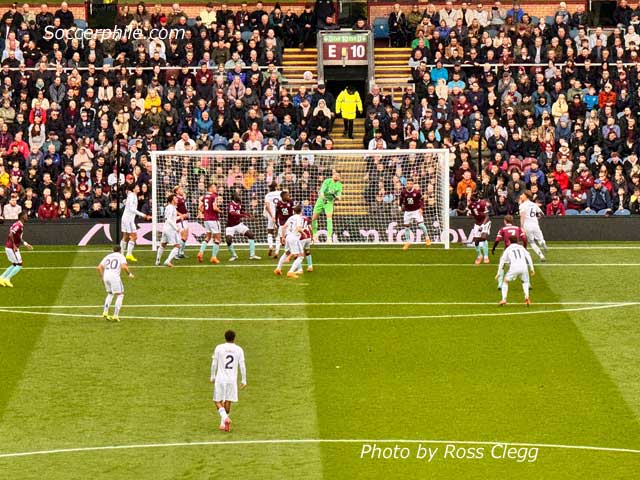
Turf Moor hosted its first floodlit football match between Burnley and Nelson in 1891. Sixteen creosote-fueled lamps were mounted on poles along the pitch's perimeter. While the edges were well-lit, spectators noted a dark area in the centre of the field.
1957 saw the club install permanent floodlights, debuting them in a friendly match against local rivals Blackburn Rovers.

Europe in 1960
Following Burnley's First Division title win in 1959-60, Turf Moor played its first European Cup match on November 16, 1960. Jimmy Robson and Jimmy McIlroy scored early in the first half, securing a 2-0 victory over French side Stade de Reims.
In 1974, Chairman Bob Lord commissioned Cambridge Soil Services to relay the pitch and install new drainage technology and undersoil heating. However, neither system was ever used, as Lord deemed them uneconomical, partly due to a significant rise in oil prices.
1992 was a tragic year, as 17-year-old apprentice footballer Ben Lee passed away after falling through the roof of the deteriorating Longside terrace while attempting to retrieve a football during training. In his 1996 book Football Grounds of Britain, author and architectural historian Simon Inglis remarked that the incident "symbolised how far Turf Moor, once considered modern, had fallen behind."
In 2006, Burnley sold Turf Moor and the Gawthorpe training ground to Longside Properties to address financial difficulties caused by the 2002 ITV Digital collapse, which resulted in a loss of over 30 per cent of the club's expected television revenue.
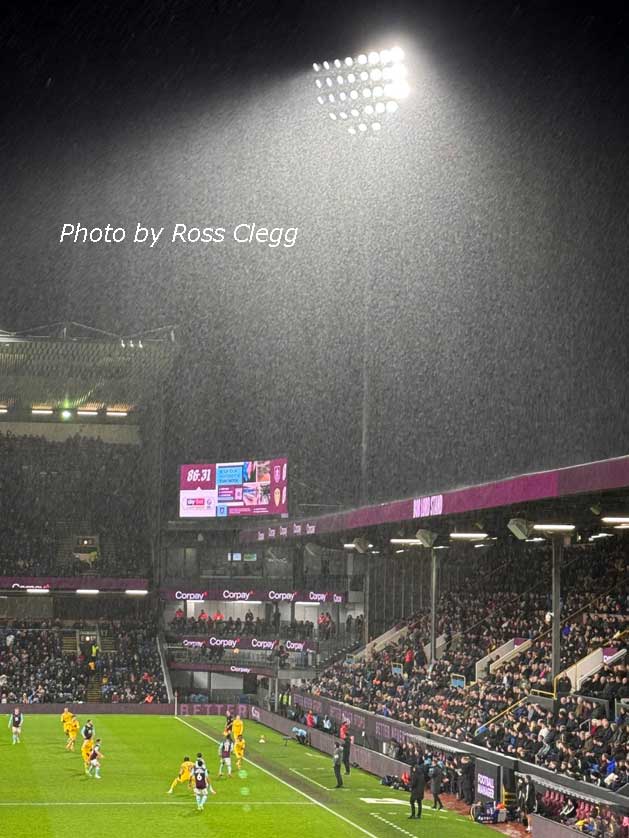
American investment firm ALK Capital acquired an 84% stake in Burnley for £170 million in a leveraged takeover in December 2020. Following the acquisition, the Preston-based company ADI installed digital signage and large LED screens at Turf Moor in 2021. In August 2023, the prominent YouTube group Dude Perfect became minority investors in the club.
Burnley is one of the best-supported clubs in English football on a per capita basis, with an average attendance of around 21,000, despite a town population of about 78,000.
Béné & Hot, a drink made with the French liqueur Bénédictine and hot water, has been a popular offering at Turf Moor since the First World War. The East Lancashire Regiment developed a fondness for the liqueur while stationed in Fécamp, Normandy, where the drink originated. More than 30 bottles of Bénédictine are sold at each game, making Turf Moor one of the largest sellers of this brand across the world. It is the only football ground in Britain that sells it.

Burnley
Nicknamed 'The Clarets,' Burnley has spent 60 seasons in the top flight, more than in any other division. They have been crowned champions in all four divisions of professional English football. The Clarets have reached the FA Cup final three times, with their solitary win coming in 1914. The Anglo-Scottish Cup, which lasted for six years, was won by Burnley in 1979 after overcoming Oldham Athletic 4-2 in the final.
Burnley's main rivals are Blackburn Rovers, and the two clubs compete in the East Lancashire derby, named after the region they both represent. Both clubs are founding members of the Football League. Separated by just 14 miles (23 km), their rivalry dates back to their earliest competitive meeting - a Football League match in 1888. Burnley's nearest geographic rivals are Accrington Stanley, but since they have never competed at the same level, no significant rivalry has developed between the two clubs.

Greatest Players & Club Icons
Goalkeeper Jerry Dawson is the record appearance maker. He spent his entire career at his local club. Dawson is mostly remembered for a game he did not feature, the 1914 FA Cup final versus Liverpool. The day before the match, he informed manager John Haworth that he didn't believe he would last the full game. As a result, Dawson was left out of the squad and in came substitute Ronnie Sewell, who kept a clean sheet in a 1-0 win. This was Burnley's first major honour and the only FA Cup triumph as of this writing.
Jimmy McIlroy, from Northern Ireland, is considered by many to be the Clarets' greatest. An instrumental figure during the club's golden era of the early sixties, he won the 1959-60 First Division, which has proven to be Burnley's last, and reached the 1962 FA Cup final. In January 1966, he transitioned into management after being recruited by the new chairman of Oldham Athletic, Ken Bates. With the club struggling at the bottom of the Third Division, Oldham paid Stoke, who McIlroy played for at the time, £5,000 to secure his services.
Robbie Blake
Shifting our attention to the modern era, midfielder Robbie Blake is regarded as a cult hero at Turf Moor. Beginning his career at Darlington, he had two separate spells at Burnley and played for a total of ten clubs.
Blake scored a famous winner against Alex Ferguson-led Manchester United at the start of the 2009-10 campaign, their first in the top flight after the introduction of the Premier League.
Their second promotion came in the 2014-15 season under the stewardship of Sean Dyche, the club's most iconic figure of the 21st century. Burnley under Dyche had a core of English talent that was solid, reliable and disciplined. These players include Nick Pope, Tom Heaton, Ben Mee, James Tarkowski, Ashley Barnes and Jay Rodriguez.
Although not regarded as club legends, Ian Wright and Paul Gascoigne both had brief spells at Burnley toward the end of their careers.
Stadium Facts
The record attendance at Turf Moor was 54,775 set on February 23, 1924, during an FA Cup third round match against Huddersfield Town.

Access - Getting There
The nearest major railway station to the ground is Burnley Manchester Road. From here, exit the station and walk down Centenary Way, from where Turf Moor is clearly visible. When you reach the roundabout at the end of the road, turn right onto Yorkshire Street, which becomes Harry Potts Way. The ground is on your left hand side.
Burnley Manchester Road Station has trains to Blackpool North, Preston, Leeds, York and Manchester Victoria, among other destinations.
By car coming from the east take exit M65 at junction 12 and follow signs to Burnley North A682. From the west exit at junction 9 and turn right at the first roundabout.
Address: Turf Moor, Harry Potts Way, Burnley, Lancashire, BB10 4BX
Tel: 01282 446 800

Nearby Hotels
A recommended place to stay in Burnley close to the ground is the 3-star Innovation House on Oxford Road.
The Holiday Inn Express Burnley M65, JCT.10 is a 3-star property on the M65.
See here for a complete listing of hotel accommodation in Burnley.
Text by Joji Imamiya

More UK Stadiums
Kirklees Stadium (John Smith's Stadium)

©Soccerphile.com
Buy tickets for soccer matches around the world