
The 10 Largest Soccer Stadiums in Japan
The 10 largest football stadiums in Japan by capacity are as follows: Nissan Stadium, Tokyo National Stadium, Saitama Stadium, Ecopa Stadium, Ajinomoto Stadium, Nagai Stadium, Toyota Stadium, Niigata Big Swan, Sapporo Dome and Kashima Stadium. Find further information on their history, facilities and construction dates below.
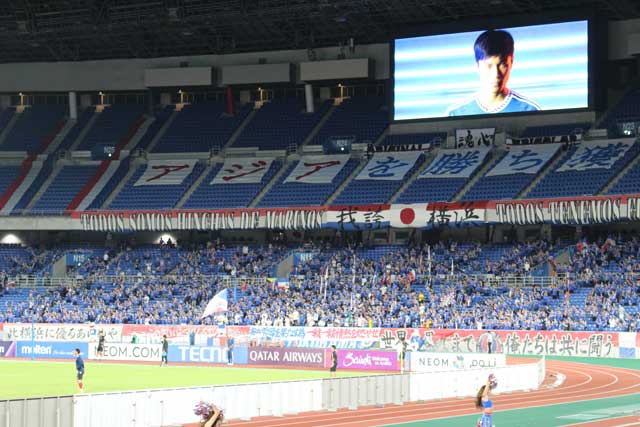
Nissan Stadium, Yokohama
Nissan Stadium (日産スタジアム) aka International Stadium Yokohama was the venue of 2002 World Cup final and is the home stadium of J.League club Yokohama F. Marinos. The stadium opened in 1998 and has the highest capacity of any stadium in country at 72,327 for soccer matches (see below), though the National Stadium in Tokyo can hold more for other events.
From the outset the stadium has been owned and operated by the city of Yokohama and managed to accommodate a variety of events, from football and rugby matches to international pop concerts.
Nissan Stadium boasts a state-of-the-art eco-friendly design and operating facilities including a recycled water supply from the roof and local homes. Power is supplied from a nearby incinerator unit and heating/cooling from a local wastewater treatment plant.
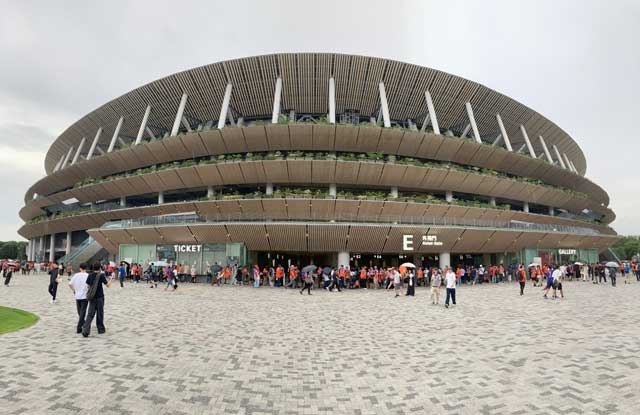
Japan National Stadium, Tokyo
The Japan National Stadium (国立競技場/Kokuritsu Kyōgijō) was the venue of 2020 Tokyo Olympic and Paralympic games. Since then the stadium hosts international matches of Japan's men and women's national sides, the final of the Emperor's Cup and occasional J.League matches.
The previous National Stadium was built for the 1964 Tokyo Olympics and was demolished in 2016 to make way for the new structure. The 'New' National Stadium has a capacity of over 68,000 for football matches.
It was designed by the world famous Japanese architect Kengo Kuma. Kuma's works in Japan and overseas include the Nagasaki Prefectural Art Museum, Sanlitun Village in China, the V&A Dundee, Scotland, and the striking, wood and steel Asakusa Culture Tourist Information Center, also in Tokyo.
Timber sourced from all 47 of Japan's prefectures was used in the construction. Sustainability was a key concern and the stadium utilizes solar panels and recycled rain water. Thus, its design emphasizes a harmonious blend with nature, featuring a wooden lattice structure that integrates elements of traditional Japanese architecture with modern engineering techniques, a hallmark of Kuma's architectural ethos.
Tokyo National Stadium officially adopted the name "MUFG Stadium" for sponsorship reasons on January 1, 2026. This came after Mitsubishi UFJ Financial Group (MUFG) signed a five-year naming rights agreement with the stadium's operator.
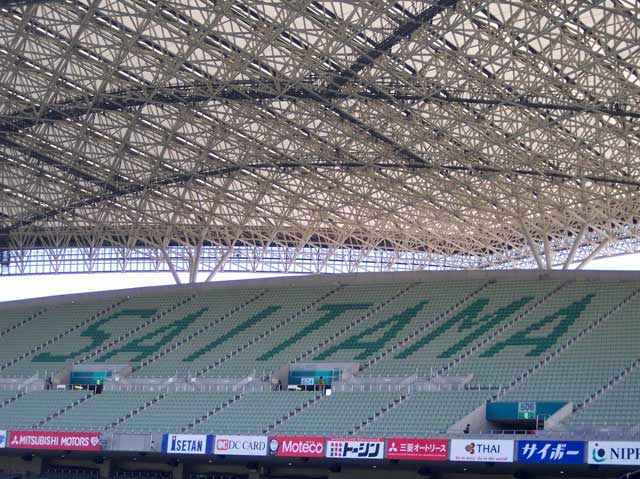
Saitama Stadium, Saitama
Saitama Stadium (埼玉スタジアム2002) is located north of the capital Tokyo near the town of Omiya. It is the home ground of Urawa Reds, the best-supported team in the J.League and a successful club with several domestic and continental titles. The ground (full name Saitama Stadium 2002) is the largest soccer-specific stadium in Japan and one of the biggest stadiums in Asia.
The 63,700 capacity stadium was built for the 2002 World Cup, though for J.League games the capacity is set at 62,300. Altogether the stadium hosted four games at World Cup 2002.
Urawa's fanatical support means the ground is often filled to near capacity for the club's J-League matches.
Often used for the Japan national team's World Cup and Asian Cup home qualifying games, the stadium can be considered the "Wembley of Japan." Additionally, Saitama Stadium hosted semi-finals of both the 2002 World Cup and the football tournament at the 2020 Summer Olympics.
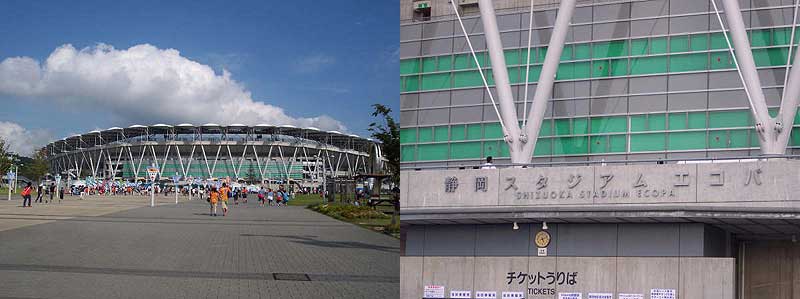
Shizuoka Stadium Ecopa, Fukuroi
A 2002 FIFA World Cup venue, Jubilo Iwata play their more high profile matches at the 51,349 capacity Ecopa Stadium, which they share with prefectural rivals Shimizu S-Pulse, other fixtures are held at Yamaha Stadium.
Brazil beat England 2-1 here during the 2002 World Cup. Visitors will need to take a local JR train from Hamamatsu Station if coming east from Osaka or Nagoya on the Shinkansen Bullet line connecting Tokyo and Osaka. If traveling west from Tokyo change at Kakegawa. Note that the fastest Nozomi trains on the Tokaido Line do not stop at Hamamatsu or Kakegawa.
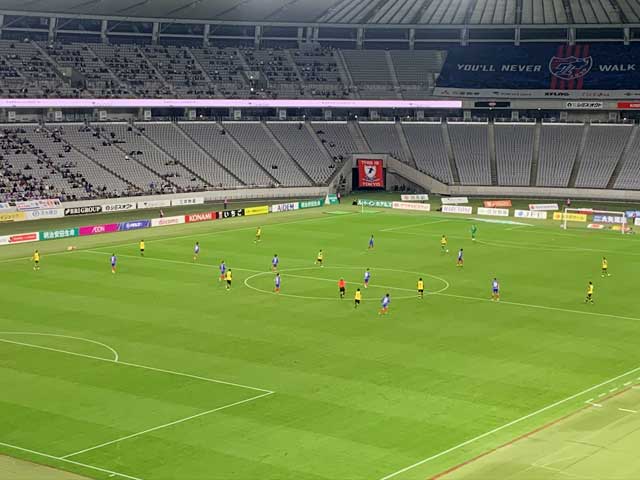
Ajinomoto Stadium, Tokyo
Ajinomoto Stadium (味の素スタジアム) in Chofu, western Tokyo is the home ground of J.League clubs FC Tokyo and Tokyo Verdy. It is the only venue which hosts two J.League clubs in Japan.
The multi-use, 50,000-capacity stadium opened in 2001. It sold its naming rights in 2003, the first stadium in Japan to do so, and is now known as Ajinomoto Stadium.
The ground also hosts other sports including rugby and American Football as well as music concerts and popular flea markets. It was a venue for both the 2019 Rugby World Cup and the 2020 Tokyo Olympics soccer tournament.
The sports complex as a whole also includes the smaller 3,060-seat Aminovital Field and the 800-seat AGF Field (former West Field). These are stadiums for American football, lacrosse, football and track and field mostly used by high school and university teams.
The stadium has various green features including a solar-power generating roof, plants growing in the walls to reduce carbon dioxide emissions and two wind power installations for outdoor LED lighting.
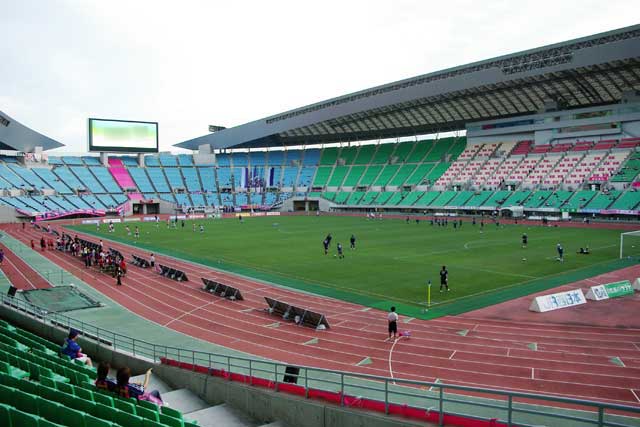
Yanmar Stadium Nagai, Osaka
Nagai Stadium in Osaka (大阪市長居陸上競技場) is a home ground of Cerezo Osaka, a J.League club and is also used for concerts, rugby matches featuring NTT DoCoMo Red Hurricanes Osaka as well as various athletic events such as the annual Osaka Women's Marathon.
For sponsorship reasons the stadium has been known as Yanmar Stadium Nagai since 2014.
The 47,853-capacity stadium is owned by the Osaka municipality and is surrounded by the large Nagai Park south of Osaka city center. It is one of the older stadiums in the J.League but has been renovated several times since its initial construction in the 1960s.
The natural grass playing surface measures 105 by 68 meters surrounded by a running track. There are two large electronic screens.
There are in fact three stadiums within the large Nagai Park sports complex, Nagai Stadium, the 24,481-capacity Yodoko Sakura Stadium, where Cerezo now play most of their home games, and also the Yanmar Field Nagai (Osaka Nagai Second Stadium).

Toyota Stadium, Toyota
Toyota Stadium (豊田スタジアム) in Toyota City, Aichi Prefecture, central Japan is a home ground of J.League club Nagoya Grampus along with Mizuho Stadium in nearby Nagoya. Toyota Verblitz, a rugby union team in the Japan Rugby League One, also uses the stadium. Indeed, it is Japan's largest rugby-specific stadium.
The stadium was built as a venue for the 2002 World Cup but was not used for that tournament. It was designed by Kisho Kurokawa Architect and Associates who also designed Oita Stadium in Kyushu, southern Japan and Zenit Arena in St Petersburg, Russia. The latter is an enlarged and modified version of the same architect's Toyota Stadium.
With a retractable roof designed to resemble the traditional curves of a temple roof, large video screen and excellent views for the spectators, Toyota Stadium is one of the most impressive in Japan. It has a maximum capacity for approximately 45,000 spectators.
The nearby Toyota Bridge spans the Yahagigawa River and was also designed by Kisho Kurokawa.
As well as J-League games, the ground has also hosted matches in the FIFA Club World Cup, international fixtures and 2019 Rugby World Cup games.
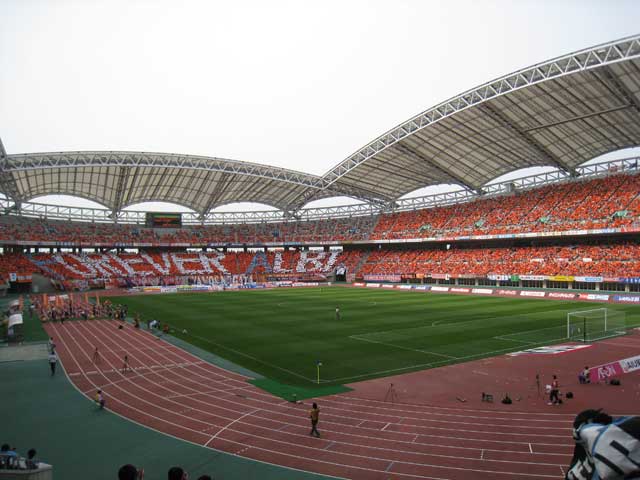
Big Swan Stadium, Niigata
Known colloquially as 'Big Swan' as the roof of the stadium is supposed to resemble a resting swan, the ground now known as Denka Big Swan Stadium was used at the 2001 Confederations Cup and 2002 World Cup and is the 42,300-capacity home of Albirex Niigata. Completed in 2001, the ground hosted three games at the 2002 FIFA World Cup and also stages rugby and other sporting events.

Sapporo Dome, Sapporo, Hokkaido
Sapporo Dome (札幌ドーム) is located in Sapporo on the northern island of Hokkaido. It is the home ground of Hokkaido Consadole Sapporo in the J.League. Until the end of the 2022, the stadium was also home to Japanese professional baseball (NPB) team Hokkaido Nippon-Ham Fighters. The 42,484-capacity stadium is owned by the City of Sapporo.
The ground is a unique stadium in Japan as its grass soccer surface slides into the stadium from outside. The baseball field is an artificial surface within the stadium itself. The structure was designed by Hiroshi Hara who was also responsible for the massive Kyoto Station Building as well as Umeda Sky Building in Osaka.
Altogether the stadium hosted three games at World Cup 2002 including England's 1-0 win against Argentina in the David Beckham "Foot of God" game. The deciding goal was a Beckham penalty after Michael Owen fell over the outstretched leg of Mauricio Pochettino.

Kashima Stadium, Ibaraki
Kashima Stadium (カシマサッカースタジアム) was a venue stadium for the World Cup 2002 Korea/Japan and is the home ground of successful J.League club Kashima Antlers. The stadium was also a venue for both the men and women's football events at the 2020 Tokyo Olympics. It has a capacity for 40,003 spectators. Since July 1, 2025 the stadium is now known as 'Mercari Stadium' ((メルカリスタジアム)) for sponsorship reasons. Mercari is an online marketplace and the largest shareholder in the club.
Antlers' legend Zico scored the first goal at the new stadium in a friendly versus Brazil's Fluminense in May, 1993. He followed that up with a hat-trick in the ground's first competitive J.League game versus Nagoya Grampus.
During World Cup 2002 the stadium was the venue for 3 group games: Argentina v Nigeria in Group F, Germany v Ireland in Group E and Italy v Croatia in Group G.
The stadium is rarely full - only travelling hordes of Urawa Reds fans push attendances towards capacity - yet it remains a hostile place to come and play, not least because the J. League's most successful club Kashima Antlers possess a relentlessly imposing home record.

Related
More Japan Stadiums
Tosu Stadium (Ekimae Real Estate Stadium)
©Soccerphile.com
Buy tickets for soccer matches around the world