
UK Stadiums: Blundell Park, Grimsby, England
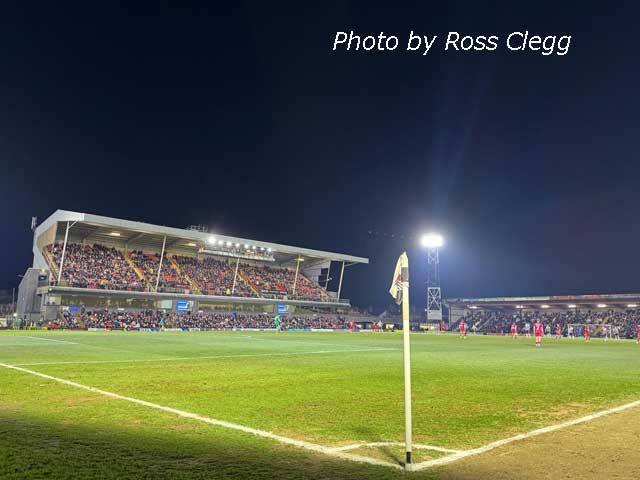
Blundell Park in Cleethorpes, Lincolnshire, England, UK, is an all-seater stadium with a capacity of 9,052. It is the home of Grimsby Town Football Club. A ground built in 1899, now only one of the original stands remains.
Grimsby Town (nicknamed The Mariners) moved to their current stadium in 1899, relocating from Abbey Park. The Mariners brought all the fixtures and fittings, meaning the Hazel Grove Stand moved with it. The stadium is named after Peter Blundell, a prosperous clothier. Blundell's wealth allowed Sidney Sussex College of Cambridge University to buy the land in 1616. The opening match was a fixture with Luton Town, a 3-3 draw.
1925 saw the construction of Barrett's Stand in place of the Abbey Park Stand. Just before the outbreak of World War II, the Osmond Stand replaced the Hazel Grove Stand, which was the last standing piece of the ground they brought from Abbey Park.
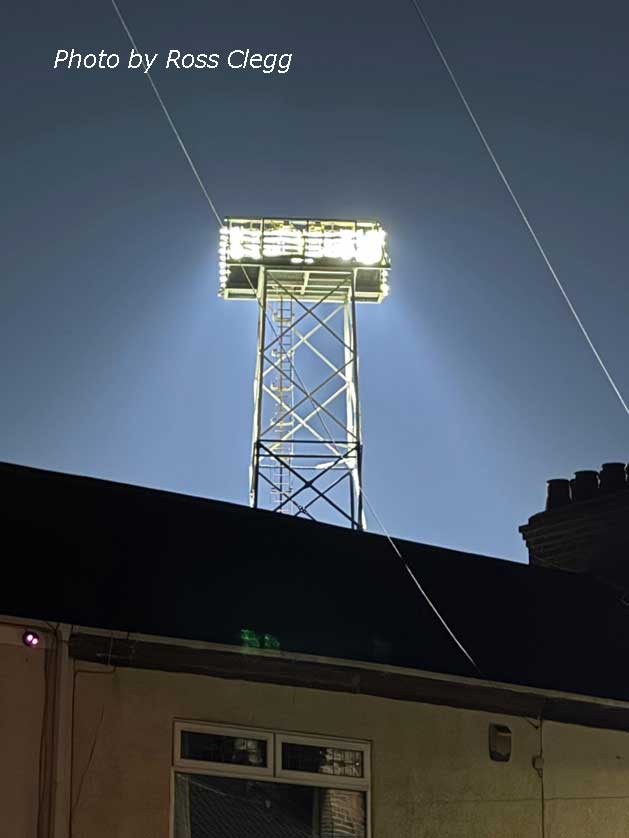
Before 1953, there were no night games at Blundell Park as the club had not installed floodlights. In 1958, Grimsby purchased second-hand floodlights from Wolves and improved the ground.
Football Stadia Improvement Fund, the largest organization to provide loans and grants to lower league football clubs, supplied Grimsby with £19,000 in April 2015, which enabled them to perform repairs to the floodlights.
The ground was the scene for one of Grimsby's greatest ever triumphs, a win over Manchester United 12-11 on penalties after a 2-2 draw in normal time in the second round of the Carabao Cup in August 2025.
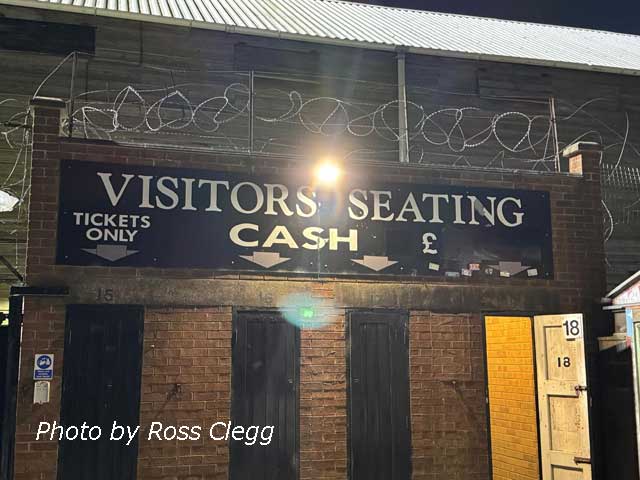
Stadium & Stands
There are four stands at Blundell Park. Main Stand, Pontoon Stand, Findus Stand and Osmond Stand.
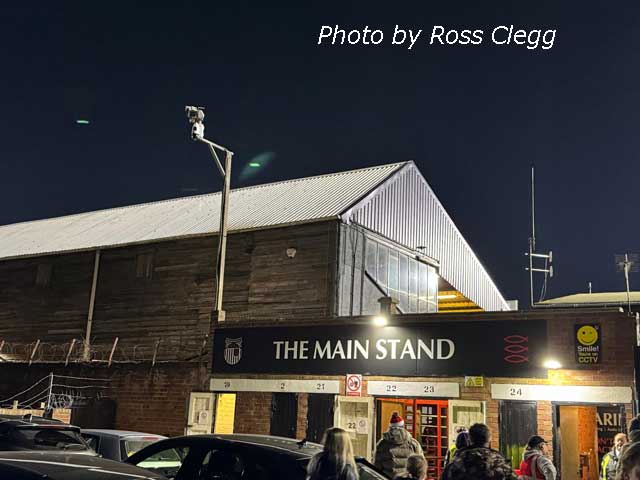
The Main Stand is known to be one of the oldest stands in the country, at least by Football League standards. Built in 1901, it is located on the north side of the ground and houses the changing rooms and disabled supporters' areas. Rows at the back have restricted viewing due to the height of the roof, giving the classical English experience akin to Southampton FC's old ground, The Dell. Today, only the central part of the stand dates back to 1901.
When the original Pontoon Stand was built along with the opening of Blundell Park, it lasted for over sixty years before it was demolished to make way for the new stand, with the funds coming out from supporters' own pockets. As is the case with most professional stadiums, the Taylor Report forced the stand to become an all-seater in 1995. Most of the noise on matchdays will come from this end, with the aid of a drummer. In the mid-1980s, the club switched the home end to Osmond Stand, which was reversed almost immediately as this was an unpopular decision. A new roof was installed before 2023-24.
The Findus Stand is a two-tier construction named after the fish processing firm Findus. It replaced the Barrett's Stand in 1980. Findus was originally a Swedish frozen food brand that sold peas, ready meals and their signature pancakes. Between 1962 and 2000, the firm was owned by Nestlé before Unilever took over for over 20 years. It is currently owned by Nomad Foods, a conglomerate headquartered in the UK.
The view of the North Sea and the Humber Estuary from the Findus Stand is spectacular, with ships visible. Between the two tiers is the corporate section, where the "McMenemy's" suite and restaurant are located. It is named in honour of Lawrie Mcmenemy, a man most famous for managing Southampton for 12 years. From the 1990s, the stand saw many name changes due to the cessation of Findus production in the town. It was first renamed the Stones Bitter and had a period sponsored by John Smith's Brewery and Carlsberg. Viking FM had the naming rights for a brief time, but in 2023, it reverted to Findus.
The Osmond replaced the Hazel Grove Stand in 1939. This section is used as an away end, but if travelling fans are in short supply, the stand is occasionally halved and houses more Grimsby supporters. It has about 2000 seats, but half of them have restricted viewing due to the height of the roof.
Blundell Park's record attendance was set in 1937 for an FA Cup tie against Wolverhampton Wanderers, as 31,651 spectators saw the fifth-round action. Since the arena's renovation in compliance with the Taylor Report, a second-division match versus Sunderland in 1999 has been set as the highest attendance.



Club History (Overview)
Grimsby Town is by far and away the most successful team in Lincolnshire. There are two other professional outfits in the county, Scunthorpe United and Lincoln City, but neither comes close to the gravitas of the Mariners. Grimsby have reached two FA Cup semi-finals, both in the 1930s, and are the only club to play in the top flight. Grimsby have won six Football League titles across the four divisions, two of which are Second Division trophies. The club have claimed the Football League Trophy twice and were runners-up of the FA Trophy twice. The Mariners made FA Cup history in 2022-23 by eliminating five teams above their level, the highlight being a 2-1 win against Southampton at St Mary's Stadium. They were subsequently trashed by Brighton 0-5 at the Amex Stadium in the quarter-finals.
The club have set other interesting English football records, examples being the first English team to appoint a foreign manager, Elemér Berkessy, in 1954, who appeared for FC Barcelona as a player in the 1930s. The Town's FA Cup semi-final tie against Wolverhampton Wanderers in 1939 at Old Trafford still stands as the Manchester stadium's record attendance for a match.
Grimsby are one of only nine clubs to feature in all top five divisions of English football. This record was set in 2010 when The Mariners were condemned to the National League.
Club History
The club was formed in 1878 as Grimsby Pelham, named after the Earl of Yarborough, a notable landowner within the area. The discussions for the formation took place at the Wellington Arms public house on Freeman Street. A year after the formation, the club was renamed Grimsby Town. The original colours of the jersey were blue and white hoops.
Between 1880 and 1889, Grimsby played at Clee Park, a land they had purchased. The club subsequently called Abbey Park their home for ten years before moving again to Blundell Park.
Grimsby entered the Football League in 1892, playing their first match against Northwich Victoria.
Grimsby became a top-division outfit for the first time in 1901-02 but only remained there for two campaigns. After seven seasons in the Second Division, the club was voted out and was condemned to the non-league, which was called the Midland League for Lincolnshire clubs. The Mariners made light work of the division and would become part of the Football League for a century.
After escaping from the Midland League, Grimsby would bounce around between the first and third tiers of the English football pyramid until the outbreak of WW2. Grimsby achieved their finest league finish in 1934-35, coming fifth in the First Division. The 1930s was a glorious era for the club, reaching the FA Cup semis twice. The first, in 1936, Grimsby were knocked out by eventual winners Arsenal at Leeds Road in Huddersfield. The second, the final season before the War, was contested at Old Trafford. Grimsby had to endure a colossal disadvantage in their match with Wolves as their second-choice goalkeeper George Moulson was injured early on and had to field an outfielder to replace him. Wolves dismantled the Town 5-0.
A little-known Bill Shankly was at the helm between 1951 and 1954 but narrowly missed out on success, with the team finishing second in the third tier in his first season. Shankly's task was made more formidable by the departures of key players and an ageing squad. The Scotsman distilled the importance of set-pieces into his players, especially throw-ins and offensive counter-attacks from conceded corners. By 1953-54, it was clear that Shankly was disillusioned by the Grimsby project as the board was reluctant to splash the cash on player acquisitions. He resigned in January 1954.
Shankley was replaced by Hungarian Elemér Berkessy, the first non-British manager to take over a Football League club. As he was appointed on an interim basis, his stay at the club was brief.
Grimsby were relegated to the fourth tier for the first time in 1967-68.
The Alan Buckley Era
After back-to-back relegations, Grimsby were back in the fourth tier in 1988-89. Due to the abysmal financial situation, Grimsby's objections for the season were to avoid demotion to non-league and stave off dissolution. The Mariners needed a saviour, and their prayers were answered in the form of coach Alan Buckley. Under the guidance of Buckley, Grimsby elevated to the Second Division as quickly as they fell to the fourth tier. For six seasons from 1991-92, Grimsby enjoyed the heights of second-tier football. During this period, Buckley was poached by West Brom but returned to Blundell Park in 1997. The Town had many quality players at this time, including Keith Alexander, Shaun Cunnington and Paul Groves, who would go on to manage the club.
The relegation to the third level in 1996-97 did not hinder the club's progression enormously, as Grimsby achieved instant promotion with Buckley back in the dugout. The club first negotiated a tough semi-final playoff round against Fulham. Top scorer Kevin Donovan was the hero in this tie and was again the headline maker in the final versus Northampton Town at the old Wembley.

21st Century
Second division Grimsby stunned Liverpool at Anfield in the 2001-02 League Cup (known as the Worthington Cup for sponsorship reasons) after extra time. Hosts and defending champions Liverpool did not field their strongest side for the match. But The Reds still could count on the quality of Sami Hyypiä, Didi Hamann, Jamie Carragher and Jari Litmanen. The first ninety minutes ended goalless, but Liverpool were in the ascendency when Gary McAllister converted a penalty. After an equalizer from Marlon Broomes, Town flipped the script with Phil Jevons scoring a superb 30-yard strike. Grimsby were later outclassed by Arsenal at Highbury in the round after.
Town were relegated from the second tier in 2002-03, and the slide continued with another demotion the following campaign. Their decline in form coincided with the ITV Digital collapse, owing substantial debts to Lloyds Bank. Their star player, George Santos, departed, and a managerial merry-go-round commenced after the sackings of Paul Groves and Nicky Law in the space of a few months. Russell Slade was tasked with steading the collapsing ship.
2005-06 League Cup
Grimsby caused major upsets in the 2005-06 League Cup by overcoming Derby County at Pride Park in the first round and shocking Tottenham Hotspur 1-0 at home in the second round. Although The Mariners took on a side which included Ledley King, Michael Carrick, Robbie Keane and Jermain Defoe in their ranks, the star names were shut out by a commanding defence. In their following match, Grimsby fought hard against another Premier League outfit, Newcastle United. It was Alan Shearer who spared the blushes for The Toon with a late winner. Town were solid in the league throughout the campaign and were one game away from League One, assuming a win versus Cheltenham Town in the playoff final. The match played at the Millennium Stadium in Cardiff was a cagey affair, with Steve Guinan producing the only goal of the game for Cheltenham.
Grimsby enjoyed another cup run in the 2007-08 Football League Trophy but missed out on silverware after MK Dons emerged victors by a 2-0 scoreline in the final at a modernized Wembley Stadium.
2008-09 League Two Season
The 2008-09 League Two season was a harrowing experience for Grimsby supporters, as they finished third bottom, narrowly escaping the drop to semi-professional football. However, the writing was on the wall for the Lincolnshire outfit, suffering demotion the following season. The struggles of 2009-10 were symbolized firstly by the appointment of Neil Woods, who had no prior first-team managerial experience, and secondly by the sale of Ryan Bennett to Peterborough United when he had signed a four-year contract just a few months ago. Bennett went on to enjoy a solid Premier League career at Wolves and Norwich City.
The first two seasons at Conference National were characterized by mediocrity, but the 2012-13 FA Trophy cup run allowed The Mariners the chance to gain extra pedigree. Their opponents in the final were Wrexham, with the Welsh club coming on top after a penalty shootout. For three seasons straight from 2012-13, Grimsby entered the promotion playoffs but failed each time. They came closest in 2014-15, where they contested the final versus Bristol Rovers. Grimsby's Lenell John-Lewis opened the scoring after only two minutes, but Ellis Harrison equalized for Rovers before the half-hour mark. Just like the agony Grimsby went through against Wrexham, penalties sealed their fate. The media singled out Jon-Paul Pittman as the culprit for his spot-kick miss. At the fourth time of asking, Grimsby were back in the Football League via the playoffs, comfortably dispatching Forest Green Rovers in the final.
Grimsby found it arduous to establish themselves as a force in League Two, finally enduring relegation again in 2020-21, finishing bottom.
2021-22 National League
Stockport County took charge of the 2021-22 National League, meaning Grimsby had to compete for promotion in a revamped playoff tournament. In the quarter-finals, Grimsby edged Notts County after extra-time at Meadow Lane. Extra-time was again required to eliminate their old foes Wrexham, at the Racecourse Ground. The final at Wembley was with Solihull Moors F.C., a newly founded team boasting plenty of momentum after finishing third in the regular season. Incredibly, Grimsby defeated their promotion rivals in extra-time for the third time running courtesy of a winner from Jordan Maguire-Drew.
Back in League Two, Grimsby made headlines throughout the English football world in 2022-23 with their fairytale run in the FA Cup. Blundell Park witnessed the destruction of Plymouth Argyle by five goals to one in Round One, and later The Mariners saw off the challenges of Cambridge and Burton Albion. The first surprise came when they defeated Luton 3-0 at home in a replay. This was impressive, considering The Hatters achieved Premier League status via the playoffs that season. Southampton were odds on to beat Grimsby at St Mary's in round five, but Town pulled off the biggest shock of the campaign with a 2-1 victory. Their dreams were shattered in the following round at Brighton.
Miscellaneous
Smoking in the stands is strictly prohibited, including e-cigarettes. There is a designated smoking area, but it is open only during half-time. Reentry is not allowed for smoking purposes.
Blundell Park has the unique perk of having a bar specifically for away supporters, Scotties. Scarves and memorabilia through past donations from opposing fans decorate the bar.
For a more traditional drinking setting, The Swashbuckle Pub on Grant Street has earned plenty of rave reviews. The pub is located near Cleethorpes station.
Grimsby and Cleethorpes are famed for their fish and chips. For fans wanting a "proper scran", fish and chips cannot be missed.
For the nearest ATM, head to Grimsby Road to find Tesco Express.
As Blundell Park is a stone's throw away from the North Sea, it has earned the reputation of being one of the coldest venues to watch a football match of the 92 clubs in England.
Access - Getting There
The nearest bus stop to the ground is Imperial Avenue, requiring a minute's walk from there to the ground. Look out for services 9, 13 and 46 on matchdays..
Local street parking is possible, but competition for space is fierce. For satnav users, type in DN35 7PY.
For supporters coming by train, the nearest station is New Clee, a small train station on the line between Cleethorpes and Barton-Upon-Humber. It will roughly take 18 minutes to get to Blundell Park from the station on foot. There is little to separate in distance from the ground between New Clee station and Cleethorpes station.
Cleethorpes has trains to Manchester Piccadilly and Liverpool Lime Street.
There are also limited trains to to Leicester via Nottingham and Lincoln.
Address: Cleethorpes DN35 7PZ
Nearby Hotels
Some recommended hotels in Grimsby include the 3-star Holiday Inn Express Grimsby by IHG on Wellowgate. The Humber Royal Hotel is a 4-star property close to Grimsby's 18-hole golf course.
The Millfields Hotel is a 3-star hotel with an art deco bar.
See here for a complete listing of hotel accommodation in Grimsby.
Text by Joji Imamiya
More UK Stadiums
Kirklees Stadium (John Smith's Stadium)
©Soccerphile.com
Buy tickets for soccer matches around the world